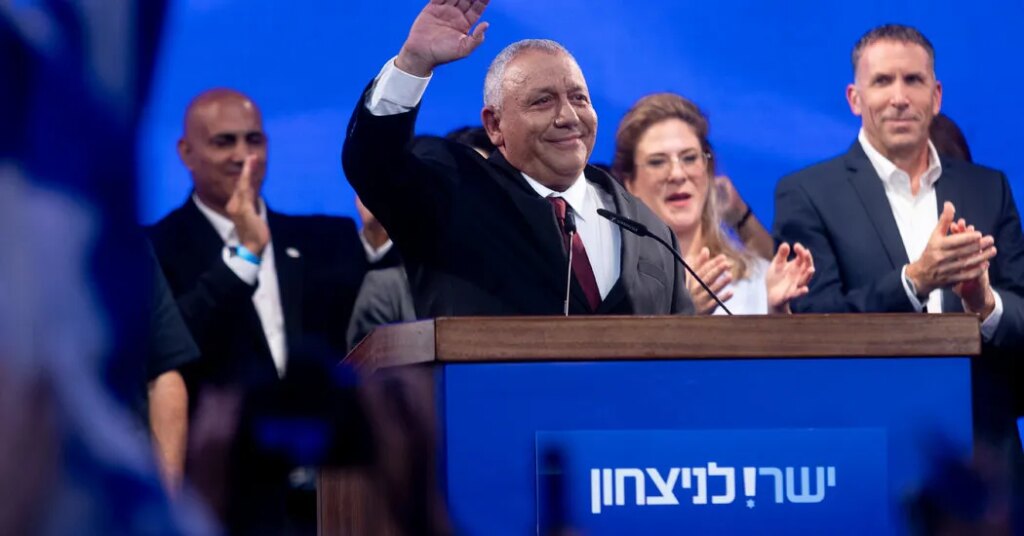
Gadi Eisenkot, the leading figure in Israel’s political opposition, had hoped voters would deliver him a clear mandate to form a government, and begin a new era without Prime Minister Benjamin Netanyahu at the helm.
The initial results show, however, that Mr. Eisenkot and his allies have no easy path to power. They face a dilemma: To secure enough seats in parliament to form a government, they either need to cooperate with Arab-led parties — anathema to many Israelis — or join with Mr. Netanyahu or members of his right-wing alliance.
“He’s in a Catch-22,” said Shira Efron, chair of Israel policy at the RAND Corporation. “He doesn’t have a lot of great options.”
If Mr. Eisenkot and the opposition were to join forces with the Arab parties, the results so far suggest that they would need the support of both the major ones: the socially conservative Raam party and the Joint List, a coalition of three factions.
“After Oct. 7, Israeli society will not accept that,” said Shalom Yerushalmi, a veteran political writer at the news site Zman Yisrael, referring to the 2023 Hamas-led attack on southern Israel. “There’s no chance.”
Many Israelis are opposed to any government that would rely on parties that are not Zionist, and would not want those parties to influence security policies or foreign affairs. On the campaign trail, a number of opposition members pledged never to agree to such an arrangement.
Although Raam’s leader, Mansour Abbas, has taken positions more amenable to Zionist members of the opposition, including putting less emphasis on the Palestinian cause, the Joint List has refused to make similar compromises.
In the aftermath of Oct. 7, the leaders of the parties in the Joint List reacted in different ways. Ayman Odeh, who was the head of Hadash, referred to “Hamas’s murderous attack” in an opinion essay for The New York Times. Ahmad Tibi, the leader of Taal, said Arab citizens were against targeting civilians.
Sami Abou Shahadeh, the chairman of Balad, said the attack was “an important, historic event in the military sense,” though he later condemned the attack after the Israeli Supreme Court discussed disqualifying him from running for parliament.
The prospect of Mr. Eisenkot setting up a unity government with Mr. Netanyahu or members of his bloc appears to be just as challenging. He made Mr. Netanyahu’s record a central theme of his campaign, saying the Israeli prime minister should “go home” and suggesting that he was unfit to lead the country.
Mr. Eisenkot may be able to come to an agreement with Mr. Netanyahu that excludes some of the most extreme elements of the current Israeli coalition from government — such as the far-right cabinet members Itamar Ben-Gvir and Bezalel Smotrich. But to do so would be to go back on a theme of his campaign.
“If he goes for a unity government, he would be destroying the whole narrative he has built,” Mr. Yerushalmi said.
Mr. Eisenkot could attempt to convince members of Mr. Netanyahu’s party, Likud, to defect to his side, but that seems unlikely because the long-serving Israeli leader has in the past been highly effective at holding his coalition together.
Mr. Netanyahu’s coalition also includes some ultra-Orthodox parties, which Mr. Eisenkot could try to bring into his bloc. Yet many opposition members are at odds with lawmakers from those parties over the exemptions from military service that many ultra-Orthodox Israelis enjoy.
Another option for Mr. Eisenkot and his partners is to hold out for a new round of elections in the hope of achieving a more favorable result. But that scenario, analysts said, was fraught with pitfalls — Mr. Eisenkot’s supporters, including those living abroad, may be feel less motivated to show up to vote again.
The post Eisenkot’s ‘Catch-22’: Main Rival of Netanyahu Has No Easy Options appeared first on New York Times.