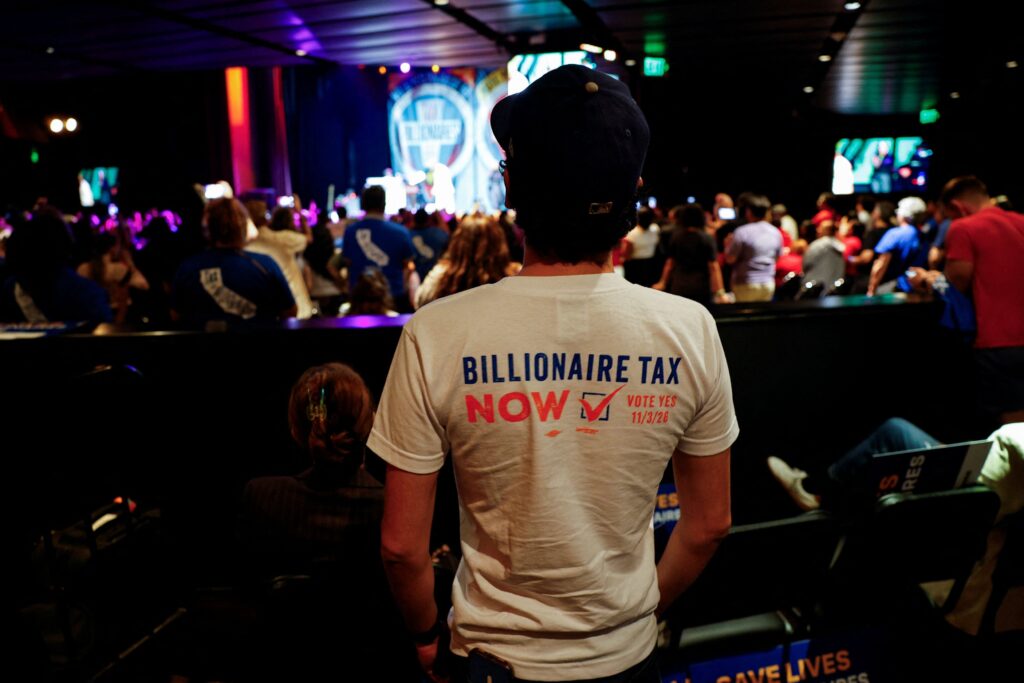
It’s possible, in principle, to impose a tax that loses money. Think of a 100 percent levy on capital gains. Yet California may have broken new ground by losing money through a tax that doesn’t yet exist. Voters on Nov. 3 will consider Proposition 40, which would collect a “one-time” 5 percent tax on residents with more than $1 billion in net worth.
The tax is vulnerable to half a dozen legal challenges. The proposal might violate the Constitution’s restrictions on government “takings” — the seizing of private property for public use without just compensation. It is also retroactive, applying to those who lived in the state on Jan. 1, 2026, and might therefore infringe on former residents’ due-process rights. Given that it would affect assets anywhere in the world, the levy arguably conflicts with the Supreme Court precedents about the scope of states’ taxing power.
Supporters think the tax can survive any lawsuit. Its biggest selling point: the $100 billion that left-wing economists estimate it would raise for the state government. The Legislative Analyst’s Office explains it would spend 90 percent of that sum on health benefits, with the rest going to “education, food assistance, and administration of the wealth tax.”
A new study by Benjamin Jaros and Joshua Rauh, two economists affiliated with the Hoover Institution, challenges that projection. Their report points out that at least seven billionaires left California before Jan. 1. In fleeing, they took with them nearly 29 percent of the proposal’s tax base. (Obviously, other billionaires may have relocated with less publicity.) Jaros and Rauh also try to account for the uncertainty over whether taxes can be collected from other billionaires, such as the ones who have left since the beginning of the year and may thus have a legal case for escaping the tax. The economists estimate the proposal would bring in roughly $30 billion.
That’s still a lot of money, but the duo then estimates how much income-tax revenue California won’t receive from the billionaires it will have driven away. They project that such foregone payments will exceed wealth-tax revenue by $39 billion in current dollars. (That’s conservative, too, as it doesn’t count the lost income-tax revenue from the Californians those billionaires would have employed if they had stayed put.) Jaros and Rauh calculate that the state will lose money so long as 24 percent of the tax base flees, a condition that’s already been met.
Gabriel Zucman, an economist, a Proposition 40 enthusiast and one of the co-authors of the more optimistic study, has issued a barrage of attacks on that paper. Zucman notes that Mark Zuckerberg, after saying he was considering leaving the state, agreed to stay after Meta’s board restructured the company’s stocks so that he could retain control while paying the tax. But his planning doesn’t mean that the tax would survive the courts, and in any case, not every billionaire will necessarily make similar arrangements.
Zucman also considers it irrational for any billionaire to leave California after Jan. 1, given that it is a one-time tax. But the billionaires may think there is a good chance that courts will strike down the retroactive element of the tax. They may also wonder whether the tax will really be a one-off. The health benefits it is meant to finance aren’t one-time expenses, after all. Zucman is defending the tax with rhetoric about a “fight for global tax justice” and the need “to end the ultra-rich’s ability to escape taxation with impunity.” That doesn’t sound like he would be satisfied with one.
Questioning whether the “one time” tax might be repeated enrages Zucman, who says it is inconsistent for an analysis to raise that possibility without taking account of any revenue from future wealth taxes. You don’t need to be an economist to see his mistake. If the billionaires leave to avoid a recurring tax, the state loses them even if their fears don’t come true.
If the wealth tax passes and in a few years progressives come back for another bite of billionaire wealth — say in 2030 — then it will be important to estimate how much revenue that second tax would raise. It might even turn out that those projections look better, since some of the economic losses from fear of the tax will have already occurred and will thus no longer be avoidable.
But that’s another way of saying that passing the one-time tax now could make it more rational to break the one-time promise later. All of which supports billionaires’ fears today.
The post Gabriel Zucman and California’s not-so-irrational billionaires appeared first on Washington Post.