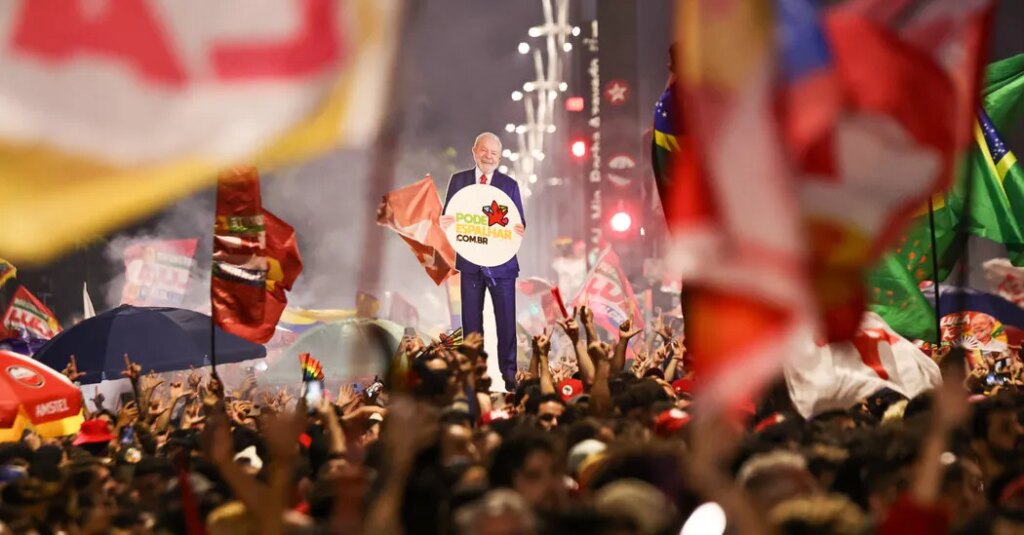
It started with a WhatsApp channel with a few thousand followers. It exploded into a digital army of 10 million people that helped swing Latin America’s biggest election.
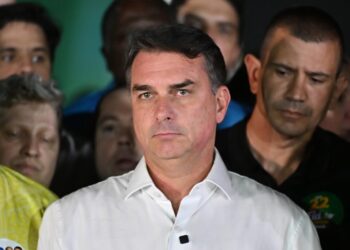
President Luiz Inácio Lula da Silva of Brazil staged a stunning comeback on Sunday, achieving an unexpected victory over Flávio Bolsonaro, the right-wing challenger whose father tried to stage a coup after losing the last election.
In winning, Mr. Lula did what no other presidential candidate has accomplished in Brazil’s history — he won election after finishing second in the first round.
His victory rested, to a significant degree, on social media. A tidal wave of messages, memes and reels flooded Brazil, a chronically online nation of 214 million, and rallied millions of Brazilians with diverging views around a single task: barring the return of the Bolsonaro family to power.
Mr. Lula’s win delivered a powerful rebuke to a right-wing movement barreling through Latin America that has been applauded by President Trump. It also deals a blow to Washington’s plans for economic and military dominance in the region, extending the reign of the only leader in Latin America — and one of the few globally — who has defied Mr. Trump.
Mr. Lula won by about double the margin he achieved in 2022, when he narrowly defeated Mr. Bolsonaro’s father, Jair Bolsonaro. The achievement is all the more remarkable because Mr. Lula, who entered the race as the underdog, received more than 10 million votes between the first and second rounds of the election, or roughly three out of every four new votes up for grabs on Sunday. The younger Mr. Bolsonaro captured roughly four million additional votes than he did in the first round.
“It was a very big victory for global democracy,” said Christian Lynch, a political scientist at Rio de Janeiro State University. It was driven, he said, by an unprecedented mobilization of Brazilian voters. “We never saw anything like this.”
These votes came from some unexpected sources.
For one, nine million people voted for minor conservative candidates in the first round. Analysts believe a significant slice of those votes went to Mr. Lula rather than the younger Mr. Bolsonaro, defying predictions ahead of the vote.
This suggested that the Bolsonaro family’s brand of right-wing politics had ultimately failed to convince some moderate conservatives.
“I’m much more of a right-wing guy — but not the far right that exists now,” said Leandro Cantini Lopes, 38, a restaurant consultant in Rio de Janeiro, who voted for Mr. Lula on Sunday after supporting a moderate conservative earlier.
Turnout also increased by nearly three million between the first and second rounds, a highly unusual reversal in a country where absenteeism tends to rise after the initial vote. Absenteeism fell to the lowest level of any Brazilian presidential election — another sign that Mr. Lula had succeeded in motiving supporters to turn out in big numbers.
Some voters were likely spooked into voting by just how much power Mr. Bolsonaro may have had as president, analysts said. With his political party making major strides in the legislature, he would have faced a mostly clear path to rewriting Brazil’s past and reshaping its future.
The elder Mr. Bolsonaro last year was sentenced to 27 years in prison for trying to stage a coup after losing the last election to Mr. Lula. His son has vowed to seek his amnesty and impeach the justices who jailed him.
Felipe Haurelhuk, 41, started worrying when the younger Mr. Bolsonaro, triumphant after his first-round victory, began talking about rewriting Brazil’s Constitution with the help of his political allies. He decided to cast a ballot for Mr. Lula, after voting for a different conservative candidate earlier this month.
“Terrible for democracy,” Mr. Haurelhuk, who owns a beauty salon in São Paulo, said referring to a potential Bolsonaro victory. “Brazil will keep moving somewhat sideways” under Mr. Lula, he added. “But better that than handling power over to the Bolsonaro camp.”
A digital comeback
Just three weeks ago, a triumph for Mr. Lula seemed unfathomable. He had finished 2.2 million votes behind Mr. Bolsonaro in the first round of voting, with analysts declaring him on the cusp of defeat.
Then, a charismatic leftist lawmaker from one of Brazil’s most populous states made a fateful rallying cry on a WhatsApp channel. At 6 a.m. the day after Mr. Lula’s defeat in the first round, André Janones, the lawmaker, called on his 53,000 followers to get to work. He renamed the channel Lula’s Army.
Around the clock, Mr. Janones, in the persona of a digital drill sergeant, would issue “missions” to the swelling number of followers in the channel. Over the next five days, the group grew to 3.4 million.
“Urgent!” he shouted in video and audio messages, ordering supporters to comment, like and share posts favoring Mr. Lula on social media. “Go viral!”
The online frenzy to re-elect Mr. Lula only grew after accusations by his campaign and independent watchdogs that Meta, which owns WhatsApp, was favoring his right-wing rival on its platforms. To try to sidestep the algorithm, Mr. Janones and his followers began filming videos wearing Brazil’s yellow jersey — a symbol of the right — and using online tactics usually employed by Mr. Bolsonaro’s movement to increase its reach.
The channel, and its head-spinning growth, drew the attention of Mr. Bolsonaro and the electoral court. After a judicial arm wrestle between justices on the electoral court, the channel was allowed to stay up. But the court’s chief justice, who was appointed by the elder Mr. Bolsonaro, ordered Meta to investigate how it had grown so much. Meta found no irregularities.
Online, Mr. Lula’s army of supporters seized on corruption investigations swirling around the younger Mr. Bolsonaro, who has not been charged with a crime. They questioned his past links to figures from Rio’s criminal underworld and his father’s handling of the pandemic. And they warned about the risks of his vague plans to cut public spending, inspired by the austerity measures applied by President Javier Milei of Argentina.
“This channel will not spread a single piece of fake news,” Mr. Janones ordered his followers. “Those who have the facts have no need for lies!”
Mr. Janones’s channel grew exponentially, eventually hitting 10 million subscribers. And just days before the vote, it welcomed a high-profile new member: Mr. Lula finally got his first smartphone and joined the channel.
“This was a 20th-century man who, at the very last possible moment, figured out how to run a 21st-century campaign,” Brian Winter, an American political analyst who studies Latin America, said of Mr. Lula.
The digital push spilled out into the real world, igniting mass demonstrations. And it helped win over some voters, like Marina Dalla Líbera Pedro, who drove for two days, with her children, to cast a ballot for Mr. Lula on Sunday, after skipping the first round. “I had to defend our rights,” said Ms. Pedro, 40, an engineer in Rio das Ostras, a small coastal city 100 miles from Rio de Janeiro. “I saw it as a collapse of society.”
A contested vote
Yet Mr. Lula’s stunning victory capped a chaotic race that has divided Brazil and risks further eroding faith in its institutions.
Polls were ordered to remain open after public transportation delays and torrential rains disrupted voting. The extended polling hours, which both candidates asked for but came right as voting was set to conclude, led Mr. Bolsonaro on Monday to say he planned to legally challenge the outcome.
Mr. Bolsonaro called an order by Brazil’s judiciary to extend voting a “dirty trick.”
Mr. Trump also criticized the vote. “It looked terrible,” he told reporters at an event in Maryland. “I mean, I didn’t take sides, but it looked like another rigged election.”
Only a small fraction of the votes — 0.03 percent — were cast after regular voting hours, and the chief justice of the electoral authority said keeping polls open did not make a difference in the result, which saw Mr. Lula win by a notable margin.
Still, Mr. Bolsonaro’s complaints, coupled with the confusion marking the last hours of voting, are likely to feed unfounded suspicions about the safety of the Brazilian voting systems.
International experts agree Brazil’s electronic voting machines, a frequent target of misinformation attempts by Mr. Bolsonaro’s movement, are some of the most secure in the world. Yet a poll shows 34 percent of Brazilians distrust the voting machines, up from 20 percent in 2022.
While in office, the elder Mr. Bolsonaro cast unfounded doubts about electoral fraud and claimed he could lose only if the vote were stolen. After his defeat, these claims inspired supporters to assault government buildings, demanding the military overturn the election result.
Reporting was contributed by Sergio Peçanha in Washington, Silvia Ribeiro, Isabela Cruz and Lis Moriconi in Rio de Janeiro.
The post The Digital Army That Catapulted Lula to Victory in Brazil appeared first on New York Times.