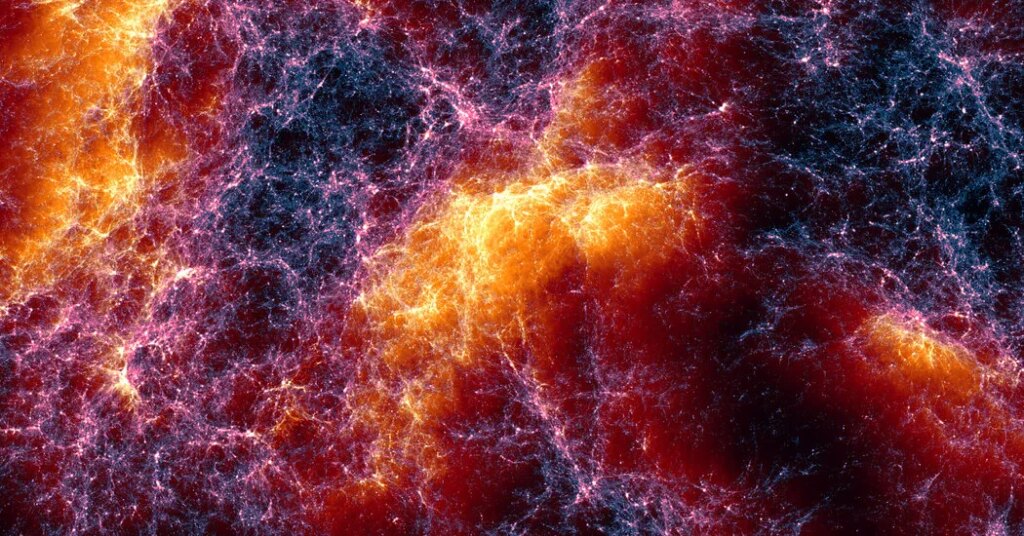
A set of sweeping visualizations released on Sunday offers one of the most detailed simulations yet of what was happening at the dawn of our universe.
The imagery charts a churning mix of dark matter and the hot, gaseous hydrogen and helium that was pervasive across the early cosmos as it evolved, between 50 million and 2 billion years after the Big Bang.
“Much of our understanding of galaxy formation comes from the nearby universe,” said Oliver Zier, who directed the effort to build Lumina, the simulation that created these visuals.
But NASA’s James Webb Space Telescope has allowed astronomers to peer farther back into cosmic time than ever before, to when the first stars and galaxies were born. Astronomers can compare Lumina’s predictions with Webb’s data to check whether physics as they understand it works the same way across cosmic time, said Dr. Zier, a scientist with the Harvard-Smithsonian Center for Astrophysics in Cambridge, Mass.
According to Dr. Zier, Lumina charts the transition of the universe from a nearly featureless expanse filled with cold, neutral gas to one that contains early galaxies, burgeoning black holes and a haze of hot, ionized matter filling the spaces in between.
This cosmic mélange is what eventually became the universe we know today.
After the Big Bang, the universe was a sizzling soup of electrons and atomic nuclei. As it expanded, it cooled, and those particles coalesced to form a fog of hydrogen and helium gas. During this time, shorter wavelengths of light, like ultraviolet radiation and X-rays, could travel only a short distance before being absorbed by the neutral gas, Dr. Zier said. This period is known as the cosmic dark ages.
Millions of years later, the hydrogen and helium atoms began to lose their electrons again in a process known as ionization. This caused the universe to become transparent to shorter wavelengths of light. Astronomers believe that the first stars, thought to have appeared around 100 million years after the Big Bang, drove this change.
Simulating this era of cosmic time can help fill in the blanks. To create Lumina, Dr. Zier and his colleagues modeled the behavior of dark matter, the accretion of black holes, the formation of stars, the ways these objects interact with the gaseous hydrogen and helium surrounding them, and more. The team described their work in a paper published in the Monthly Notices of the Royal Astronomical Society.
Lumina then modeled the universe’s evolution within a simulated volume of space, about 1.5 billion light years across in each direction. The program took about a year to run on a supercomputer located at Oak Ridge National Laboratory in Tennessee.
The program delivered a suite of information about the conditions of the early universe, including the distribution of dark matter and the temperature of intergalactic gas as it changed over time.
Lumina found that starlight most drove the ionization of hydrogen gas in the early universe, and that most of this change occurred between 500 million and 1 billion years after the Big Bang. This light imbued the gas with enough energy to knock away its electrons. The ionization of helium occurred in stages: Starlight was enough to remove one of a helium atom’s two electrons; higher energy radiation from supermassive black holes removed the other.
Lumina also produced intricate video representations of what the cosmos might have looked like back then, if we could have somehow flown through it. One shows an overarching view of what astronomers call the “cosmic web,” a sea of connecting clumps and filaments made mostly of dark matter.
“It’s literally like the backbone of the universe,” Dr. Zier said.
Another zooms in on a massive halo of dark matter enveloping a cluster of galaxies. Dark matter’s gravitational pull attracts intergalactic gas, which is “shocked” by an extreme amount of energy as it falls into the halo, Dr. Zier explained. This causes the gas to slow down and heat up. As it cools, that gas becomes the material for future stars.
The team behind Lumina has already begun comparing its results with data collected by the Webb. Astronomers also expect to use Lumina as a base line for data taken by the Nancy Grace Roman Space Telescope, which launched at the end of August, in part in order to map the universe’s dark matter as never before.
If the observations match up with what Lumina predicts, “that tells us that our model, and our understanding of physics, is working,” Dr. Zier said. But “if it does not agree, then that’s the more interesting part,” he added. “It means that something is missing.”
The post Gaze at the Cosmic Dawn in Dizzying Detail appeared first on New York Times.