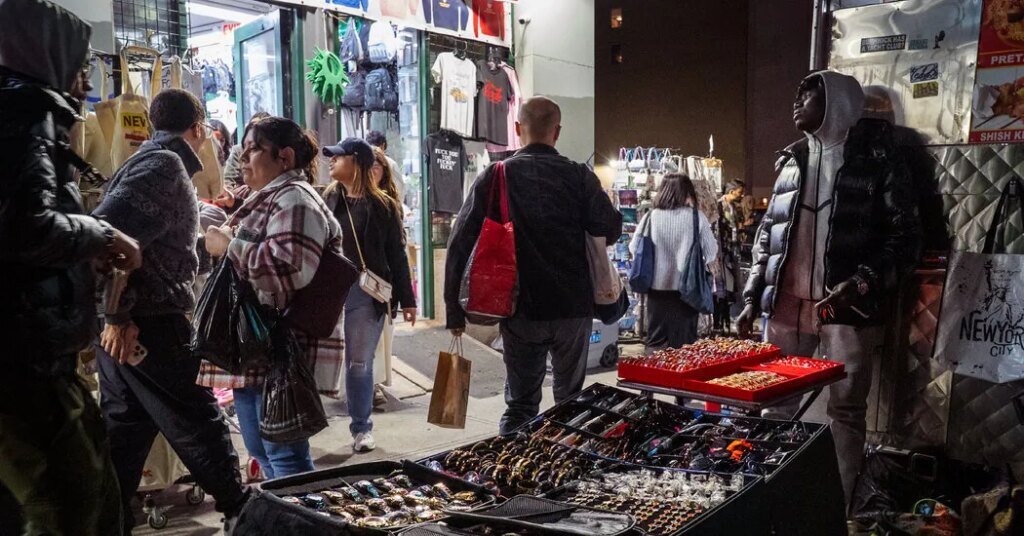
Most days, Khadim Ndiaye wakes up in the apartment he shares with five people in the Bronx and heads down to Canal Street, where he sets up shop on the sidewalk. Cat-eye, oversize and aviator frames bearing familiar logos — Prada, Gucci, Fendi — are among the sunglasses he hawks to passers-by.
Some days are better than others, but the worst are the days when he comes “back home the same way I left in the morning,” which is to say, with no money.
Mr. Ndiaye, 33, is among the thousands of Senegalese migrants who have made their way across the Atlantic from Dakar, Senegal’s capital, followed by a perilous overland trek through South and Central America to New York with one goal: to create a better life for themselves and their families in Senegal.
For many, that means spending days on the city’s sidewalks, selling everything from coffee to knockoff designer handbags. They are sustained by their faith and an unwavering belief in the American dream, even as fear has swept through New York’s Senegalese community over the Trump administration’s mass-deportation campaign.
While Senegalese immigrants have long had a foothold in the city, a recent surge of newcomers, many of them young men seeking asylum, have found themselves struggling to find work and adapt to their new surroundings. The Trump administration’s immigration crackdown has made life even harder for the new arrivals, many of whom are members of the Baye Fall, a subgroup of a Sufi Muslim brotherhood called the Mouride, for whom labor and prayer go hand-in-hand. Unable to find work, many turned to vending.
A 2024 report by the Immigration Research Initiative, a nonpartisan think tank, found that 55 percent of general merchandise vendors in New York City are from Senegal. The work comes with its own risks. The police frequently seize counterfeit merchandise, forcing vendors to essentially start over from scratch. At least five vendors from Senegal were arrested in an ICE raid on Canal Street in October 2025.
To guard against the risks they face, vendors have banded together, Mr. Ndiaye said, using WhatsApp to text the locations of law enforcement operations, for instance, or warn others when a block is teeming with ICE agents.
It’s hard “leaving your home birthplace and going to a new place,” he said, adding that “being mistreated in that new place makes it harder to bear.”
Despite the hardships and discrimination he’s faced, Mr. Ndiaye said that he and other newcomers like him just want to support their families and contribute to the building of this nation.
“We believe in the American dream,” Mr. Ndiaye, who has applied for asylum, said. “We believe in a country that has opportunities.”
Jeanne Batalova, a senior policy analyst at the Migration Policy Institute, a nonpartisan think tank, said it’s not surprising that Mr. Ndiaye and other Senegalese migrants have turned to street vending, particularly “in a country that doesn’t really provide much support to people who arrive.”
“It’s a younger population and it’s a working-age population with a strong work ethic,” she said. In addition to supporting themselves and their families back home, she added, many asylum seekers arrive owing considerable sums to smuggling networks.
“There is a significant pressure on people to work,” she said.
Amadou Ly, an activist and founder of the Amadou Ly Foundation, which assists immigrants in New York, said the city does not provide enough support for new arrivals, particularly for Senegalese migrants and other “communities that do not tend to have a loud voice or a loud representative.”
“Instead of the NYPD utilizing its resources towards over-policing people who are selling counterfeits, we can actually use resources towards employment and things that benefit our economy,” he said.
Ousmane Diop said he started AFRIC’A.R.T., a grass-roots organization based in Harlem, about five years ago to support the African immigrants, including Senegalese migrants, as they arrived in New York, many speaking only their native Wolof. After an initial surge early in the Biden administration, he said, about 10,000 Senegalese migrants crossed the Southern border between March 2023 and March 2024.
“We were facing a housing crisis, employment crisis, integration crisis,” he said, “and we had to come up with some plan.”
Mr. Diop, who was granted asylum in the United States in 2018, is now the chief executive and president of AFRIC’A.R.T. The organization offers English classes and helps newcomers navigate the asylum process and find a safe place to live.
As President Trump has taken a harder line on immigration in his second term, Mr. Diop said, people have skipped hearings in immigration court, fearing that they could be arrested and deported. Among those who turned to street vending as a way of making ends meet is Abdoul Azez Kasse, who said he started selling wallets on Canal Street after the work permit he received as an asylum seeker expired. Under the Biden administration, his paperwork was renewed like clockwork, but under Mr. Trump, “the immigration procedures have been dragging now, and taking too long.”
With nearly 20 people in Senegal relying on the money he makes, Mr. Kasse, 35, said he leans on his faith as a Baye Fall to get him through.
“Even if I have to sell water and make 50 cents out of every bag that I sell, I will do it,” he said. “I will do it because I believe that here, work is worship.”
Even as organizations like Mr. Diop’s help Senegalese migrants settle in New York, tensions have surfaced with more established members of the city’s Senegalese community, which has historically been based along a stretch of 116th street in Harlem known as Le Petit Sénégal.
Having arrived in the United States when she was 8, Marie Ndiaye, 36, is what the newcomers call an “ancient.” Some of the more recent migrants, she said, felt that “the ancients, people like myself, did not truly embrace them and did not help them the way they felt like they needed to be helped.”
Ms. Ndiaye, who has helped organize “know-your-rights” workshops for new migrants and has even let a few of them stay with her to help them get on their feet, said that sense of entitlement was frustrating.
But she credits the newcomers with rejuvenating Le Petit Sénégal and restoring some of its flavor after years of gentrification.
“They’re not diluted like people like myself,” Ms. Ndiaye said, referring to the nearly two decades she has spent in the United States. “They are very authentic from what they wear, how they talk. I mean, my Wolof improved.”
Malamine Bamba, 33, who survived a dangerous trek through South America to reach the United States a little over two years ago, believes he is on a holy mission. Dressed in colorful patchwork clothing that identifies him as a Baye Fall, and with a smile on his face, he walks around Le Petit Sénégal selling small cups of café touba, coffee made from beans ground with djar, a musky black pepper, which he pours from a 10-liter container. On good days, he can make $80 to $90. He uses the money to support himself and his family back in Senegal, and to pay off the $10,000 he owes to the smugglers who helped him get to the United States. Mr. Bamba said he’s paid off about half.
The spiced coffee is a sacrament, he said, one that his faith implores him to share with the world. Mr. Bamba walks until he sells out, and then he goes home to brew another batch.
“Everybody knows that if you sweat, you’re going to get the benefits,” he said. “I strongly believe in that so that’s why I be always smiling because I know that a better future is ahead of me.”
The post For Senegalese Street Vendors in New York, ‘Work Is Worship’ appeared first on New York Times.