The thing about sex scenes in TV and movies is that filming them is, usually, very funny.
This is so even when one partner isn’t covered in a sculpted, synthetic material that makes him look like a buff, thatched-together take on the captor/suitor in “Beauty and the Beast.” Or when it’s not scripted for the set’s bed to break with a thunderous clatter. Or when the married writer-director team in charge of their project isn’t demonstrating what needs to happen with the aid of an intimacy coordinator.
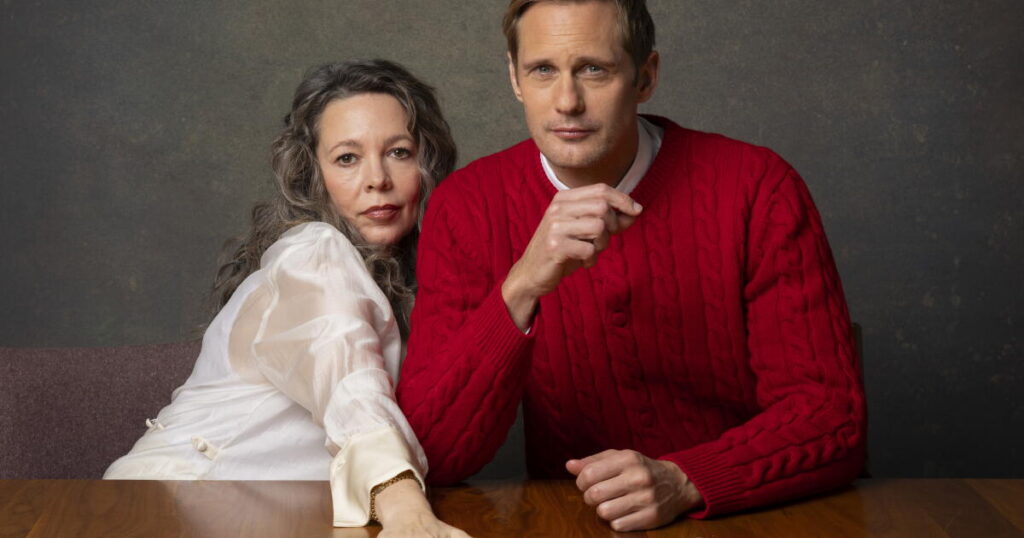
Then there’s “Wicker.” Filmmakers Alex Huston Fischer and Eleanor Wilson’s steamy-yet-hilarious adaptation of the Ursula Wills short story is about an ostracized medieval fisherwoman who, on a lark and to stick it to the pretty mean girls in town, asks the local basket weaver to fashion her a husband made out of wicker. What grounds that preposterous plot is that the film stars Olivia Colman and Alexander Skarsgård, award-winning actors who are both known to have impeccable comedic timing and to not take themselves too seriously.
Skarsgård says of “Wicker,” which takes on toxic masculinity, the institution of marriage and more, “What I thought was really fun was that the protagonist was not only a woman … but a woman who wasn’t 23 … and it can still be steamy and sexy and fun and exciting, even.”
Plus, Colman says, her co-star’s full-body wicker suit helped with the simulated coitus.
“It actually makes it less embarrassing for me because there wasn’t skin touching,” she admits.
There’s also no nudity in the sex scenes, which Colman says was everyone’s choice, because they wanted to keep it “all in our imaginations.” The most sensual scene in the movie is actually a dance number at a public gathering where the two characters slowly sway and caress each other, much to the horror and confusion of the other townsfolk.
“It’s lovely, and they forget completely that there’s anyone around them,” Colman says. “They are absolutely in the moment. I don’t think they consider that anyone could be looking at them.”
Gathered on the rooftop of “Wicker” distribution company Black Bear’s Santa Monica office, the two speak in matching leveled and frank tones, seemingly oblivious to the traffic and sirens buzzing below us. Their outfits even seem slightly coordinated with an edgy prep style. He’s in a plaid button-down and long shorts that stop above a leg tattoo. Calf-high white socks stick out of his black loafers. She wears cropped barrel jeans, a white shirt and an oversize blazer; her graying black wavy hair in expert (yet casual) curls. This is the last interview in a day of interviews and photography. They’re polite, but understandably eager for the day to be over; already thinking about a few hours from now when they’ll meet “Al and El” and others for dinner at Chateau Marmont. When we’re waiting for the elevator after the interview, Colman goofs off and attempts to moonwalk.
They both say that explicit conversations about traditional male-female power dynamics didn’t happen on set, although such themes were omnipresent in the process. Colman says that the metal collar costume designers András Dániel Tóth and Attila Godena-Juhász made for “Wicker’s” female characters to wear on their wedding days are marked by intricate renderings of fallopian tubes and breasts. And both stars see the humor in this supposed specimen of a perfect man being born from Peter Dinklage’s queer basket weaver.
Colman says her character, naturally, has some “self-esteem issues” for being ostracized from her community. But she also relishes the freedom of nonconformity.
“She’s still happy on her own and is probably more comfortable on her own,” she says. Plus, the Fisherwoman is the only woman in town with a job (and even a name) that’s not associated with a man’s. Elizabeth Debicki’s town queen bee, for example, went from being known as Doctor’s Daughter when she was a child to Tailor’s Wife after she got married.
Colman says Fisherwoman is the only female character “who makes her own money, who has her own space and can choose what she does with her own evenings.” The actor says Fisherwoman doesn’t intend to sleep with her custom-ordered husband; they naturally fall in love.
Skarsgård understands why people could see this as counter to his titular character in Apple TV’s sci-fi series “Murderbot,” especially because both characters come with constricting costumes and because “Murderbot is terrified of human connection and Wicker Husband is drawn to it.”
“He wants to connect with his wife and other people, so he seeks it out,” Skarsgård says. Whereas, “Murderbot flees from it.”
Skarsgård adds that the comedy of “Wicker” lets the cast and crew subvert traditional fables and sagas, or even George Bernard Shaw’s classic “Pygmalion” story.
“There’s so much you can unpack in that social commentary: institution of marriage and how silly it can be and what a prison that can be,” he says. “It deals with patriarchy and jealousy and social hierarchy that, regardless of gender, we’re all existing in. And how transgressive and how much of a threat it can be if someone disrupts that hierarchy, the way the Fisherwoman does in a way which sets everyone off.”
But, he says, “it’s done in a way that doesn’t feel like you’re going into the movie and you paid money to watch a lecture for an hour and 40 minutes.”
The sex scenes might sell the movie to audiences, but the commentary is truly priceless.
The post Sex scenes with a ‘Wicker’ man? ‘Less embarrassing’ than usual, says Olivia Colman appeared first on Los Angeles Times.