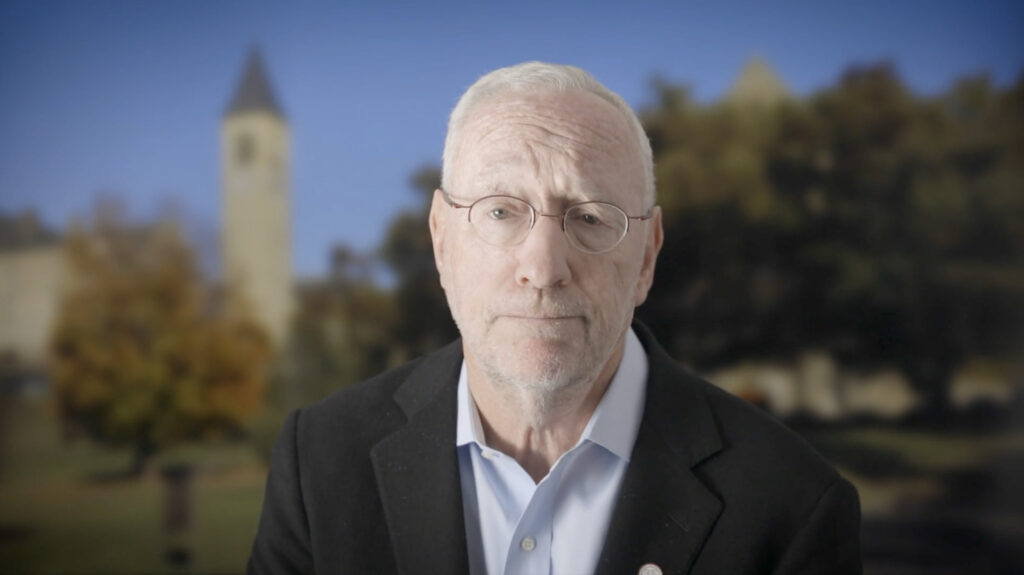
Cornell University President Michael Kotlikoff had already been hit with a petition signed by more than 70,000 alumni who pledged to withhold donations to the school after allegations of a gang rape at a fraternity house caused a national outcry.
Then during a meeting with faculty who were mulling whether to take a vote of no confidence in his administration, he was put on the spot. Upset faculty senators wanted him to explain why reports of sexual assaulthad recently gone up on campus.
The next day, Kotlikoff gave his State of the University address in which, after weeks of public and private acrimony, he said the university must do better.
“This is the beginning,” Kotlikoff said, “of what will become the defining effort of the rest of my presidency.”
The rape allegations outlined in a lawsuit filed last month against the university, seven men and other defendants have delivered to Kotlikoff arguably the most fraught moment of his more than 25 years at the Ivy League university in central New York state. The crisis has drawn more national attention and outrage than any of the challenges during his tumultuous, short time leading the school, including a Trump-imposed research funding freeze and student protests over the war in Gaza.
On campus, evaluations of his leadership are sharply divided: There are those on faculty who say he and his administration failed to keep students safe from sexual assault, repressed free speech and were overly focused on optics. There are also many who are warmly supportive, describing Kotlikoff as a compassionate and steady hand who has repeatedly proved he can make tough decisions and the right person to guide Cornell through this searing period.
If the faculty senate takes a vote of no confidence in Kotlikoff’s administration this week, the results would not be binding but would send a strong signal.
The chair of Cornell’s board of trustees, Anne Meinig Smalling, did not respond to requests for comment. The board met on campus earlier this month, and several faculty members said their understanding is that Kotlikoff has strong support from trustees (who have the power to fire him).
Kotlikoff also did not respond to requests for comment for this article.
Kotlikoff’s presidency has been fraught from the beginning. It began abruptly when his predecessor told him she would be stepping down and Kotlikoff, then Cornell’s provost, was asked to lead the school only minutes later.
He took office as interim president in July 2024, inheriting the fallout from intense protests over the Israel-Gaza war, and outright hostility toward higher education from many political leaders.
Two Ivy League presidents had just resigned under pressure. A third was about to.
In November of that year, a sophomore reported allegations of a gang rape at a campus fraternity, Chi Phi. The university suspended the chapter house, began a Title IX investigation, and Kotlikoff created a task force to examine the problem of sexual assault at Cornell.
Then the Trump administration launched its blitz of attacks on elite universities. Last spring, federal research funding was disrupted at Cornell in connection with civil rights investigations. Kotlikoff and the school’s provost sent an email to campus alerting them that the school had received 75 stop-work orders on research grants from the Defense Department without explanation.
In November, Cornell became the fourth Ivy League institution to reach a dealwith the Trump administration, agreeing to pay $30 million to the federal government and invest $30 million in farming research to close investigations and restore research funding.
Kotlikoff, who had been named president by the board by this time, told the campus community that the university had faced $250 million in funding interruptions. The White House, at the time, maintained that $1 billion had been frozen.
The agreement divided people on campus, with some viewing it as school leadership relenting to federal extortion, while others were relieved that research could continue.
Similarly, some faculty and students called the university’s enforcement of rules about disruptive protests repression of free speech, while others applauded what they viewed as reasonable guidelines. In May, protesters said Kotlikoff struck two of them with his car when they tried to ask him questions as he was leaving an event; trustees later said they had looked into it and cleared him of blame.
But the alleged gang rape is a different kind of controversy.
Since the civil lawsuit was filed by the former student known in the case as Jane Doe, it has gripped the country’s attention and ignited debate. For weeks, the university has been swept up in a wave of rage and recriminations. Hundreds of people have protestedon campusand at other schools, accusing Cornell of not doing enough to investigate or punish the accused men.
People smashed windows and spray-painted Cornell’s administration building. And some doxed people connected to the case — along with others mistakenly assumed to be connected.
Several of the accused men were suspended or expelled. No criminal charges were filed.
This month, Kotlikoff announced changes, including suspending fraternity and sorority parties for the rest of the year, allowing state police to investigate allegations of sexual assault on campus, and adding staff to help people who report sexual misconduct.
By the time Kotlikoff took those actions, a faculty senator had already proposed a resolution: “That the Faculty Senate has no confidence in the ability of the central administration to effectively address the ongoing crisis of sexual assault at Cornell University.” A dozen faculty senators joined as co-sponsors, and an additional 122 faculty members signed on in support of the resolution. Cornell has about 3,000 faculty members, but only the senators, elected by their departments, are expected to vote in a process that could take place over 10 days.
The recent meeting was heated. Kotlikoff was asked why more people accused of sexual assault weren’t expelled, why Greek life was still allowed, and why people Doe had accused were still on campus.
Ariana Kim, an associate professor of music, told Kotlikoff that Doe’s case was not unique. “One in three undergraduate women report sexual misconduct. More than one in two women in Greek life report sexual misconduct,” she said, citing student survey numbers. “Those numbers have only gone up since you’ve been in positions of leadership. How is that acceptable to you?”
Kotlikoff answered that the level of sexual assault has been unacceptable for years, but pointed out that the increase last year occurred when there was a very low response rate to the student survey, just 12.5 percent. He said they need better data, but they don’t need better data to say that is too much sexual assault; and they need to take action to change campus culture. It’s a complicated issue, he said.
Kim shot back, “I don’t think it’s complicated to look at a 12 percent slice and say one in three to one in two is too much.”
Applause rang out.
But there were also people who asked to postpone a vote until after the results of independent investigations.
Trustees commissioned an independent inquiry into how Cornell handles sexual assault, including Doe’s case, to be led by Sally Q. Yates, a former deputy attorney general. New York Gov. Kathy Hochul (D) also appointed the state attorney general as special prosecutor to reexamine the case.
Other faculty senators asked what the central administration was accused of doing wrong, who was included in the list to be voted on, and whether faculty should be examining their own record of response to students’ concerns about campus culture rather than blaming the administration.
When senators meet this week, they will consider an additional resolution, just added by the University Faculty Committee: “A Sustained Faculty Commitment to Preventing Sexual Violence.”
One topic the faculty did not discuss at the meeting — because senators did not know about it yet — was a letter that Doe had written to senate leaders. She wanted her views known to the faculty while they deliberated, her lawyer told The Washington Post. In the letter, Doe said that she felt unsupported by Kotlikoff.
Doe wrote that her sorority president heard him say something that she interpreted as questioning why it took Doe so long to report the alleged rape and doubting her account. A university spokeswoman said the letter was incorrect and the remark was not about Doe; he had asked why people were posting about the allegations on social media but not reporting them to an anonymous university tip line to get help.
Kotlikoff has held leadership roles at Cornell for a long time. In 2020, he was one of the leaders who helped Cornell swiftly launch coronavirus testing and other changes to allow the school to stay open during the pandemic. In 2024, when he became interim president, he said he had never imagined being a provost or a president, but he said yes “because I would — and will — do anything for Cornell.”
While some colleagues criticized him as a top-down, closed-minded administrator, others described him as thoughtful, measured, visionary, a talented researcher who took pains to listen and create consensus.
“He’s very kind, always trying to help, just a lovely person to have around,” said Susan Fubini, senior associate dean for academic affairs at Cornell’s College of Veterinary Medicine and a friend of Kotlikoff’s — someone who is as nice to the custodial staff, she said, as to his colleagues in leadership.
Before the faculty senate meeting, David Bateman, associate professor of government, was unsure how he would vote. But he was disappointed by Kotlikoff’s comments. By the end, he had decided to vote no confidence.
“Leadership should feel compelled to resign because the buck stops with them, and because a principled resignation might make clear the gravity of the problem,” he said. “I no longer have confidence in this administration, not as individuals, but as the accountable stewards of institutions that have failed us, and failed Jane Doe.”
Brian Crane, a professor in the chemistry and chemical biology department, said replacing the president and other leaders is the last thing Cornell needs now.
“We should be coming together as a community to take a hard look at the situation and really see what we can do,” he said. “It’s a complex problem. It’s not going to be solved by one action.”
The post Alumni revolt and a faculty divided: Cornell’s president faces a defining test appeared first on Washington Post.