Nadav Eyal is a senior research scholar at Columbia University and a columnist for Yediot Ahronot.
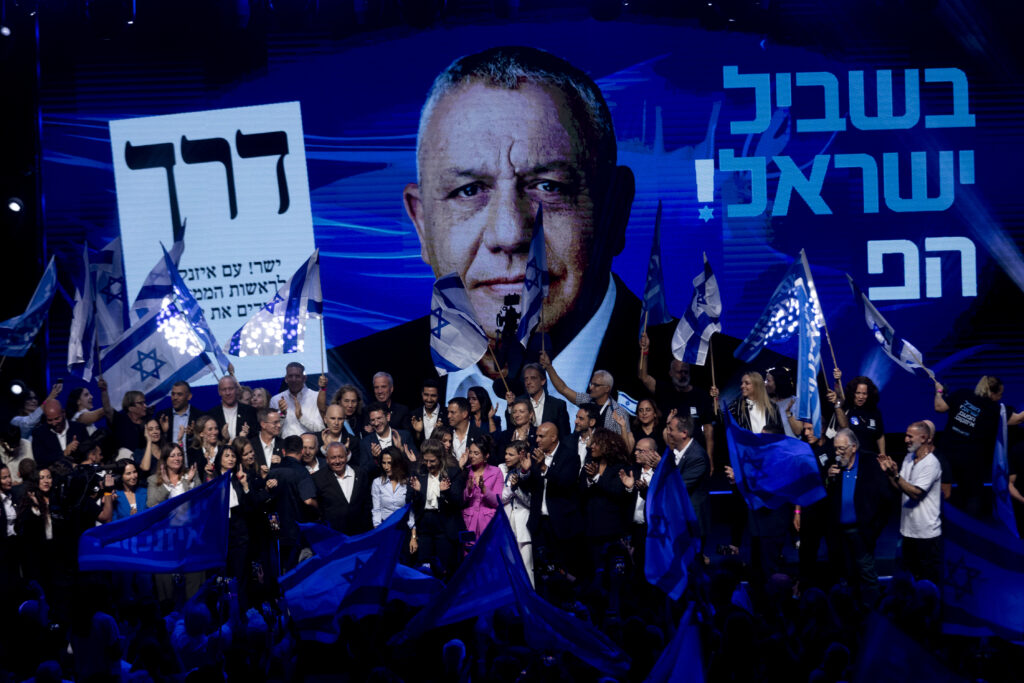
Last week, in Dimona, a longtime Likud stronghold in southern Israel, Gadi Eisenkot faced an angry voter. In a choppy video, the man appears to accuse the former Israel Defense Forces chief of staff, now seen as Prime Minister Benjamin Netanyahu’s strongest challenger, of planning to govern with Hamas supporters or of being unwilling to destroy Hamas. It’s a core accusation of the Netanyahu campaign.
Eisenkot answered: “Hamas killed my son and two of my nephews. I won’t compromise. There is no one in the State of Israel who wants to destroy them more than I do.”
His son Gal was killed in combat in Gaza during the war, as were two of his nephews. He has rarely spoken about it this way during the campaign. Still, part of the trust Israelis place in him stems from that loss, even if few say so outright.
The exchange captures the campaign in miniature. The fight over Hamas is not about policy but about credibility. Netanyahu promised in 2009 to topple Hamas in Gaza. Eisenkot is now promising to finish what Netanyahu did not. On the goal, the two agree.
For many abroad, the rivals seem indistinguishable on other questions, too: Both favor a hard line on Iran and want Hezbollah disarmed. Neither supports a Palestinian state, though Eisenkot would strengthen the Palestinian Authority. What separates them is character, biography and the coalitions available to each.
Netanyahu is a product of Israel’s right-wing elite. He grew up in an academic family in an affluent Jerusalem neighborhood. His father, Benzion, served as secretary to Ze’ev Jabotinsky, founder of Revisionist Zionism, the movement from which the Israeli right descends. He served in Sayeret Matkal, the army’s most elite commando unit, and then later received what was effectively a political appointment in the foreign service, which launched his political career.
Eisenkot was born in Tiberias, on the Sea of Galilee, and raised by Moroccan-born parents without university degrees who later divorced; he then moved to Eilat. He finished high school as an external student, passing the national matriculation exams outside the regular school system, a route typically taken by those the system had failed. He then enlisted in Golani, an infantry brigade known as excellent but decidedly working-class.
Netanyahu earned degrees at MIT; Eisenkot built a military career. Netanyahu attended high school in the United States, his second home, and speaks flawless American English. Much of Likud’s campaign has mocked Eisenkot’s English, which is functional but nowhere near Netanyahu’s. Netanyahu’s son Yair spent much of the war in Miami. Eisenkot’s son reported for reserve duty in the infantry and was killed.
A well-known story about Eisenkot: When he went to the United States for military studies, his wife, an Israeli-American dual citizen, wanted to get American passports for their children. He came home to find her and her mother (who was born in the U.S.) filling out the forms in the kitchen. Eisenkot told me he took the forms and tore them up. Better the children learn to swim, he told them. They would grow up in Israel with their backs to the sea, and swimming would be their only way out.
Netanyahu’s brand is the ability to spot threats to Israel and act against them, defying the world if necessary. His supporters see a visionary, larger than life, bigger even than Israel. Eisenkot’s is integrity, unity and a certain authenticity. He named his party Yashar, “Straight,” and calls Netanyahu a “liar” again and again.
If elected, Eisenkot would be Israel’s first prime minister of Mizrahi descent. Mizrahi Jews trace their roots to the Middle East and North Africa and were long marginalized by Israel’s European-born founding elite. On Oct. 17, a host on pro-government Channel 14 called Eisenkot a Moroccan-Mizrahi “monkey.” (In his defense, the host claimed that kof, Hebrew for monkey, is underworld slang for a criminal doing others’ bidding.) The uproar undoubtedly helped Eisenkot. He spent most of his life avoiding mention of his background, but it now works in his favor among Mizrahi voters, who have historically leaned Likud.
Both are thoroughly secular pragmatists. They once worked well together: Netanyahu appointed Eisenkot chief of staff of the Israel Defense Forces. But they rely on very different political partners, and it is precisely their prospective coalitions that represent fundamentally different visions of what Israel should be.
Large parts of Israeli society wholly reject Netanyahu: not only the left, center and Arab citizens, but portions of the right as well. Without the ultra-Orthodox and the far right, he has no partners left. That dependence helps explain the government’s failure to confront far right Jewish terrorism in the West Bank. For the far right, taking over Palestinian land is the central vision. Without the far right’s support, Netanyahu would lose both the premiership and much of his ability to stall the criminal proceedings against him.
Eisenkot, by contrast, would need a coalition stretching from the Zionist left, which supports Palestinian statehood, to relatively liberal right-wing politicians such as Naftali Bennett and Yair Lapid. This is why his government would look so different even though the two men’s formal positions barely diverge. Eisenkot could embrace and implement President Donald Trump’s plan for Gaza. Netanyahu may want that too, but he is constrained by the far right on which his political fate rests.
At home, the two coalitions dictate different visions for Israel. Netanyahu’s is producing a more conservative, more religious state, with growing far-right influence. Eisenkot can’t change demographic trends, but he can change the incentives behind them. The state subsidizes a swelling ultra-Orthodox community, many of whose members remain outside the workforce and whose yeshiva students have long been exempt from military service. Eisenkot and Bennett have pledged to challenge that. They could also end the protection enjoyed by extremists attacking Palestinians in the West Bank.
Clichés are sometimes accurate. Even if the election produces no stable government, it will offer Israelis the most consequential choice in Israel’s history. They must decide between two men who agree on their country’s enemies yet embody starkly different visions of what Israel should be entering its eighth decade.
The post The real difference in Israel’s election? Character. appeared first on Washington Post.