When Anthropic goes public as soon as next month, its initial offering will be more than just a coming-out party for the artificial intelligence company. It will also be a litmus test for the economy, with trillions of dollars at stake.
Anthropic, which makes the Claude chatbot, is a tent pole of the A.I. industry. Valued in the private markets at nearly $1 trillion and backed by more than $130 billion in funding, it could raise $100 billion in its offering and promptly become one of the world’s biggest public companies. But the stakes are even higher than that.
Anthropic and OpenAI, its chief rival, sit atop a pyramid of business partners and suppliers — infrastructure providers, chipmakers, energy companies and A.I. start-ups — that have all spent heavily over the last four years because they believe demand for A.I. products will keep growing.
Anthropic’s listing will provide the first in-depth look at the health of a key business underlying the A.I. boom — and will be a test of its durability. Is there unending appetite for A.I. services to justify the spending on chips, data centers and other infrastructure? Or will Anthropic’s performance show that there are limits?
“For the market, it’s a bellwether,” said Umesh Padval, an investor at Seligman Ventures, who has worked in tech for nearly 40 years.
If Anthropic disappoints in its public debut, that could hurt investor confidence and cascade into a wider market sell-off, casting doubts on how much longer the A.I. boom can go. A successful offering could lift the market and pave the way for more A.I. companies to go public.
Stock markets are already on edge, with technology stocks broadly falling this month, led by a sell-off in the companies that design and produce the computer chips that power A.I. The Philadelphia Semiconductor Index is in a bear market, defined as a decline of 20 percent or more from a recent high and a sign of significant investor angst, after falling 26 percent from its June peak.
Over the last couple of weeks, Microsoft canceled a deal with Nscale, a provider of data centers. A report from the research firm Gartner predicted that 80 percent of “neoclouds,” the companies that provide data and computing power for A.I. firms, could be forced out of business. And Ken Griffin, the billionaire owner of the hedge fund Citadel, said A.I. investors were “almost certainly” in a bubble.
Those negative signals have added to fears about the huge piles of money being spent on A.I. infrastructure. Amazon, Meta, Google and Microsoft have said they plan to spend at least $740 billion on A.I. infrastructure, including data centers, this year. Private market investors have poured $1.1 trillion into Anthropic, OpenAI and other A.I. companies since 2022, according to PitchBook, which tracks investments.
As spending and investment have risen in private markets, public investments have grown, too, increasing the stock market’s reliance on the performance of the A.I. industry. The top 10 stocks in the S&P 500 are worth more than $1 trillion together, with eight of them being tech companies. Combined, the top 10 account for over 40 percent of the index, up from less than 20 percent a decade ago.
When Anthropic is added to the index, it is likely to displace either Berkshire Hathaway or Eli Lilly, the only non-tech companies with valuations above $1 trillion, from the top 10.
“There is a lot riding on this one,” said Brad Gastwirth, the global head of research and market intelligence at Circular Technology, a supply chain services firm. “If it goes bad, it’s going to bring down the market.”
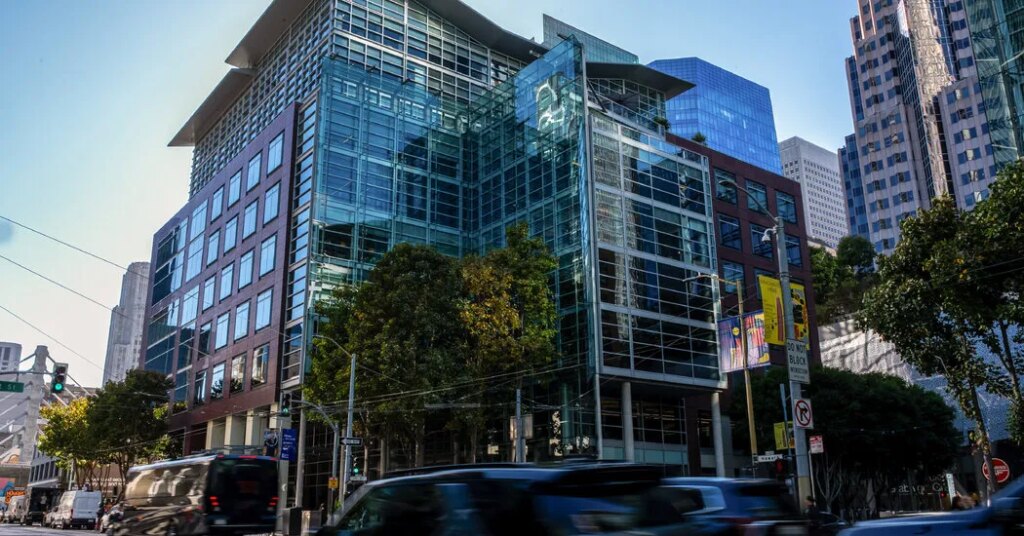
This month, Anthropic gathered investors at its San Francisco headquarters to present its financial performance and growth plans. By most measures, its numbers were astounding. The company’s revenue hit $16.8 billion in the third quarter, up 45 percent from the prior quarter. But investors compared that with even faster growth of 141 percent in the second quarter.
How Anthropic explains that slowdown will be important. If it was because the company lost market share to OpenAI or companies using cheaper open-source A.I. models — the technology that powers chatbots and other tools that generate videos, text and computer code — that means the overall demand for A.I. services remains healthy. If Anthropic’s growth slowed because the entire market saw less demand for A.I. products, the reaction could be more dramatic.
Anthropic declined to comment. (The New York Times has sued OpenAI and Microsoft, claiming copyright infringement of news content related to A.I. systems. The two companies have denied those claims.)
For the past year, Anthropic has been Silicon Valley’s hottest company, thanks partly to Claude Code, the service that transformed how software engineers write code. The company’s revenue soared, causing private market investors to drive up its valuation to $965 billion, topping OpenAI.
To meet the demand for its A.I. products, Anthropic struck deals worth hundreds of billions to lease computing power from Google, Amazon and Microsoft. It has also spent on chips from Nvidia and data centers from Nscale and others. The companies serving Anthropic are, in turn, shelling out money to their suppliers.
But over the summer, some Anthropic customers concluded they were spending too much on “tokens,” or units of data processed and generated by A.I. systems. They sought cheaper options. Meta, one of Anthropic’s largest customers, projected this year that it would spend as much as $10 billion a year on the company’s technology, but pulled back as it switched to other A.I. models.
Stocks of some A.I. companies that went public this year have wilted. Shares of Cerebras, a Silicon Valley maker of A.I. chips, have fallen roughly 40 percent from their offering price in May. Shares of Accelevation, an A.I. infrastructure company, are trading about a third lower than their $18 offering price in September. Elon Musk’s SpaceX, which went public in June, has also fallen far from its peak, though it remains roughly 9 percent above its offering price.
Against this backdrop, the market for initial public offerings has slowed. Holtec, which provides nuclear energy to the A.I. sector, withdrew its listing last month. SB Energy, a data center company controlled by SoftBank, one of OpenAI’s biggest backers, and Aggreko, a power company that works with data centers, have delayed their plans to go public.
A.I. infrastructure is a “dominant theme” of the I.P.O. market this year, said Matthew Kennedy, a senior strategist at Renaissance Capital, which tracks public listings. “It’s also been among the hardest hit by the sell-off these past few weeks.”
Bankers have warned companies that they may not get the valuations they were contemplating just two months ago. In an earnings call this month, David Solomon, the chief executive of Goldman Sachs, said that while the market for public offerings was “wide open,” companies seeking valuations close to those discussed this summer might choose to wait.
“Things got a little bit softer in September,” he said.
Anthropic’s revenue numbers have added to the doubts. The company had been expected to go public at a valuation as high as $2 trillion. But after seeing the slowing growth and the market doldrums, some investors have started discussing a valuation of $1.5 trillion to $1.7 trillion, according to one person with knowledge of the matter.
A.I. executives have been trying to provide reassurance. Taiwan Semiconductor Manufacturing Company, which supplies chips to the A.I. sector, saw “no ceiling” to its profits, its chief executive, C.C. Wei, said this month.
Late last week, amid growing concerns about A.I. spending, the markets fell further. The tech-heavy Nasdaq experienced its largest drop since June.
Sri Muppidi contributed reporting from San Francisco, and Joe Rennison from New York.
The post What’s Riding on Anthropic’s Market Debut? Nearly Everything. appeared first on New York Times.