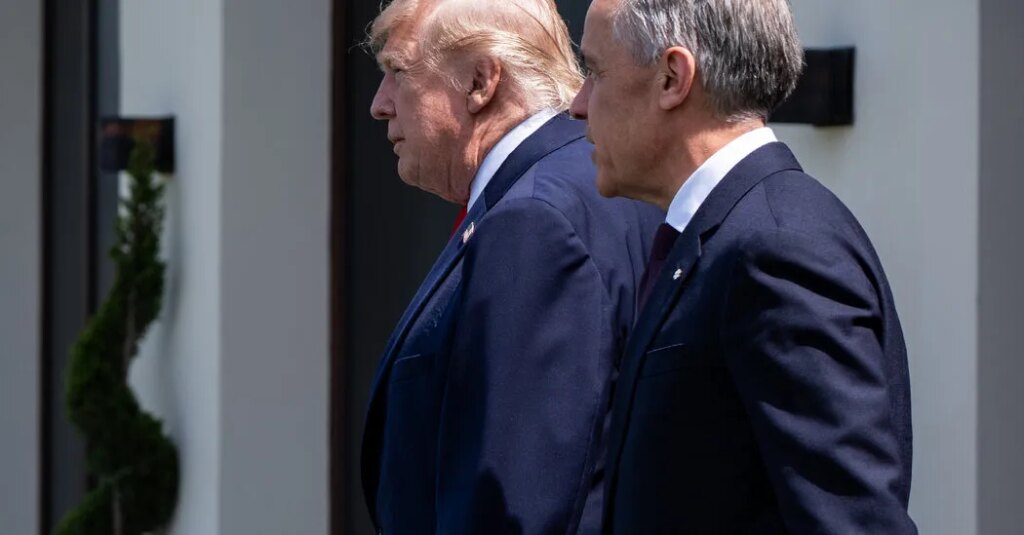
As President Trump stares down what could be a bruising midterm election in November for the Republican Party amid his record-low approval ratings, his administration has identified a familiar target to place some blame: Canada.
This past week, the U.S. Embassy in Ottawa said Canada’s “ministers and premiers openly describe plans to influence American politics in official documents and public appearances.”
Prime Minister Mark Carney of Canada said in a news conference on Friday that those claims had “no merit” and that his government was ready to “drop everything” to negotiate an end to its costly trade war with the United States.
The Trump administration’s claims of election interference added to a long list of animosities that have been piling up between the two countries since Mr. Trump’s second term began.
What are the accusations?
In a statement on Wednesday, the U.S. Embassy accused Canadian officials of meeting with Democratic lawmakers, urging the use of retaliatory levies to hit Republican states and running anti-tariff political advertising campaigns in the United States.
The embassy zeroed in on Canada’s industry minister, Mélanie Joly, who has said or implied on multiple occasions that her nation’s trade policy was designed to strategically hit Republican states. In a news conference in August, shortly after trade talks had collapsed, Ms. Joly said Canada would impose tariffs on “products that will target states in the U.S.” to “put political pressure” on the Trump administration.
The embassy also said she met in September with Democratic officials in Boston and Chicago. Ms. Joly said the goal of the trip was to discuss trade and investments with individual U.S. states and companies.
In addition, the embassy’s statement recalled an incident in October of last year in which Doug Ford, Ontario’s conservative premier, announced he would run an advertisement that included sound bites of President Ronald Reagan criticizing tariffs. In response, the Trump administration halted trade negotiations altogether.
Pete Hoekstra, the U.S. ambassador to Canada, has since walked back his office’s accusations.
“Someone could assume” based on Canadian officials’ actions that they were trying to interfere in U.S. elections, Mr. Hoekstra said on a Canadian politics podcast recorded on Wednesday and released Friday. “As an embassy, we hadn’t reached that conclusion.”
Mr. Trump has repeatedly drawn Canadians’ ire by calling the nation America’s “51st state,” and by moving to rename Lake Ontario, which straddles the border between the two countries, “Lake America.”
But the greatest strain on the neighbors’ relationship has been their trade war. Shortly after President Trump returned to office, he imposed tariffs on Canadian exports in return for what he said was the country’s role in allowing fentanyl to enter the United States. Canada retaliated with tariffs of its own, and the dispute has devolved into an ongoing retaliation hurting businesses and consumers in both countries.
On Friday, the Trump administration announced that it would shuffle its tariffs on Canadian products, exempting some items and applying new tariffs to others, in what appeared to be a last-minute bid to provide relief to American farmers ahead of the midterm elections.
How has Canada responded?
At a news conference in Turkey on Friday, Mr. Carney said Canada took pains to avoid the appearance of meddling in U.S. politics. And he dismissed any notion that Canadian officials had favored one party or another in its dealings.
“We have no intention to interfere with their democratic processes,” he said.
Ms. Joly also defended herself against the U.S. Embassy’s claims on Thursday. “Indeed, I met with Democrats in the U.S., but I met with Republicans,” as well, she said.
On Wednesday, Mr. Ford told reporters he had “no interest” in engaging in election interference.
“We’re going to focus on what we can do here in Ontario, and in Canada, to make sure we protect our economy, protect the people and protect communities,” he said. “And the people of the United States will make that determination in the midterms.”
Stewart Prest, a political science lecturer at the University of British Columbia, said the Canadian actions cited by the U.S. Embassy could have been intended to encourage policy changes, not to hurt Republicans at the ballot box.
Didn’t U.S. officials meet Albertan separatists?
In his statements, Mr. Carney noted that some Trump administration officials met with Albertan separatists this year, before the province’s referendum on holding a vote on whether to secede from Canada. (Voters roundly rejected it.)
“The resources of the media here can make their own judgment about the extent to which very, very senior U.S. officials have directly intervened, so to speak, in Canadian sovereignty, Canadian democratic processes,” Mr. Carney said.
White House and State Department officials confirmed that State Department officials met with activists in the separatist movement in Washington three times last year. But the Trump administration has denied making any material promises to Albertan separatists.
“The department regularly meets with civil society types,” the State Department said in a statement. “As is typical in routine meetings such as these, no commitments were made.”
To Mr. Prest, the political science lecturer, the Trump administration’s rhetoric and involvement in the Albertan separatist movement showed that its latest claims of election interference by Canada smacked of hypocrisy.
“The accusation is itself a kind of confession,” he said. The administration was “trying to create an equivalency where I don’t think any exists.”
The post Why Is the U.S. Accusing Canada of Election Interference? appeared first on New York Times.