In January 2019, Jon Ossoff’s cellphone lit up with a frenzy of calls and texts.
The messages, streaming in from Ossoff’s colleagues at the small documentary film production company that he ran, carried grim news. The night before, one of Ossoff’s colleagues, the Ghanaian journalist Ahmed Hussein-Suale Divela, had been driving through the suburbs of Accra when two men on a motorbike pulled alongside his BMW and began shooting through the driver’s side window. Their bullets struck Divela in the neck and chest, killing him on the spot.
Just a few months before, Ossoff had worked with Divela on a documentary about corruption and bribery in African soccer. The investigation, which captured FIFA’s second-highest official in Africa accepting a bribe on hidden camera, had sparked a political firestorm in Ghana. A prominent member of the Ghanaian Parliament responded by inciting violence against Divela on a public television broadcast. “If you meet him somewhere, slap him … beat him,” the MP had said on one broadcast. “Whatever happens, I’ll pay.”
On the evening of Jan. 16, the two gunmen followed Divela to his neighborhood. No one has been convicted of a crime in connection to the killing.
Ossoff, who had advised the team in Ghana on security, was crushed by the news of Divela’s death. “I’ve never been more devastated about anything in my professional life,” Ossoff recalled in a recent interview. “It was everything that I hate — corrupt people who were exposed for their corruption who retaliate by killing a journalist.”
But the episode also carried a lesson for Ossoff. Exposing corruption drew attention — and attention was a form of power.
Seven years later, Ossoff, now a U.S. senator, is putting that theory into practice as he runs for reelection in Georgia — and, some Democratic operatives suspect, tests the waters for a possible 2028 presidential bid. On the campaign trail, Ossoff has leaned into an aggressive anti-corruption message, touting his record of oversight investigation in the Senate and attacking President Donald Trump and his “Mar-a-Lago mafia” for profiting off the presidency.
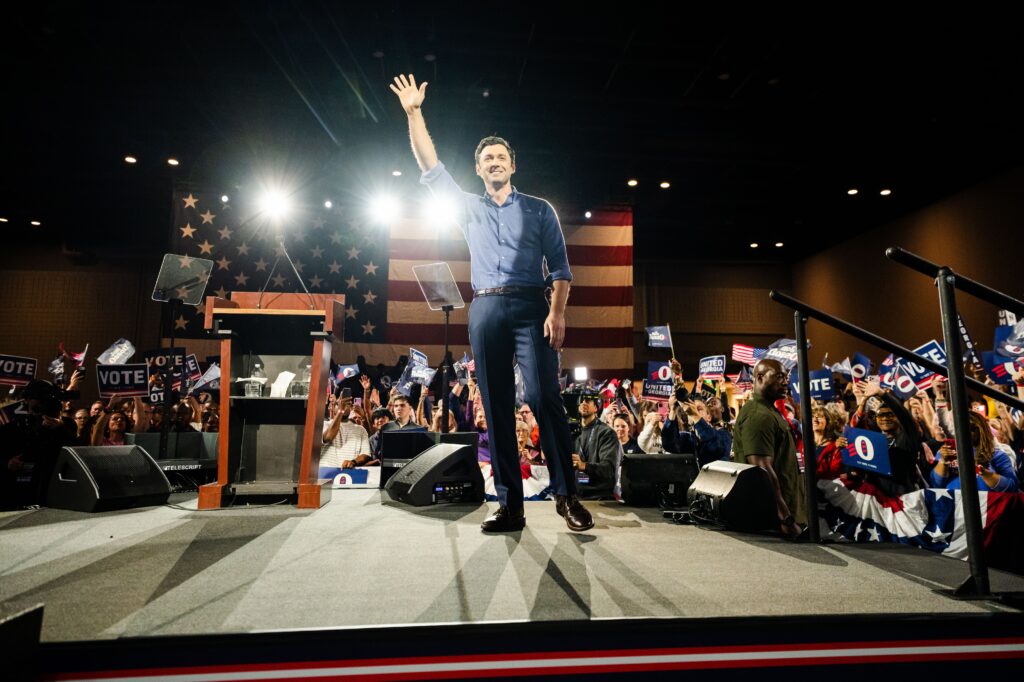
That message has galvanized voters in Georgia, where polls show Ossoff with a comfortable lead over his Republican opponent — a stark reversal from 2024, when the state voted by a slim margin for Trump. Online, meanwhile, clips of Ossoff’s jeremiads against “the crook president” have repeatedly gone viral, flooding social media feeds with cinematic, high-angle shots of Ossoff solemnly speechifying from behind a lectern. The viral clips have drawn favorable comparisons to the aesthetics of Barack Obama’s 2008 campaign, further fueling the buzz around Ossoff as a possible dark horse candidate for president.
Yet Ossoff’s knack for turning anti-corruption messaging into viral content has come as no surprise to his former colleagues at Insight Film, the independent production company that he ran from 2013 to 2021. According to interviews with his colleagues and close collaborators from the time, Ossoff’s tenure at the production company served as a kind of unconventional apprenticeship in the workings of the modern attention economy. It was there, his colleagues say, that he first came to grasp the potency of corruption as a political issue and mastered the craft of turning anti-corruption investigations into effective political entertainment.
“He understands communication as a medium,” said Clive Patterson, who joined Insight in 2008 and now serves as its CEO. “He can join the dots [into] a bigger picture and present it in a way that people really connect to.”
On the campaign trail, Ossoff has pointed to his documentary career as one of his primary qualifications for tackling allegations of corruption and self-dealing within the Trump administration. In an interview, he pointed to his record of oversight in the Senate, where he has led investigations into abuse in federal prisons and Georgia’s foster care system, as an example of the chops he developed as a producer. “I’ve applied the skills in investigation that I learned leading Insight to produce really impactful Senate oversight,” he said.
But the lessons of his filmmaking career extend beyond the mechanisms of anti-corruption investigations. At Insight, Ossoff began to hone the viral messaging techniques that have fueled his rise to national attention.
“When I watch these videos, and I see that he is mentioning corruption and Trump, and I say, ‘Hey, this is not new,’” said Anas Aremeyaw Anas, a Ghanaian undercover journalist who frequently collaborated with Ossoff’s company. “This is the Jon I know.”
Ossoff’s path to filmmaking began in 2003, in a plum orchard in southwestern France.
Ossoff, then 16 years old, was on summer vacation with his family when they were invited to a dinner party at the home of a family friend. Seated across from Ossoff was Ron McCullagh, a British documentary filmmaker who had founded his own production company, Insight News Television, in London in 1991.
The two tablemates chatted about documentaries and foreign affairs, and McCullagh came away impressed by Ossoff’s knowledge of global politics. They stayed in touch after Ossoff returned to the United States, and in the summer of 2008, while Ossoff was an undergraduate at Georgetown University, McCullagh invited him to spend a summer interning for the company at its headquarters in London.
The budding professional relationship quickly proved useful to both men. In 2011, after Ossoff had gone to work as a senior foreign policy aide to Rep. Hank Johnson (D-Georgia), McCullagh produced a film with the Sierra Leonean journalist Sorious Samura documenting corruption in the country’s timber industry. The film implicated the country’s vice president, sparking a major political scandal and prompting the government to threaten Samura with arrest.
In an effort to protect his reporters, McCullagh called Ossoff to ask for assistance from Washington. Ossoff briefed Johnson, who in turn organized an open letter, signed by 18 of his colleagues in Congress, urging the State Department to investigate the situation in Sierra Leone. Shortly after the letter was published, Samura and his team were able to leave the country safely.
Two years later, Ossoff was back in the United Kingdom, having left Capitol Hill to pursue a graduate degree at the London School of Economics. His decision to leave Washington, he has said, was driven in part by his disgust with the extent of corporate influence in Washington, which he witnessed while working on the annual defense appropriations process. “I couldn’t stand the corruption,” Ossoff said in a 2020 campaign ad.
In London, Ossoff would occasionally meet McCullagh for lunch at the Frontline Club, a members’ club frequented by conflict journalists. At one meeting toward the end of Ossoff’s time at LSE, McCullagh approached him with a proposal: How would he like to take over as CEO of the company?
Ossoff, who had once dreamed of becoming a diplomat, accepted the offer, despite having no background in journalism or filmmaking beyond his internship at Insight. “I wasn’t fearful of it,” Ossoff said. “I was excited by it.”
Inside the company, McCullagh’s decision to promote a 26-year-old graduate student to the top position initially raised some eyebrows. The suspicions were fueled in part by the financial arrangement that Ossoff agreed to after joining: He and McCullagh would each invest $250,000 in the company, which was teetering on the brink of insolvency. Much of Ossoff’s share came out of money he had inherited in 2008 after the death of his grandfather, a successful leather manufacturer.
Samura, who was a co-owner in the company at the time, said that Ossoff’s colleagues knew he was affluent but that his wealth wasn’t a decisive factor in his hiring. “We knew he had a little bit of money, but we knew that he had the skills to raise it for us,” Samura said. (McCullagh declined to be interviewed.)
Once on the job, his colleagues say, Ossoff quickly earned the confidence of the small team. “He had a sort of a natural inclination for the kind of work we were doing,” said Patterson. “He was very switched on.”
As CEO, Ossoff’s first move was to rebrand the company to “Insight TWI” — short for “The World Investigates” — to emphasize its collaborations with foreign journalists. His next task was to shore up the company’s finances. In his first year, he made inroads with the shrinking pool of broadcasters willing to invest in international investigative work, securing commissions from Al Jazeera English to produce two investigations — one about the Rwandan strongman Paul Kagame and another about China’s deepening influence in Africa. Diarmuid Jeffreys, a commissioning editor at Al Jazeera who collaborated with Ossoff on several films, recalled that Ossoff could be ruthless in negotiating the terms of deals.
“Jon was just doggedly determined to make sure that he got every penny that they needed to make these films,” Jeffreys recalled.
Ossoff also tapped into new sources of funds to support the company’s work. In January 2015, he secured a $350,000 grant from the Omidyar Network, the philanthropic foundation funded by eBay founder Pierre Omidyar, to fund a training program for investigative journalists in Africa. Together with Ossoff’s and McCullagh’s investments, the moves put the company back on relatively stable financial ground: By the end of 2015, the company had just over $150,000 cash on hand, according to financial documents filed in the U.K. at the time.
Ossoff involved himself in the various stages of Insight’s production process, including research and development, editing, and distribution. He also doubled the size of Insight’s small team, hiring four new researchers and junior producers. Among directors, he garnered a reputation as a particularly involved and hands-on producer. “At the end of every day [of shooting], we were having some sort of debrief,” said Joshua Baker, who directed a 2018 film that Ossoff produced about the Islamic State’s abuse of a Yazidi woman in Iraq. “There were a couple of times where I literally rang him at 3 o’clock in the morning to talk through the situation and game it out together.”
Ossoff proved particularly cautious about risk planning and information security. One of his earliest reforms as CEO was to move all of the company’s communications to encrypted channels, and Baker recalled working on a 50-plus-page risk assessment document with him before shooting in Iraq.
He also took an interest in the mechanics of filmmaking. Before the team started shooting the film about Kagame, Patterson recalled, Ossoff used some of the company’s limited budget to upgrade its camera to a higher-spec model. “He wanted to push the aesthetics of the film,” Patterson said. “He understood film language.”
Ossoff’s fastidiousness could sometimes get on the nerves of his reporters. When working with the BBC, for instance, Ossoff was responsible for making sure that his reporters complied with the network’s complex policies on undercover filming. In disagreements between the network and reporters, he would often side with the network out of an abundance of caution. “I would get angry with him,” Anas recalled. “Like, the crime is happening right in front of me, and you want me to do all this paperwork?”
Ossoff did most of his work from his home in Georgia and the company’s headquarters in London, but the job occasionally took him out into the field. In 2014 and 2015, he traveled to Kenya and Ghana with Jeffreys and his Insight colleagues for a series of workshops for African journalists.
The trip gave Ossoff’s colleagues a rare glimpse of his more laid-back side. In the evenings after the workshops, Anas recalled, Ossoff liked to visit off-the-beaten path neighborhoods in Accra, where he would eat zongo rice with his fingers and sweat his way through spicy bowls of stew. On another evening, the team members gathered at their run-down hotel bar to play a drinking game called “top shelving,” in which they would compete to see who could drink the most exotic liquors from the bar’s top shelf.
“I thought I was pretty good at this, but Jon beat me,” Jeffreys recalled. “It still slightly irks me.”
In November 2016, Insight was preparing to release a series of investigations focused on Latin America when voters went to the polls in the United States. Ossoff’s colleagues say that Trump’s surprise victory deeply shook him. “A lot of his work has been focusing on oppression and human rights abuses,” said Helen Spooner, a researcher and producer whom Ossoff hired in 2015. “I think he saw what was coming down the tracks in America.”
Some of Ossoff’s colleagues were nevertheless surprised when, in January 2017, he announced that he would be stepping away from the company’s day-to-day operations to run for a congressional seat in Georgia. “He certainly had never spoken about politics before in that way,” Spooner said.
Other colleagues were less surprised by the move. Samura recalled a discussion he had had with Ossoff early in his tenure at Insight about the persistence of racism in the American South. Impressed by Ossoff’s take on the issue, Samura joked that he and McCullagh sometimes mused about Ossoff one day occupying the White House. Ossoff, he recalled, had just smiled and offered a noncommittal response.
“He almost gave the answer of a politician,” Samura said. “There was that sense that this young man was thinking big.”
Ossoff returned to Insight in July 2017, shortly after losing in a close runoff election. He jumped back into the company’s work, launching an investigation into a string of unsolved murders in Malawi and a behind-the-scenes look at Anas’s investigation of corruption in African soccer.
Both productions ran into trouble. In February 2018, a team of reporters led by Anas was on the ground in Malawi to investigate the murders, which they had traced back to a group of hired killers who were selling human body parts for ritual purposes. Posing undercover as a local businessman, Anas had arranged a meeting with one of the killers, but the operation went awry: The meeting was delayed until after dark, when a group of villagers mistook Anas and his crew for the killers, holding them at machete-point and bludgeoning them with stones. The team eventually escaped with the help of local police, but only after blowing their cover and exposing the investigation.
The incident, which prompted recriminations between the crew and McCullagh, who was overseeing the production, unnerved the security-conscious Ossoff. “He was not happy about what we did,” recalled Anas, who acknowledged that the team had taken a risk by following through with the meeting even after dark.
Residual unease from the incident colored Ossoff’s handling of the next production. For two years, Anas’s team, which included Divela, had conducted a series of undercover sting operations exposing African soccer officials, culminating in an operation that captured FIFA’s second-highest African official accepting a $65,000 bribe on film. In June 2018, Anas’s production company released a documentary about the investigation. The film quickly became an international sensation, resulting in the dissolution of Ghana’s national soccer association, the suspension of several top referees and the resignation of one senior FIFA official. Concurrently with Anas’s film, Insight released its own documentary with the BBC about the making of Anas’s investigation.
The films prompted new threats against Anas and his team. In Ghana, Kennedy Agyapong, a member of the country’s Parliament whose allies had been implicated by the investigation, used his popular television show to publish photos of Divela and details about his and Anas’s locations.
The team in Ghana stepped up security measures, but the situation on the ground remained dangerous. On Jan. 16, 2019, Divela was shot and killed.
After the shooting, Ossoff traveled to Ghana to speak at Divela’s funeral and published an op-edin The Washington Post calling on international press freedom groups to investigate the shooting, which remains unsolved. But the experience left him confronting the limits of his influence as a journalist. “To really make a difference,” Ossoff recalled thinking in the aftermath of the shooting, “you do have to engage in the political arena.”
Eight months later, in September 2019, he announced his Senate bid in Georgia.
Ossoff formally left Insight in February 2021, the month after winning in a runoff election. Shortly after taking office, he transferred ownership of the company to Patterson and another colleague, who reincorporated the company as Insight Film. Ossoff was not compensated for relinquishing his stake, which was valued between $1 million and $5 million, according to financial disclosure documents.
Since then, his former employees have watched with an uncanny sense of familiarity as Ossoff has brought his cinematic approach to anti-corruption work to the Senate. Patterson mentioned Ossoff’s performances during recent oversight hearings, in which the senator has clashed with Trump’s nominees over their support for the administration’s controversial policies.
“I very much recognize the person who’s cross-examining the individuals in those committees,” Patterson said.
During one confirmation hearing this summer, a stony-faced Ossoff sat on a dais across from Jay Clayton, Trump’s nominee for director of national intelligence.
“Who won the 2020 election?” asked Ossoff.
“I’m not going to do this with you,” Clayton responded, squirming in his seat.
“This is a job interview,” Ossoff shot back. “… Who won the 2020 election?”
Clayton dodged, and Ossoff pressed him again. After a few minutes of sparring, an exasperated Clayton threw up his hands and leaned back in his seat.
Before the hearing was over, Ossoff’s team had clipped the exchange and blasted it out on social media. It immediately went viral.
The post Jon Ossoff’s films exposed corruption. Then his colleague was murdered. appeared first on Washington Post.