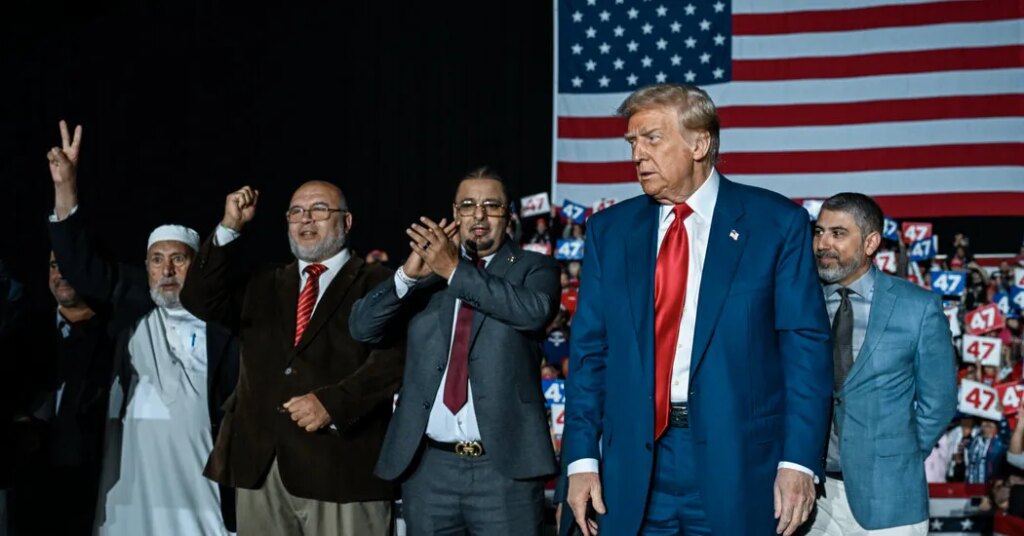
This month alone, President Trump has called Dr. Abdul El-Sayed, the Democratic nominee for Senate in Michigan, a “vicious, violent jihadist.” He has repeatedly vilified Somali Americans in Minnesota, prompting calls for security measures at mosques. He gave a lift on Air Force One to a far-right activist who has called herself a proud Islamophobe.
Mr. Trump’s words and actions have rattled communities around the country, including Somali American neighborhoods in Minnesota and predominantly Arab American areas in Michigan. And they have come as anti-Muslim rhetoric has become increasingly normalized in the ranks of the Republican Party ahead of the midterm elections.
For some Muslim voters who backed Mr. Trump in 2024, it all feels like a betrayal.
Two years ago, as a presidential candidate, Mr. Trump made considerable efforts to win votes in some Muslim communities. Now they say that Mr. Trump pledged his support only when it was politically convenient, then alienated and scapegoated them once he won the election.
“My whole community is scared,” said Hassan Nehme, who served as a vice chair to the Michigan Republican Party in 2024 and helped the Trump campaign reach Muslim and Arab American communities like Dearborn. “It’s post-911 in Dearborn. It’s that feeling, like we’re under attack.”
He added: “And this is the same guy we went out and fought tooth and nail for.”
Olivia Wales, a White House spokeswoman, said in a statement that Mr. Trump was “calling out the radical extremists stoking division, defrauding their communities and perpetuating violence.”
She added: “The president will continue to unapologetically fight for American greatness and call out the extremists who want only to divide and destroy.”
Mr. Trump’s allies often respond to criticism of his remarks on Muslims by pointing to the administration’s work securing a cease-fire between Israel and Hamas in Gaza. (The shaky agreement has not stopped Israel from entrenching further into Palestinian territory.)
But the administration has at times appeared to celebrate the reduction in illegal and legal immigration, if it is from a Muslim-majority country.
An official White House social media account has boasted about such declines in “legal immigration from Majority-Muslim Nations.”
But the concerns among Muslims could resonate in next month’s elections, even though Mr. Trump is not on the ballot.
A Washington Post-Schar School poll released this week found that 58 percent of registered Arab American voters support Democrats for Congress this year, compared to 34 percent who prefer Republicans, a shift for a group that split its votes between Mr. Trump and former Vice President Kamala Harris in 2024.
About half of Arab Americans are Muslim, according to the poll.
‘Instilling Fear’
Mr. Trump has disparaged Muslims since his first run for president.
He once claimed that Islam “hates us.” During his first run for the White House, he proposed creating a national registry of Muslims. And he carried out a ban on Muslim-majority countries in his first term.
During his 2024 campaign, however, Mr. Trump made a play for these voters, particularly in Michigan, a key battleground with many Arab American and Muslim voters. Mr. Trump sought voters who were unhappy with Democrats over the war in Gaza and other issues, and their support helped lift him to a second term.
After his victory, Mr. Trump promised at one point to stand with Muslim communities. “The Muslim community was there for us in November, and while I’m president, I’m going to be there for you,” Mr. Trump said. “I think you know that.”
The sentiment did not last.
Earlier this month on Air Force One, Mr. Trump hosted Laura Loomer, the right-wing activist who describes Islam as a “cancer” and has posted on social media under the hashtag “#proudislamophobe.”
After giving her a lift to a campaign event, Mr. Trump praised Ms. Loomer as a “great Republican strategist.” She later said on social media that she warned Mr. Trump about the “Islamic takeover infiltrating our government,” and urged him to target Islam more often when speaking about Democrats. In an interview, Ms. Loomer said Mr. Trump appeared “receptive,” adding that she also told Mr. Trump his so-called Muslim ban in his first administration remained popular with his base.
David Campbell, a Notre Dame professor who researches religion and politics, said Mr. Trump was again surfacing anti-Islam sentiment in order to stir up his base, push his supporters to vote and mitigate Democratic gains in November.
“It’s certainly instilling fear,” Mr. Campbell said. “You know, midterm elections are largely about turnout, so they’re clearly trying to turn out the base.”
He said the current climate was a departure for a party once led by President George W. Bush, who in the wake of the Sept. 11 attacks visited a mosque and proclaimed “Islam is peace,” an apparent attempt to quell Islamophobia.
But Mr. Trump’s strategy has also made Muslims in the United States feel like a target, including those who turned to Mr. Trump in 2024 after growing frustrated with the Biden administration on social issues and its foreign policy in the Middle East.
“Donald Trump, for all his flaws, can be a gifted communicator, and knows how to dial it up or dial it down when it’s advantageous to him,” said Fayrouz Saad, a former Biden administration official who helps lead an organization analyzing Muslim and Arab voter data. “And so he saw that opportunity in 2024, and took it.”
“He’s just dialing it up now,” she added.
Mr. Nehme, a Muslim, military veteran and Republican candidate for local office in Michigan, said he was one of many Dearborn residents in 2024 who trusted Mr. Trump.
But over a potluck at his mother-in-law’s home in Dearborn on a recent morning this month, he found himself at a loss for words when his cousin asked him what he thought about Mr. Trump calling Dr. El-Sayed “Mohamed.”
Earlier this week, Mr. Trump said he had called Dr. El-Sayed that because “I just felt like it,” not because he knew it was his middle name.
“Somebody said, ‘How did you do that?’ I said, ‘I’m the president. I can call him whatever the hell I want,’” Mr. Trump said. “And then they sent me his full name, and actually his middle name is Mohamed, you can believe it?”
“One good thing: If you call somebody from that part of the world Mohamed, you’re about 65 percent sure to get it right,” he added.
Mr. Nehme said the story made him question why he had helped the Trump campaign.
“What’s the point if my own party is going to play against us?” he said. “Since I got into the party, it’s constantly been: We’re trying to change the image of the Republican Party from this racist old rich white man image that it has, and I mean every time we’ve gotten there, it’s like they don’t want to.”
Bishara Bahbah, who led the Arab Americans for Trump coalition in 2024, said the president’s comments had cost him Arab and Muslim voters he had previously won over.
“We’ve been fooled. We’ve been taken for fools, and they got our votes,” Mr. Bahbah said. “It’s not just Michigan — it’s throughout the United States. I think the administration has managed to alienate the Arab and Muslim communities, and they will not vote Republican.”
Mr. Trump has been particularly harsh in his rhetoric with the Somali American community in Minneapolis, which is heavily Muslim. Seizing on a welfare fraud scandal that was concentrated among Minnesota’s Somali community, Mr. Trump has disparaged the Somali community as “garbage” who should “go back to where they came from.”
Residents there were particularly alarmed after Mr. Trump said that Minnesota was “being taken over by Somali immigrants,” and that the “people of Minnesota must fight back.” The post came after a spree of shootings that local authorities connected to Somali American gangs.
“The problem we’re facing right now is that every time the president says something, it absolutely emboldens the craziest people in our community,” said Jaylani Hussein, the head of the Minnesota chapter of the Council on American-Islamic Relations.
Local imams in the community gathered for a meeting after the social media rant and expressed concern over the safety of their mosques.
“These words are reckless,” Imam Abdulahi Farah said at a news conference earlier this month with other Muslim faith leaders in Minneapolis. “They are dangerous, and they have consequences.”
Mr. Farah is an imam at a mosque where a militia group leader who claimed to want to drive Muslims out of the United States set off a bomb in 2017.
“We know what it means when an entire community who comes to worship are made to feel unsafe,” Mr. Farah said. “Blaming an entire community is not accountability. Scapegoating is not a public safety strategy.”
The post Trump Asked Muslim Voters to Trust Him. Now Some Feel Used. appeared first on New York Times.