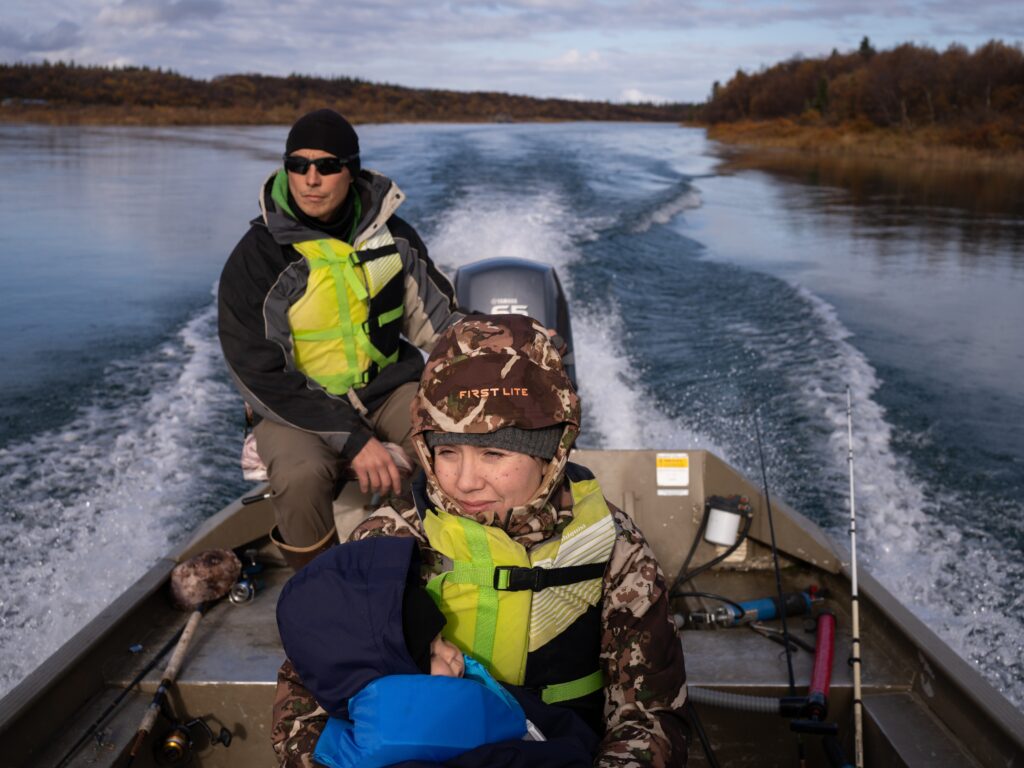
Living a traditional lifestyle inspired by centuries-old practices in Alaska requires a lot of modern fuel. Heating fuel to warm a remote village home through the bone-chilling winters. Gas to fly in everything that cannot be caught or harvested locally. Fuel for the boat to hunt the moose and the plane to reach the annual salmon harvest.
For Apay’uq Moore and her partner, Jon Salmon, living off meat and fish they catch themselves once felt like a way to economize. Now, with gas prices soaring because of the U.S. war with Iran, it feels barely doable.
“People have all these different ways of saving money. Ours is by trying to harvest our own food,” Moore said. “But this year, the cost of everything has definitely made it feel like we’re benefiting spiritually from our way of life, but financially, now it’s starting to cost us more.”
An independent artist and mother of four, Moore has spent her entire life, except for college, in Alaska Native villages disconnected from the road system. Her village of Igiugig, Alaska, is so small that her household of six represents nearly 10 percent of the population. She loves living in a place where she knows everyone intimately and never takes her key out of her car.
But high gas prices are making the practices she cherishes harder to afford. Gasoline prices in New Stuyahok, the nearest village tracked by the state, hit $10 a gallon this summer, and heating fuel recently reached $12.75 a gallon, up $2.60 in just six months.
Financial snapshot
Total household income: $155,000 (The couple’s incomes can vary. Moore makes about $70,000. Salmon works multiple jobs and earns about $85,000.)
Age: 42
Profession: Artist
Projected winter heating fuel costs: $1,000 per month
Moore’s family has cut back on familiar expenses, including streaming services that would have provided entertainment during the long, dark winter. But they are also making cuts that affect their traditions.
Salmon always used a boat to hunt for a moose, sometimes taking their teenage children along to teach them the custom. Last year, he spent about $120 on gas each time they took the boat out, adding up to $1,000 before he got a moose. This year, with higher fuel prices, he couldn’t justify spending even more. Though he missed taking his children and found hunting by ATV to be less pleasant, he skipped the boat and caught a moose near the village instead.
Part of Salmon’s job working for the village includes supervising the protected local caribou herd, which is supposed to be off-limits to hunters. This year, Salmon predicts some will shoot a caribou to avoid going hungry. “I’m foreseeing an increase in illegal harvesting,” he said.
With a life so rooted in hunting, Moore cares fiercely about gun rights, which has led her to favor Republican candidates in the past. Other times, she has supported Democrats, in part because of her distaste for President Donald Trump’s ethics. This year, she is firmly siding with Democrat Mary Peltola in Alaska’s Senate race, primarily because of the issue of affordability. The race is one of the most competitive in the country and considered key to deciding which political party will control the U.S. Senate.
Peltola is Alaska Native and spent much of her childhood in small villages. Her Republican opponent, Sen. Dan Sullivan, moved to Anchorage as an adult after growing up in the Cleveland suburbs and graduating from Harvard and Georgetown universities. Moore doesn’t trust him to understand how fuel costs shape her daily life.
“People who have not had any rural experience are not people I want speaking for me … when it’s cutting this deep into our ways of life,” Moore said.
Her village is far too remote for a grocery store. Instead, every other week, she places an order from an Anchorage supermarket on Instacart and has the groceries dropped off at an air-taxi hangar to be flown to her. Fuel costs have gone up so much that the freight now costs almost as much as the groceries.
“This year feels disheartening,” she said. She has been working long hours, including taking on contract illustration work, yet still finds herself dipping into her savings just to pay for the basics. “I did all this extra work so I would have a little bit of a cushion, and … I’m thinking, ‘Sweet, now we could go on a vacation this year.’ Instead, all our groceries are so much more expensive.”
Alaskan winters feel long and almost endlessly dark. One winter, Moore was able to take the kids away for a few days to Houston for a break from the darkness. She had dreamed of Palm Springs, California, this winter but knows she won’t have the money for it.
“We are walking into an almost unimaginably expensive winter for food and heat,” she said. She anticipates needing 100 gallons of heating fuel a month, which would cost more than $1,000 at today’s prices.
Each summer, the couple and their children join other Alaska Native families, putting out nets at night, pulling in the salmon every morning, then smoking the fish.
The trip typically saves the family money since they eat the salmon during the winter. But the round-trip flights to nearby Dillingham cost more than $3,000 this year. From there, they tacked on a second quick flight to Twin Hills to harvest pike and herring, which drove the cost up even higher. In total, Moore suspects they came out behind. She’s canceling smaller excursions now.
“We aren’t going on vacations. We’re not even getting out on road trips. … We didn’t do a family camping trip,” she said. She choked up, talking about the isolation, the end of the rural rambles that brought her together with her children, the fear of the winter ahead.
“It’s feeling like they’re sucking us out of our rural communities,” she said. “We’re not able to enjoy what we live here for.”
Affordability in America
Why a retired teacher has cut back on food, trips and electricity
How a nanny with medical debt is struggling to get ahead in Maine
Why a recent college grad wants Republicans to ‘step it up’ on affordability
The post In remote Alaska, a family making $155K struggles to uphold traditional lifestyle appeared first on Washington Post.