How self-obsessed — how quintessentially American — to believe that our political rhythms could dictate those of a country as large and idiosyncratic as Brazil.
For the first half of my career as a journalist and an analyst following Latin American politics, this was my message to U.S. audiences: Brazil, the world’s seventh-most-populous nation, with a landmass greater than the continental United States, governed by a Portuguese-descended monarchy in the 19th century, a military dictatorship for part of the 20th and a vibrant if often messy democracy in the 21st, would always dance to its own drummer.
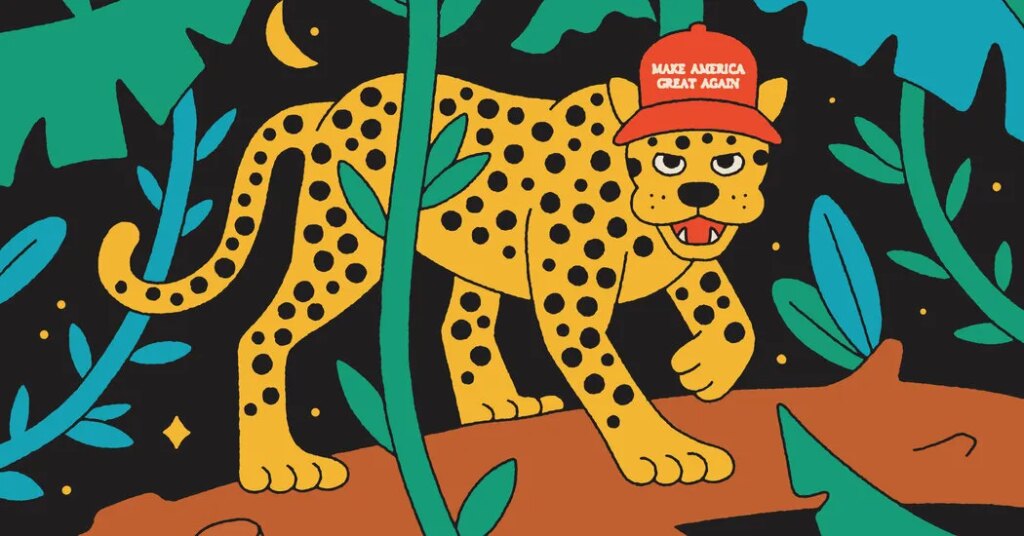
But then, starting around a decade ago, the Brazilian echoes of American politics became too eerie to deny, like watching a Brazilian spinoff of a U.S. television series with a two-year production lag and a few homegrown plot twists. The 2016 election of Donald Trump was followed by the 2018 arrival of the “Trump of the Tropics,” Jair Bolsonaro, so in sync with his northern counterpart in style and worldview that he once livestreamed himself for an hour quietly watching Mr. Trump give a news conference on TV.
Like Mr. Trump in 2020, Mr. Bolsonaro narrowly lost his re-election bid in 2022, after voters tired of his clashes with democratic institutions and mismanagement of the Covid-19 pandemic. He then did everything in his power to try to overturn the result, including attempting to organize a military coup. When that effort failed, and hundreds of the defeated president’s supporters invaded government buildings in Brasília on Jan. 8, 2023, shattering windows and vandalizing offices, the comparisons practically wrote themselves: “Brazil’s Jan. 6 arrived two days late,” Olívia Bulla, a veteran Brazilian journalist, drolly noted at the time.
Today, history may be on the verge of repeating itself, more or less, once again. While Jair Bolsonaro remains under house arrest for his attempted coup, his son Flávio, a senator, seeks to return the family to the Palácio do Planalto. Even as the Bolsonaro family was written off by most of the Brazilian establishment as politically dead just a few months ago, Flávio unexpectedly placed first in the initial round of voting on Oct. 4, setting up a runoff election on Sunday.
The only figure standing in the Bolsonaros’ way is the incumbent, Luiz Inácio Lula da Silva, an 80-year-old leftist who has posted videos of himself boxing and lifting weights in an explicit attempt to stave off comparisons to Joe Biden, but has nonetheless been tarred as the face of an aging, out-of-touch establishment. Mr. Lula is pursuing a fourth nonconsecutive term as president in a campaign season marked by public anger over inflation, crime and “affordability” (Brazilian newspapers have regularly used the English word). Heading into the second vote, Mr. Bolsonaro still leads Mr. Lula by a small margin in recent polls.
The question of exactly why two nations separated by thousands of miles, with such different political histories and socioeconomic structures, have of late walked such similar paths has set off vigorous debate, and no shortage of memes, inside Brazil. Some have warned against overstating the similarities, pointing to distinctly Brazilian elements including this election’s arguably existential stakes for the Amazon rainforest, or Mr. Lula’s biography as a leader who rose from poverty to oversee an economic boom that lifted millions into the middle class during his first two terms from 2003 through 2010.
These things are all true. But it is also true that both direct U.S. influence and several shared political and economic trends have combined to nudge not only Brazil, but other countries in Latin America, in a decidedly Bolso-Trumpian direction in recent years.
In Mr. Trump’s first term, both the president and others in his circle of advisers, particularly Steve Bannon, took an interest in the Bolsonaros even before they were elected. Eager to aid ideological fellow travelers at a time when the list didn’t extend far beyond Viktor Orban, then the prime minister of Hungary, Mr. Bannon helped ease the family’s entrance into global right-wing circles and conservative U.S. forums like the Conservative Political Action Conference. An adviser to the Bolsonaros once told me they “took enthusiastic notes” from their new friends in the White House about incorporating U.S. culture war themes like gender ideology, as well as attacks on “fake news” and the press, that had not been major features of mainstream politics since democracy returned in the 1980s.
U.S. interference in Brazilian politics has since become more heavy-handed. In 2025, Mr. Trump imposed a 50 percent tariff on Brazilian exports, hoping to persuade Brazil’s courts to drop their case against Jair Bolsonaro — “a WITCH HUNT,” the U.S. president wrote at the time, “something I know much about!” When that effort backfired, and polls showed a nationalist backlash lifting Mr. Lula’s approval ratings, Mr. Trump reversed course; he has mostly stayed quiet about the Brazilian election in recent months.
Nevertheless, Mr. Lula and his aides have accused the United States of continued interference, citing, for instance, a White House statement from September claiming that Mr. Lula’s government has failed to confront organized crime groups.
Still, the Bolsonaros’ Trumpian tactics would never have worked had it not been for deeper changes in Brazilian society. The first has been the extraordinary growth of the evangelical Christian community, which expanded to around 27 percent of Brazilians in 2022 from about 7 percent of Brazilians in the 1980s, providing what polls suggest is the most loyal base for the Bolsonaros’ rallying cry of “God, country and family.”
The second shift was, ironically, an indirect consequence of the prosperity of Mr. Lula’s first two terms: The annual number of Brazilians traveling to the United States has almost tripled since 2000, fueling an enthusiasm for American culture that has extended well beyond politics. Many of Brazil’s most popular musicians now perform in cowboy hats and bluejeans, while the National Football League began hosting annual games in Brazil, one of its fastest-growing global markets, in 2024.
The most important change: Fear of crime has overtaken pocketbook issues like unemployment and hunger as voters’ top concern. This is true not only in Brazil but throughout much of Latin America, and is a major reason that right-of-center, generally Trump-aligned candidates have been cleaning up in the region’s recent democratic elections. In the final weeks of his campaign, Flávio Bolsonaro has said the mega-prisons and other tactics of another key Trump ally in the region, President Nayib Bukele of El Salvador, are “not enough” — vowing to build room for another half a million prisoners in a country that already has the world’s highest prison population after China and the United States.
Brazil is hardly the only country whose politics have evolved in ways that might have been unrecognizable a generation ago. In the United States, rising inequality over the past 40 years means that roughly 70 percent of wealth is now concentrated among just 10 percent of the population, according to the World Inequality Lab — a ratio almost identical to that of Brazil.
Much has been made of the “americanização” of Brazilian politics. But Latin America, home to the world’s biggest gap between rich and poor, has long been fertile ground for so-called caudillos, leaders who rise to power by blaming feckless, corrupt elites for their nation’s troubles and promising easy solutions. Which raises the question: Who, precisely, is resembling whom?
Brian Winter is the editor in chief of Americas Quarterly.
The Times is committed to publishing a diversity of letters to the editor. We’d like to hear what you think about this or any of our articles. Here are some tips. And here’s our email: [email protected].
Follow the New York Times Opinion section on Facebook, Instagram, TikTok, Bluesky, WhatsApp and Threads.
The post Attempted Coups. Aging Left-Wing Incumbents. Which Country Are We Talking About? appeared first on New York Times.