Days after Albertans voted on their future within Canada, signs promoting both sides of the question are still lingering on the lawns of many homes — some of them mixed in with Halloween decorations. They aren’t the only things still hanging around from Premier Danielle Smith’s referendum.
The referendum result was decisive. As of Friday, the still-unofficial results showed that 75 percent of Albertans chose to remain Canadian. Just one-quarter of voters were seeking a second, binding referendum to secede from Canada.
[Read: Voters in Oil-Rich Alberta Reject Leaving Canada]
Predictably, many separatist leaders vowed to fight on, with some claiming they had fully expected defeat this time around.
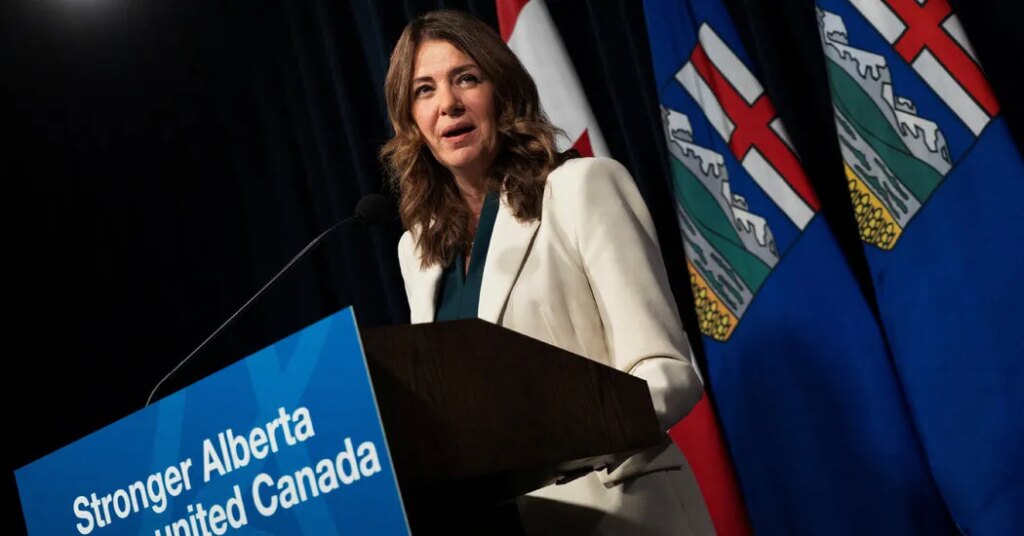
Much less clear, however, is the future of Ms. Smith, the premier, and her United Conservative Party.
As I wrote before the vote, Ms. Smith managed to alienate people on both sides of the Canada question.
[Read: Alberta Voting on Its Future in Canada, With Its Leader Caught in the Middle]
Federalists were put off when she initially came to the aid of the separatists. After a court struck down their attempt to hold a direct referendum on independence, Ms. Smith added her question on staying or holding a second, binding vote as the 10th one on her previously announced referendum on constitutional powers and immigration.
Then Ms. Smith turned around and angered separatists, a group largely responsible for carrying her to office, by saying that she herself would vote to remain a part of Canada.
It didn’t end there. To the consternation of many on the side to stay, Ms. Smith didn’t require United Conservative members of the legislature to follow her lead and vote for a united Canada. While she was not invisible during the period leading up to the vote, many people viewed her campaigning for Canada as tepid.
“The premier hasn’t done, at all, much,” Thomas Lukaszuk, a former Progressive Conservative legislator and deputy premier who led the Forever Canadian group, told me days before the vote. “I had the pleasure, or honor, of serving with five premiers in the Alberta provincial government. And I can tell you, not one of those previous premiers would have ever asked Question 10.”
In the end, it was Prime Minister Mark Carney who emerged, among current politicians, as the strongest voice for staying in Canada.
[Read: As Alberta Rejects Separatism, Carney Gets Much of the Credit]
[Read In Opinion: Canada Said No, Again]
Similarly before the vote, Mitch Sylvestre, one of the most prominent separatist leaders, was equally unhappy with Ms. Smith.
“She’s playing a very interesting game that I think has very dire consequences for her,” he told me.
So where does that leave Ms. Smith?
Two days after the vote, she laid down the law around supporting Canada for her caucus and party members.
“For those few who cannot reconcile this fact and remain intent on dividing and turning our party into a vehicle for the independence movement, I would respectfully invite them to join a different party,” Ms. Smith said.
Again, the result angered the separatists, while many federalists complained that the gesture came too late.
At the end of November, the United Conservative Party will meet in the convention hall in Calgary where Mr. Carney gave a rousing and well-received speech to remain in Canada last week. Lisa Young, a political scientist at the University of Calgary, told me that it is now anybody’s guess what will happen to Ms. Smith and the party that was the result of a merger, in 2017, between the Progressive Conservatives and the Wildrose Party, which Ms. Smith once led.
“It’s incredibly puzzling,” Professor Young told me. “I keep trying to think about what she thought was going to happen the day after the vote. You’ve got to think that she just didn’t see this coming — that people would be angry at her for the referendum in the broader electorate.”
By gradually gaining control of local United Conservative riding or constituency associations, the separatists ousted Jason Kenney, the former federal Conservative cabinet minister, as the United Conservative Party leader and premier, and brought in Ms. Smith.
Professor Young said that it’s likely that the cabinet will back Ms. Smith.
“They want to keep their jobs,” Professor Young said. “There’s nobody plausible in the conservative movement who’s a better political communicator than she is.”
Also, Professor Young added, many U.C.P. members are aware that division and turmoil within their party can only benefit the New Democrats, who are currently led by Naheed Nenshi, the popular former mayor of Calgary.
“I would guess that they’re going to, sort of, reluctantly line up behind her, but that’s just a guess,” she said.
Further undermining Ms. Smith are the results of her nine other questions in the referendum.
Five of them passed by only small margins. Four of them were rejected.
An effective challenge next month to Ms. Smith from conservatives who were put off by the referendum and her other nine questions, Professor Young said, seems a remote possibility. That group has no obvious leader and many of them have given up on the party, she said.
“The people who have shown up for the last couple of years are essentially the separatists and others who are part of that right populist movement that got her in,” Professor Young said. “Everyone else has walked away.”
The monthslong referendum campaign revealed that the separatist movement is divided into several camps with differing concepts about an independent Alberta. That makes it difficult to predict what independence supporters who aren’t elected politicians will do in November.
“They just really love the protest life,” Professor Young said. “So they’re having the time of their lives. Why wouldn’t they keep it going?”
Trans Canada
-
A fierce burst of wind inflamed a grass fire and raced about a kilometer in less than a minute toward a group of soldiers training at Canadian Forces Base Wainwright in Alberta. Four of the people caught in the deadly onrush of flame died, and 39 were injured.
-
In the trade war, President Trump on Friday lifted some tariffs on Canadian products used by American farmers, ahead of the U.S. midterm elections. Earlier in the week, a group asked a court to strike down Mr. Trump’s steep tariffs, brought under a law from 1930, on Canadian products, arguing that the president had overstepped its provisions. And Pete Wells, who writes about food culture for The Times, reports that artisanal Canadian cheese was about to become a big deal in the United States — then the tariffs hit.
-
In Opinion, Chrystia Freeland, the former deputy prime minister, appeared on “The Ezra Klein show.”
-
Les Éditions du Boréal, the Quebec publisher, said it would not reprint “It Was Either That or Die,” or any other books by Thélyson Orélien, after finding evidence of A.I. use in early versions of the manuscript.
-
A man from Ontario was convicted in the birdnapping of Peachy, a flamingo at a Las Vegas casino hotel. He estimated that he had consumed 30 to 40 beers before committing the crime.
-
After a string of professional and romantic setbacks, Bayleigh Regina Pelham, who is originally from Halifax, found love with Stephanie Cassano of Toronto on a trip to Mexico.
Ian Austen reports on Canada for The Times. A Windsor, Ontario, native now based in Ottawa, he has reported on the country for two decades. He can be reached at [email protected].
How are we doing? We’re eager to have your thoughts about this newsletter and events in Canada in general. Please send them to [email protected].
Like this email? Forward it to your friends, and let them know they can sign up here.
The post Alberta’s Referendum Was Clear, Unlike Danielle Smith’s Future appeared first on New York Times.