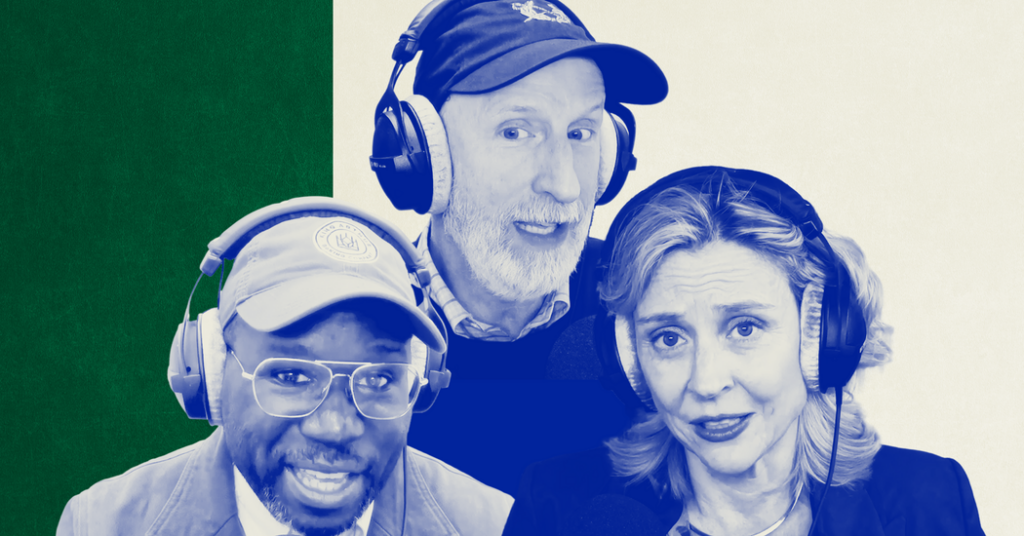
We’re less than two weeks out from Election Day. In their last conversation before Americans head to the midterm polls, the national politics writer Michelle Cottle joins the columnists Jamelle Bouie and David French to take stock. While Jamelle makes the case for cautious optimism about a possible blue wave, David worries about what could happen if Trump doesn’t like the results.
Below is a transcript of an episode of “The Opinions.” We recommend listening to it in its original form for the full effect. You can do so using the player above or on the NYTimes app, Apple, Spotify, Amazon Music, YouTube, iHeartRadio or wherever you get your podcasts.
The transcript has been lightly edited for length and clarity.
Michelle Cottle: I’m Michelle Cottle. I cover national politics for New York Times Opinion, and I am here this week with my brilliant colleagues, columnists Jamelle Bouie and David French. Gentlemen, how goes it?
Jamelle Bouie: It goes well.
David French: Doing well, Michelle.
Cottle: All right. We are less than two weeks out from Election Day. This is our last episode before the will of the voters becomes clear, and I have so many pressing questions for you, most of which fall into the category of: What in God’s green earth is going to happen?
So I know, I know, we can’t really know, but from everything we’re seeing and hearing, how do we think this is going to play out? And maybe this is just my PTSD from 2020 talking, but how might a certain president try to undermine the results if things don’t go his way? So let’s dive in.
There has been a lot of optimism in the air for the Democrats in recent weeks. Our latest newsroom poll has Democrats leading nationally by 11 percentage points. Are we expecting a blue puddle, a blue wave or, maybe more accurately, what has been termed a “red undertow”? David, you go first.
French: You know, it’s really interesting, Michelle. Everything empirical is saying that this could be a blue wave, this could be a blue tsunami. You’re starting to see things, like polling in South Carolina, in Mississippi, within the margin of error, and it’s becoming so blue-ish in all of the data ——
Cottle: Blue-ish.
French: That a lot of smart people I know are like: Wait a minute, can we trust this data? Because it feels like people have been through this before. They have been through optimistic polling waves. We’ve also been through years and years and years of very closely divided politics, where it doesn’t feel like something like Democrats +11 in a popular vote, if you’re going to like ——
Cottle: That’s not a real thing.
French: Take the whole House and put it at, would it actually end up Democrats +11? Highly doubt that. Highly doubt it. But at the same time, there’s nothing really empirical to point at to diminish the optimism.
I keep going back, though, to the sense I felt when I was in Texas recently. When I was talking to Democrats, I would call it “cautious, guarded, daring to dream, but not really dreaming,” if that makes sense. Which I think is actually a pretty healthy attitude to take.
Cottle: Jamelle?
Bouie: Yeah, I would advise people, if they’re thinking about this, to just stress-test it against previous elections, when you’re thinking about, OK, how, how might this be off? And I think that’s useful, because it forces you not just to look at the polls, but at the larger national conditions. And that’s where I think it’s worth just taking seriously what the polls are saying.
So if you look back at 2018, Donald Trump was not this unpopular. He just wasn’t. He was in, I believe, the low 40s, right? So at the moment, he is about 10 points on average less popular than he was in 2018. And I really think it’s important to stress that he’s never been this unpopular before. Economic conditions under Trump have actually never been this bad before, other than, again, the early days of the pandemic.
And so in a lot of ways, we’re in a situation that is actually quite distinct from previous situations when Trump has been on the ballot — and the results we’re getting in terms of polling are consistent with that. It doesn’t mean that things might be better for Republicans than the polling suggests, but I do think that it’s a good reason to think this is capturing something. The exact contours of what that something is, we won’t know until all the ballots are counted. But as far as where the national mood is and what appears to be competitive, that all seems quite right to me.
Cottle: OK. Well, this makes me feel a little better, because I tend to be a pessimist with a lot of these things, and I tend to look at, say, Maine, where I’m not so sure Susan Collins isn’t on track to pull this out. So if I look at Texas, where, yep, the polling looks good for James Talarico, and I don’t think Beto was ever ahead in the polls.
French: No.
Bouie: No.
French: Never like that.
Cottle: People always compare it to that. At the same time, I’ve been reporting and waiting for Texas to turn blue. I remember doing a story about how the Black and brown coalition was going to turn it blue, I think, like a quarter century ago.
I tend to pick the states and areas that make me the most nervous and obsess a lot about those. In part because one of the just broader things that I’m worried about is that Democrats — not even the electeds, but like a lot of the voters or the activists or the kind of watchers — I worry are playing the expectations game badly, that they’re so excited, that they want to win in Texas.
They want to win in some of these red states — in Alaska, that sort of thing; Iowa — that they’ve got expectations so high that, unless they just completely wipe out the Republicans in the House and claim the Senate, I still worry that they’re going to just be declared underperformers, which is going to give Trump an opportunity to stand up and say, “See? We’re fine, and I can just continue running amok,” and all of that. So aside from the people that you talked to in Texas, David — just like broadly — is anybody else worried about the expectation game being played wrong?
French: Absolutely, Michelle. Let’s put this in perspective for a second. We’ve long been thinking that the Democrats could hold in Georgia. We’ve thought that Ohio could possibly be in play. Ohio is a swing-ish state. Even Iowa, swing-ish somewhat recently. Maine, a relatively blue state. So these are states that nobody would just fall out of their chair in shock about. But now we’re talking about Kansas. We’re talking about Nebraska. We’re talking about South Carolina, Mississippi, Texas. And so I do think, if the Republicans hold those states — sort of ending up by going, “Ha, ha, we narrowly held Kansas” — it’s not the flex that you think that it is. But I do think that expectations are building to such a point that there would be at least some degree of disappointment and upset if Democrats don’t win Kansas. I think there might be some real disappointment, again, if Democrats don’t win in Texas.
To Jamelle’s point — I think Jamelle makes a ton of valid points — about the fundamentals of this race, they are enough to make anyone who’s wanting to see the MAGA era end feel more optimistic. I think those fundamentals are there. It’s just, for me, it’s becoming sort of so overwhelming as state after state and race after race goes from likely R to lean R to tossup, that you start to wonder, could this be something realigning? Could this be something truly resounding that we haven’t seen for some time in American politics? And that’s when all of the skepticism lights start to come on. And we’re just going to have to wait and see.
Cottle: Jamelle?
Bouie: I will be surprised if Adam Hamilton wins in Kansas. That’s kind of a crazy outcome. If Darline Graham only wins by one point, that’s a crazy outcome. But having said that, I guess I’m not as shocked by this development as David might be, in part because of the point I made earlier: The actual fundamentals, the national conditions right now, are different. The closely divided elections of the past since 2016 have all operated under a kind of similar set of circumstances: a relatively strong economy; relatively evenly matched, in terms of popular sentiment, political parties; coalitions that aren’t that fluid because there aren’t any new issues changing the nature of the political debates. And all that stuff has changed, right?
Again, the president’s very unpopular, the economy is sluggish, inflation is still relatively high, still with us. Fuel prices are high. There are these new issues on the table — A.I., data centers — that are scrambling partisan coalitions somewhat. There is the fact that Trump simply isn’t on the ballot. And if you think of Trump as an issue and not just a person — the dividing issue of the past 10 years or so of American politics — him not being on the ballot, and thus voters aren’t being forced to choose about their view of Trump’s role in American politics, that itself maybe opens things up a bit. “Oh, now I’m not voting about Trump; I’m voting about diesel prices. Now I’m voting about the fact that I don’t like data centers.”
So there are all these things happening below the surface of American politics that the divided nature of American politics over the last 10 years may have somewhat obscured, and now, as Trump is leaving the scene, they’re kind of bubbling up again. Again, that’s not to say that I think it’s going to be a big Democratic sweep, but that when you look at a place like Mississippi, which apparently is competitive, the high levels of racial polarization in that state actually mean that Democrats have a pretty high floor, right?
Cottle: Sure.
Bouie: They’re usually winning 45, 46 percent. Is it really that crazy to think that, in an unusually bad time for the incumbent party, some percentage of white Mississippians may decide either to sit it out or switch votes? And in that environment, is it really that crazy that the state becomes competitive? I don’t think so. For so much stuff, it’s like tiny changes on the margins can produce these big effects, and I kind of think that’s what we’re seeing.
Cottle: Well, I do think you touched on something interesting there, which is that it’s not that Republicans need to vote for Democrats; they just need to stay home. You hear these discussions about, “Oh, well, there’s no way with the Democratic brand that somebody who’s been voting Republican forever is going to come out and pull that lever.” But this is a midterm election. Midterm elections are always about who you can get to show up at the polls. I do think that from what we saw, certainly, during the primaries, the enthusiasm gap in Democrats’ favor is enormous, which could always make the difference in these sorts of places.
French: And this is a point in Jamelle’s favor on why you should be looking at some of these polls and saying, “OK, they’re measuring something real.” I can’t remember the last time in an election where you could trace voter anger at specific issues to very specific actions by the administration. Normally, when you’re talking about things like inflation rates or job creation, it’s kind of debatable what’s causing all of the inflation or how are these jobs being created, how much is the government versus the private sector, etc. But here you’ve got: Why are gas prices high? The Iran war. Why is background inflation creeping up again? Why are wages falling behind? Tariffs.
You can look at very specific things that this administration has done, which is one of the reasons I think that that term you used — the red undertow — is very appropriate. You can go issue by issue by issue and say, “On what planet does a smart political party do this? On what planet do you do this if you’re actually trying to win elections?” And rarely have I seen a party squander a victory more thoroughly and more efficiently — and more comprehensively — than what the Republican Party has done to the 2024 victory. It is astounding what the Republican Party and what Trump has done after this vibe shift in 2024. And so that’s to Jamelle’s point: Voters can look at very specific things that Trump and the Trump administration have done that have made their lives worse, and I think it makes it easier to vote against them.
Cottle: Yeah, I think you make an important point there, when you’re like, what party would do this if they want to be successful? It’s not a party. It is one man who has never cared about his political party. Donald Trump has no interest in the success of the broader Republican Party. He is only interested in how people talk about him or what he wants to do. And so there has been, obviously, plenty of frustration among Republican lawmakers about some of these issues. Now, if they were really frustrated about it, they should have stood up and done something before now. But, here we are.
So we’ve laid out basic expectations. Let’s turn now to the kind of dark, weird possibility of what happens if all of this comes to pass — blue tsunami, blue wave, blue whatever — and a certain president doesn’t like the outcome. Does he try to meddle with it, to overturn it? I mean, it wouldn’t be the first time. Earlier this week, the Department of Justice charged 28 people with violating federal voting laws. And after claiming that there are likely 20,000 noncitizens registered to vote in California, I mean, are you guys worried about any of this, and the efforts that seem to be kind of percolating along?
Bouie: So I’m of two minds: The first is that all of this is obviously very bad, right? It seems to be the administration doing what it typically does: abusing its power, harassing innocent people, that sort of thing. The claim that there have been 20,000 noncitizens registered — you know, California disputes that, and every time D.H.S. or the administration has made this kind of assertion, it’s promptly fallen apart, so there’s no reason to believe that it’s true. So all of that is very worrisome, right? I think one should have every expectation that the administration is going to say that the elections were tainted by fraud, etc., etc., etc.
My question always is: OK, so what, practically speaking, does that matter? Because practically speaking, it’s not like the White House can’t overturn the election. When I say that, people are going to hear something like, “Well, that’s illegal. He can’t do it.” No, I mean that in the very literal sense. What specific person talks to what specific person to invalidate 435 congressional elections, to invalidate 30 Senate elections, right? That’s not a thing.
Cottle: It’s just not a thing.
Bouie: It’s just not a thing! And in the event that there is a big Democratic win, that disincentivizes regular Republicans from going along with this stuff, because at a certain point, it’s like, well, what’s the point? What’s the point in causing all this grief if we know we’ve just got our butts handed to us? So I see this stuff very much as a desperate administration lashing out in whatever way it can to try to intimidate people, right? To try to convince people not to turn up, not to vote, to create enough fear and uncertainty to make people think that something truly catastrophic might happen.
But when you think about it rationally, they don’t have much they can do in terms of subverting the outcome. And what they can do is not something they can do without opposition, right? Localities will, states will, the Democratic Party will, in terms of being able to file litigation. There’s all this room for pushback and relatively little room for action from the administration. So for me, it’s these two things at once. It’s a problem and it’s bad, but it’s also not, like, apocalyptic.
Cottle: David?
French: I’m a little darker than Jamelle, not on the front end. I draw a distinction between the voting and counting and certifying. I think it’s just so hard. It is really, truly so hard to mess with the actual voting.
Now, where I’m more concerned is that some of these states, if you win — if the Democrats win Ohio by seven or eight, or Jon Ossoff wins Georgia by eight or nine — I’m not worried about that. But what about Talarico up 0.6 percent on Ken Paxton in Texas? That’s when I’m saying all bets are off at that point. Or you have Hamilton 1 percent or less up in Kansas. And in those circumstances, you’ve got the very red-state election officials. And if there is a contest — the contest in the House, for example — as to who sits in the House is settled by the House. And this is something under procedures that are really pretty cursory and not really fully defined very well.
And then at that point, yeah, Jamelle’s right: There’s lots of opportunities to contest this and to fight this. But as we learned with Jan. 6, and Trump in 2020 and 2021, they don’t even need a credible legal argument. They can get people storming the Capitol over stupidity, like, just lunacy. That’s the thing: The 2020 election conspiracy theories weren’t just wrong; they were stupid and wrong. They were incandescently stupid and wrong, and he got people storming the Capitol in that circumstance. And so that’s where I’m a little bit more worried — the back-end certification challenge in maybe some of these very red states that are suddenly competitive.
Cottle: Yeah, I tend to be more nervous about the structure, and I tend to be specifically nervous about the very low-down officials, like precinct-level type stuff. I just remember, after the Jan. 6 hoo-ha, there was this shift in the Trump world where they were basically readying the playing field to take over. Steve Bannon did this call-out, the precinct strategy, where he called for MAGA people to go in and get elected, or get appointed or volunteer, to take over all these low-level offices, so if there was a question next time, it would be Trump loyalists who would be making the calls about: Did this look like fraud? Should we have this recount? Should we do this, that, or the other?
And then on top of that, of course, you have Trump doing what he always does, which is just to sow distrust and undermine the public’s confidence that any of this works. So that if something gets thrown to this board or that recount, people are kind of primed to think, “Oh, well, there must be something wrong.”
So I have to say, that does make me nervous. On the other hand, I do think that the difference is Trump’s not on the ballot. And on some level, if things don’t go his way, maybe he just wants to throw up his hands and say, “See, you guys are total losers when I’m not there. This just proves that I am the only thing that matters, and I’m just going to go forward for the next two years and fight it out with Democrats, and enjoy my status as the undisputed only Republican that matters.” So his lack of give-a-crap-ness, on some level, makes me feel a little better, I guess.
Bouie: I would say as well that I think it’s just important to think of all this stuff as part of a larger dynamic system, right? So Trump claiming fraud is significant, certainly, but it also has to be weighed against the fact that Trump is very unpopular. So he’ll claim fraud, and what percentage of people will hear that and be like, “Yeah, well, of course he’s going to say that,” and they just move on, right?
The extent to which public sentiment is just not on his side — the extent to which, if it’s a big election victory for Democrats, there’ll be tangible evidence of that — really does, I think, diminish the actual capacity of Trump and his allies to do shenanigans. They may still have the mechanical ability to do it, but you also need some sense that this sentiment is going to be on your side. And an election where, let’s say, Republican turnout collapses — which is very possible — would suggest that it isn’t. So they can do stuff, but I think the response is going to be “OK, whatever,” and you move on.
French: Fox has about 787 million reasons to not go along with stolen election theories this time around. And we’ve actually seen this since 2020. You’ve actually seen, in certain circumstances, when someone goes on Fox and spouts some crazy election conspiracy now, you will have a host come on and say, “There was no evidence. All courts ruled —” etc., etc. And so you are seeing some, for lack of a better term, quality control, editorial standards locking in here a bit. So I do think that’s an absolutely better environment than in 2020 and 2021, and that does give me some optimism. But mark my words ——
Cottle: Mark your words.
French: If it’s Talarico by 0.5 percent, watch what’ll happen in Texas, in conspiracy land.
Cottle: Are you worried about the certification process, Jamelle? I mean, not the voting, but the after — the process.
Bouie: Not particularly. In part because Republicans will be on these ballots, too, right? They’re going to want their offices, too, and the secretary of state, state boards of election, which are responsible for certification, are going to want to certify those people as well. If it were the case that these were the only elections where the competitive Democratic Senate wins, then maybe. But the fact that — in terms of do you get your office, do you get your staff, do you get your salary — everyone’s kind of bound up together. I think that leads me not to worry, not to worry as much.
Cottle: What you’re telling me is that you’re feeling good.
Bouie: What I’m saying is that I think that there is a tendency to treat the desire and will of the president as equivalent to ability and capacity. And so they say, “We want to do these things,” and they make these threats, and I think that there’s a tendency — because of all the crazy stuff we’ve experienced over the last 10 years — to say, “Well, if they say they really want to do it, then it must be a thing that they can do.” And my view has always been: Is it, though? They can both practically — and thinking politically — thinking about the interplay of forces and institutions and people — they may try, but that doesn’t mean they’re going to succeed.
It doesn’t mean people should be complacent, but I do think it means that one should try to, um … I’m going to, I’m going to do a me thing. So in his memoirs, Ulysses S. Grant tells this really interesting story that during the Mexican War, he is out with a writing partner and they hear wolves. And Grant’s like: We’re surrounded by wolves, what are we going to do about this? And his writing partner’s like: Let’s just go check out and see what this is. And they go find the wolves, and there’s only two wolves. And Grant says: There’s always more of them before you count them.
That’s where we are.
Cottle: Nice. OK.
Bouie: There’s always more of them before you count them. Being able to have a clear view of what the landscape looks like I don’t think should, again, make you complacent, but should give you a better sense of what the actual possibilities are here, and how we can deal with those.
French: I hate to contradict one of my childhood heroes, Yoda, who famously said, “Do or do not. There is no try.” There is a try, and the try can be really dangerous and destructive, even when the try fails. Like Jan. 6, for example. That was a very damaging thing to Americans, the American body politic, even though it failed. And I’m with Jamelle. Can they do it? I’m skeptical. Will they try it? If the conditions are at all where there’s any shouting distance, any kind of possibility at all, I think they would try it. And then you’re in the realm of how destructive does the effort get? And that’s what I get worried about.
Cottle: We have been talking about polls and the radioactivity of Trump rubbing off on the Republican Party. It’s not like Americans are really happy with either party. There’s a lot of just general disgust and frustration. That said, as we wrap up this very weird midterm conversation, I want to go positive. Tell me something that you think each team has done well. I mean, obviously, operating within the circumstances that they’ve been given. So give me some high points for each team.
Bouie: I mean, I think Democrats have done an actually exceptional job at candidate recruitment this cycle. Talarico; Hamilton in Kansas; getting Sherrod Brown to jump back into it in Ohio. I mean, when you start looking at the people who are running in these races, Roy Cooper in North Carolina, you’re looking at a set of just strong candidates that match the states, match the circumstances and aren’t really making major mistakes, right? There aren’t a ton of missteps. And it’s a real contrast with, I think, how Republican candidate recruitment has gone, especially in the Senate races.
In fairness to Republicans, when the cycle began, there was no expectation that these races would be all that competitive. So sure, you can let a below-replacement-value person get the nomination because you’re like, “Yeah, well, we’re going to win anyway.” So there’s a certain sense of Republicans not quite understandably realizing where the puck was going. But I think Democrats basically recruited the strongest possible candidates they could, and that, as much as anything, is contributing to their good fortune here.
Cottle: And do you have anything from the red team that you want to say something positively?
Bouie: I mean, no. I can’t ——
Cottle: Fair. Fair.
Bouie: But seriously, seriously, seriously — just in terms of how the Republicans have been trying to, or have been approaching this election cycle, it is genuinely difficult for me to think about or think of a good choice. I mean, they have one very strong candidate on the table: That’s Ashley Hinson in Iowa. Great recruit. But beyond that, the big, strategic mistake Republicans made was to just completely defer to Trump for 18 months, and now they can’t separate themselves from him.
Cottle: They’ve made their bed.
Bouie: Yeah, they’ve made their bed, so.
Cottle: David?
French: So I would say, if you’re going to look at a red bright spot, it would be Michele Tafoya in Minnesota. That is much more competitive. That race is a lot more competitive than Democrats expected it would be. I think that the Democrats will still pull it out, but if you’re going to look across the country and see where a Republican did overperform expectations, I’m betting Minnesota is going to be at the top of that list. Again, I think the odds are against her. Minnesota’s a blue state. It’s been closer and closer blue, but it’s still a blue state. All the fundamentals are with the Democrats, but I think that this is one race to keep an eye on from the Republican perspective.
On the Democratic side, I think watching the Democrats more intentionally compete for the faith-based vote is one of their better decisions, quite frankly. And this is something I wrote about at some length, about the “God gap,” where in 2024 it wasn’t just white evangelicals who came out in large numbers for Trump; 18 of 22 Protestant denominations moved more red, including some of the more liberal and most liberal denominations in America.
So you had a faith-based problem. The Democratic Party had a real problem with faith-based voters. Now, Black Protestants still went overwhelmingly, obviously, for Kamala Harris, but you saw even movement in those numbers in a more red direction.
And so I think by getting candidates out there like Hamilton, like Talarico and others — and Raphael Warnock, in many ways, showed that way and blazed that trail in Georgia — to have very faith-forward candidates, no, you’re not going to peel off too many of the conservative white evangelicals. They’re too closely wedded to the Republican Party, but those are not all the people of faith in this country. And so diving in and fighting over that turf and over that ground, I think, has been very, very smart by Democrats. Necessary.
Cottle: Yeah, and I think, beyond the specifics of the individual candidates, what the Democrats are trying to do is shuck some of their aura of being extremist and anti-traditional and anti-everything along those lines. So I think that this helps. I do think that this helps with that on a bigger picture.
I take the point that Republicans have done some truly wretched things in the recruiting department, most of which can be tied to the MAGA brands like Paxton or the situation in Georgia, where Ossoff is up against a very weak Mike Collins. But I also think that where they’ve got their swing state moderates like Susan Collins in Maine, the party — and by that you have to say Trump in particular, has let them separate themselves. I mean, I guess that’s damning with faint praise, but, you know, it is what it is.
And as far as the Democrats, this time they seemed to have gotten serious about trying all kinds of different things to appeal to the particular electorates. So in addition to the great candidates within the party that they have put forward, they’ve also — say, in Nebraska, you guys know I went out there to talk to Dan Osborn, who’s an independent running against Pete Ricketts — the Democrats have fully thrown in behind him because the Democratic brand in Nebraska is a disaster, and they are looking at this as: It’s better to have a like-minded independent in the race than to just throw in behind somebody with a D just for the sake of it.
So that’s it. But before we go to recommendations, I’ve got to take a minute, and I want to let folks in the New York City area know that on Nov. 5, just two days after the midterms, the three of us will be together live and in person, taping “The Opinions” at the Central branch of the Brooklyn Public Library. We really would love to see our fellow political sickos come out while we chat with one another altogether for the rare, rare face-to-face confab. So see our show notes or check out the Brooklyn Library’s events pages for more info. You know you want to come out and see these guys in their hats live and in person. So I look forward to seeing everybody there.
And with that, it’s everybody’s favorite moment. It’s time for recommendations. David?
French: So I’m going with a little bit of lighter fare this time, Michelle. And this is not a new show. It’s been around for a few years, but my wife and I just discovered “The Gilded Age” on HBO, and it’s a historical period drama. And I say lighter because the stakes in any given episode are not necessarily huge, because it’s a story about social life in Gilded Age-era Manhattan. And so sometimes the stakes are things like, is one of the main characters going to get invited to a box at the opera house, signifying ——
Cottle: Very important.
French: Like, increasing social status. And you’re thinking: Why would anybody watch that? Well, it’s incredibly well acted. I’m a sucker for history, for anything that is set in real-world history and modeled, at least to some degree, on real-world history. And it’s just really well done. It’s not as dark and murdery as my typical fare that I’m watching. So every now and then you need a break from it, Michelle. Just every now and then.
Cottle: Are the costumes pretty? Because this is important to me.
French: Oh, everybody is dressed, like, this is the kind of thing ——
Cottle: That’s what I need to know. That’s what I’m here for.
French: Where people are going to dinner with their family in tuxedos. That’s the kind of thing.
Cottle: There you go. I’m sold. Jamelle?
Bouie: I have a recommendation that involves the same time period. I recently watched the 1975 Peter Weir film “Picnic at Hanging Rock,” which is this very important film in Australian cinema. It’s the film that made Peter Weir a big-name director, and it is about the mysterious disappearance of a group of girls at a picnic in 1900, at a place called Hanging Rock. The best way I can describe this movie is that it feels like you’re watching someone’s memory of a dream. It’s a very enigmatic film. With the mystery that doesn’t really resolve itself, but you’re there as much for the vibe as you are anything else. And I was really taken with it.
Cottle: Where can I watch this?
Bouie: I believe it’s on the Criterion Channel. Or you can just rent it from Apple TV or whatnot. It’s like an hour and 40 minutes. It’s not particularly long. But I found it kind of enchanting, and very strange, but enchanting.
French: Jamelle, one day you will recommend a movie that I have seen. And it is not this day.
Cottle: Hope springs eternal. All right, well, it’s October. We’re coming up close on Halloween, and as pod fans may know, I’m a fool for Halloween. My house turns into — it’s like Spirit Halloween threw up in my front yard. The neighbors wait on it. We have a party. That sort of thing. So I watch horror movies or horror series during the month, because that’s just how I roll, and I want to recommend something that I thought was going to be absolutely horrible but turned out to be wildly entertaining, and that is the Mike Flanagan mini-series just remaking “Carrie,” the original Stephen — I think that was Stephen King’s first novel.
Bouie: Stephen King, yeah.
Cottle: But it’s actually kind of fantastic. They play around a little bit with the supernatural element of it. I won’t get into details; I don’t want to spoil anything. It’s not a big commitment. It’s streaming. Mike Flanagan, for those who follow this sort of thing, he’s the guy who did “The Haunting of Hill House,” “The Fall of the House of Usher.” He does horror movies as well, but they tend to be smart, and they’re not slasher movies. So anyway, that’s my recommendation for the Halloween spooky season people out there. Check it out. And with that, we’re going to land this plane. Guys, it has been delightful, as always. I will see you on the other side of Election Day.
Bouie: Yeah. See you, and we’ll find out what happened to our country.
Cottle: Speaking of spooky. So spooky.
French: Looking forward to it.
Thoughts? Email us at [email protected].
This episode of “The Opinions” was produced by Derek Arthur. It was edited by Jillian Weinberger and Alison Bruzek. Mixing by Gautam Srikishan. Video editing by Kristen Williamson. The postproduction manager is Mike Puretz. Original music by Pat McCusker. Fact-checking by Annika Robbins and Mary Marge Locker. Audience strategy by Kristina Samulewski and Ali Baluch. The director of Opinion Video is Jonah M. Kessel. The director of audio engineering is Isaac Jones. The deputy director of Opinion Shows is Alison Bruzek. The director of Opinion Shows is Annie-Rose Strasser.
The Times is committed to publishing a diversity of letters to the editor. We’d like to hear what you think about this or any of our articles. Here are some tips. And here’s our email: [email protected].
Follow the New York Times Opinion section on Facebook, Instagram, TikTok, Bluesky, WhatsApp and Threads.
The post Dare We Dream of a Blue Wave? appeared first on New York Times.