Less than two weeks before the midterm elections, Michigan Republican Senate candidate Mike Rogers continues to advance claims that Abdul El-Sayed, the Democratic candidate, has ties to the Muslim Brotherhood, a 98-year-old Islamist organization.
El-Sayed has repeatedly denied any ties to the Muslim Brotherhood and disavowed the organization. No evidence has been produced to show he has had any affiliation with the Muslim Brotherhood.
Polls show El-Sayed, a Michigan-born physician and epidemiologist, with a slight lead over Rogers, a former FBI agent and congressman, in a tightening race seen as crucial to determining which party will control the Senate.
Here’s what we know.
What is the Muslim Brotherhood?
The Society of Muslim Brothers was founded in Egypt in 1928 as a pan-Islamist movement opposing British colonial rule and promoting social, economic and political development with the goal of establishing a caliphate, or Islamic State under Sharia law. Its leaders argue that violence is permissible as a means to that end.
Scholars describe the movement as decentralized: It spans dozens of countries, and different branches vary widely in the way they operate, including in the use of violence.
“The Brotherhood in Tunisia has mostly been peaceful — it participated in elections. It won the elections,” said Lorenzo Vidino, director of George Washington University’s Program on Extremism. “But, for example, [brotherhood offshoot] Hamas in the Palestinian territories has opted for violence as its foundation.”
Several countries, including Egypt and Jordan, have banned national chapters of the group. The U.S. State Department this year designated its Lebanese, Jordanian and Egyptian chapters as foreign terrorist organizations. Other chapters have not been so designated.
The brotherhood’s views on social issues, including opposition to gender equality and LGBTQ+ rights, are “highly problematic,” Vidino said, and at odds with universal human rights.
What is Mike Rogers saying about El-Sayed?
El-Sayed won the Democratic primary for Michigan’s open Senate seat on Aug. 4. The next day, amid a broader surge of anti-Muslim rhetoric, Rogers issued a statement saying El-Sayed had “pledged his support to the Muslim Brotherhood.”
In 2012, El-Sayed was listed as a signatory on an open letter from Egyptian Americans supporting the “revolutionary decisions taken” by Egyptian President Mohamed Morsi, demanding he purge the police and media of holdovers from the dictatorship of Hosni Mubarak and calling on him to clarify that his authority to do so would be temporary.
Morsi was a senior official of the Muslim Brotherhood. He was elected president in 2012, the year after Arab Spring protests forced Mubarak to resign, as the nominee of the Freedom and Justice Party, the brotherhood’s political wing.
“We, as Egyptian Americans, strongly reject these voices that are courting America and Europe to take a position against [Morsi’s] Egyptian regime,” the Egyptian Americans wrote, “and we will stand united in support of the elected President.”
El-Sayed’s campaign declined to comment on the letter.
In a HuffPost piece the year before, El-Sayed urged the United States to support the protesters and argued that fears that the uprising “might throw [the country] to the hands of the Muslim Brotherhood” were overstated.
“Even if the Muslim Brotherhood were to take power,” he said, “there are several reasons why the ensuing state would look nothing like Iran.”
Neither Rogers nor his campaign have produced evidence that El-Sayed has “pledged his support to the Muslim Brotherhood.”
As an undergraduate at the University of Michigan, El-Sayed was vice president and president of the campus chapter of the Muslim Students Association. The MSA’s founders in 1963 included members of the Muslim Brotherhood, among others. El-Sayed attended Michigan from 2003 to 2007.
Rogers also says El-Sayed has accepted “donations from terrorist organizations.”
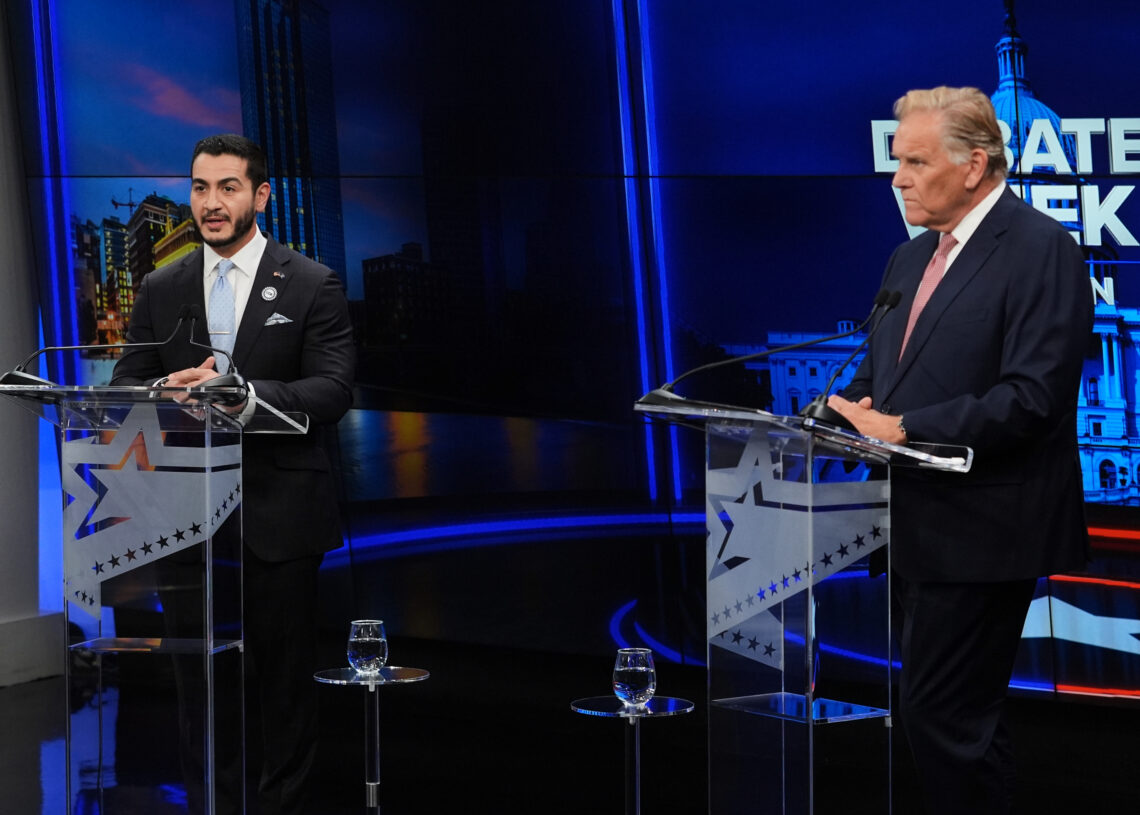
“His biggest funders are from a group that supports the Muslim Brotherhood,” he said during a debate on Oct. 8. “He gets money from people who support openly Hamas, Hezbollah, al-Qaeda.”
The claim is based on donations El-Sayed has accepted from individuals affiliated with the Council on American-Islamic Relations and the Islamic Society of North America.
CAIR, the country’s largest Muslim civil rights and advocacy group, and ISNA, which convenes the largest annual gathering, were named as unindicted co-conspirators in a 2007 terrorism financing case against Hamas. The organizations were not charged, deny wrongdoing and deny allegations they are terrorist groups or are affiliated with terrorist groups.
The Republican governors of Texas and Florida have designated CAIR a terrorist organization. The federal government has not. CAIR has filed federal lawsuits challenging the designation against both states.
“If Abdul doesn’t have allegiance to the Muslim Brotherhood, Hamas and Hezbollah he should put out an unequivocal statement saying so,” a spokesperson for the Rogers campaign said. “He’s signed a letter in support of, taken money from and has joined groups supported by the Muslim Brotherhood.”
What is being said about El-Sayed’s family?
As Election Day approaches, Rogers and right-wing media outlets have advanced allegations that El-Sayed’s family has ties to the Muslim Brotherhood.
The claims are based largely on two social media posts from 2012 by Eman Abdelhadi, El-Sayed’s half sister.
El-Sayed was born in Rochester Hills, Michigan, to Egyptian immigrant parents. They divorced when he was 3. El-Sayed’s mother left the state and he was raised by his father and stepmother.
In a tweet on June 24, 2012, Abdelhadi wrote that her “family has long been MB” but she “always felt that [the organization] has navigated the political sphere poorly/destructively.”
In a separate tweet that day, she wrote that she “had an amazing talk” with her mother “about her activism in the Muslim Brotherhood during the early 70s while she was in college.”
Asked about the posts last week by NBC, El-Sayed again denied ties to the organization.
“I have no ties. We have no ties,” he said. “I have never had these conversations with my mother. I wasn’t raised by my mother. … You’re using hearsay evidence from a tweet. It’s just not serious.”
The social media posts were surfaced by the Washington Free Beacon on Oct. 11. Abdelhadi, a sociology professor at the University of Chicago, did not respond to a request for comment.
Egypt’s Muslim Brotherhood denounced violence in the 1970s, according to the Council on Foreign Relations, and “earned popular support by providing social services such as pharmacies, hospitals, and schools.” Members of Egypt’s Muslim Brotherhood met with U.S. officials and White House staffers during the Obama administration in 2012.
Vidino said elements of the organization remain service-oriented and peaceful.
How has El-Sayed responded to the claims?
When asked, El-Sayed has denied ties to the Muslim Brotherhood and disavowed the organization — and then focused on the questioner’s intent.
“Let me ask you, though,” he said Oct. 11 on NBC’s “Meet the Press.” “Why is this even a subject of debate?”
Asked at a town hall Saturday whether he would disavow the Muslim Brotherhood, El-Sayed said “Sure. Yeah, absolutely,” and pressed the questioner on why he was asking. He noted that the U.S. Constitution guarantees his right, and the questioner’s, to practice their faiths as they choose, or not to practice any faith.
El-Sayed has been subjected to claims of ties to the Muslim Brotherhood for years. It was a line of attack by a Republican opponent in 2018, when El-Sayed was a candidate for governor, and has been a fixture of Rogers’s campaign.
“They don’t want to talk about any of the other issues that people are actually experiencing in their lives,” El-Sayed told reporters last week. “They want to talk about me or point to my mom or my sister.”
“My mom and my sister are not running for office,” he said. “I’m running for office.”
The post Examining the Muslim Brotherhood claims in Michigan’s Senate race appeared first on Washington Post.