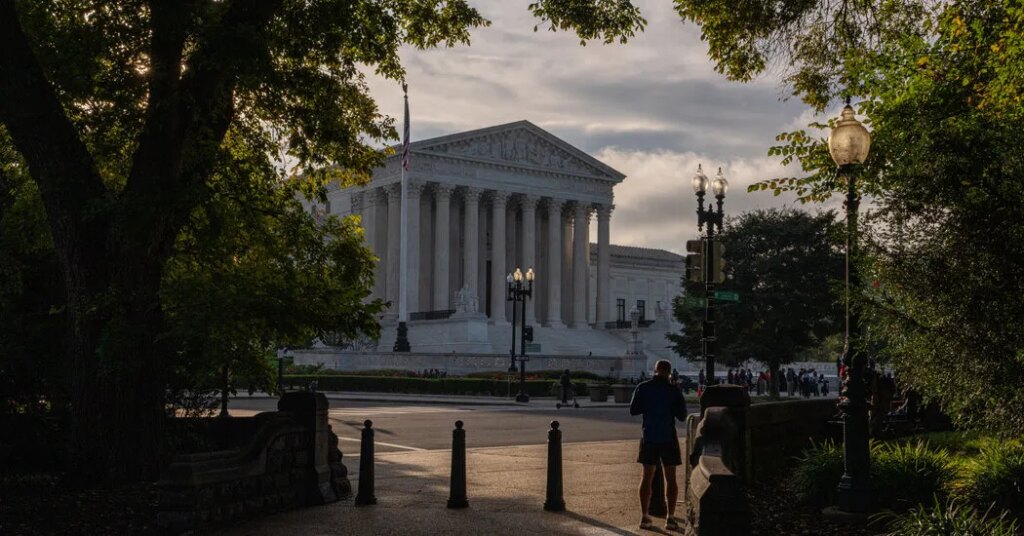
The Supreme Court agreed on Thursday that New Hampshire can direct election officials not to consider student IDs when verifying voters’ identities, ahead of the midterm elections.
New Hampshire’s secretary of state in April ordered officials to avoid reviewing student IDs, even in conjunction with other documents, for voters who are having trouble establishing their identity when checking in at the polls or requesting absentee ballots.
Republican state leaders had argued that the measure was needed to combat voter fraud and had asked the Supreme Court to intervene after a lower court blocked the directive earlier this month.
The ruling by the court did not include a vote count, which is typical for such emergency orders. The one-paragraph order explained the court’s reasoning by quoting a previous Supreme Court ruling that said the justices have “repeatedly emphasized” that “lower federal courts should ordinarily not alter the election rules on the eve of an election.”
Justice Ketanji Brown Jackson dissented, writing that she viewed the federal judge’s action as merely a “targeted order” to correct public statements and guidance by the state’s secretary of state that the lower court judge had concluded were “at best, misleading.”
The ruling dealt with a relatively rare circumstance in New Hampshire — how election officials exercise their discretion when a voter has difficulty verifying their identity. It is not clear how many voters will be affected by the court’s action. Still, the dispute was symbolic of the lengths to which both sides have gone in battles over voter identification ahead of the hotly contested vote.
The retirement of Senator Jeanne Shaheen, a long-serving Democrat, set off a high-stakes contest for an open Senate seat in New Hampshire, making it an important battleground. Democratic candidate Chris Pappas is running against former Senator John E. Sununu, a Republican, in a race that both parties view as critical.
The ruling was the latest in a string of election-related emergency actions by the justices in the lead-up to November, including their blocking of a Trump plan to screen ballots sent through the postal system, which would have drastically altered how Americans vote by mail.
More issues are expected to reach the justices before, and potentially after, the Nov. 3 vote.
The New Hampshire challenge stems from a law signed in April by Gov. Kelly Ayotte that required government-issued identification like a driver’s license or passport to vote. It prevented voters from using student IDs as the sole method of proving their identities at the polls.
After the measure was signed, Secretary of State David Scanlan, who oversees elections in New Hampshire, issued a directive that student IDs could not be used under any circumstances.
Republicans had asserted that the law was needed to eliminate the possibility that someone could present a fake college ID card at the polls. Democrats countered that it was a tactic to make it harder for young people to vote, arguing that high school and college students who do not have driver’s licenses might struggle to find other ways to prove their identities.
New Hampshire has required voters to show identification since 2012. In 2024, the state tightened its rules, eliminating some exceptions to rules that require photo identification and requiring first-time voters to present a birth certificate, passport or other official citizenship document to register.
Voter advocacy groups challenged the student ID law, arguing that it violated the Constitution and would disenfranchise hundreds, possibly thousands, of qualified voters.
They also argued that the secretary of state’s directive went too far, asserting that under a “safety valve” provision in state law, if a voter is unable to prove their identity by a document listed in the statute, election officials should be able to consider a student ID as evidence to help prove the voter’s identity.
In a ruling earlier this month, a federal judge declined to pause the New Hampshire law for the midterms but blocked the directive that student IDs could not be used under the “safety valve” provision. The judge found that the state had “offered no independent justification for that broader prohibition.”
In asking the justices to weigh in, New Hampshire state officials argued that the lower court had injected “uncertainty” into the state’s election procedures. State officials had already distributed student voting guides and launched a public campaign to explain how the voter ID law worked. They asserted that the judge’s decision would require state officials to “reverse all these efforts in the immediate lead-up to the general election.”
The Republican National Committee weighed in to support the New Hampshire voting rules, arguing that the judge’s decision “threatens to disrupt identity verification in New Hampshire’s looming elections.”
In response, the voter advocacy groups argued that it was Republicans who were attempting to inject uncertainty into the election by changing the rules “in the direction that keeps eligible voters from proving who they are.”
The post Supreme Court Allows Blanket Ban on Student IDs at Polls in New Hampshire appeared first on New York Times.