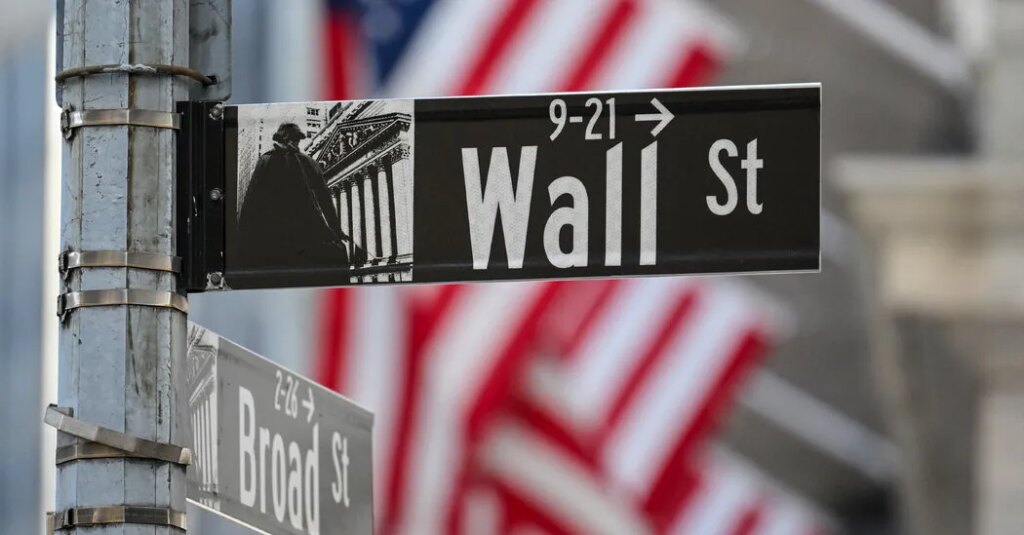
Stocks experienced one of their steepest declines in months on Thursday after earnings from big technology companies and tensions ratcheting up in the Middle East spooked investors.
The S&P 500 index fell 1.2 percent, its largest daily decline since July, while the tech-heavy Nasdaq slumped 2.6 percent, posting its biggest one-day decline since June.
Investors are growing increasingly wary of tech giants’ lavish spending on building out their artificial intelligence businesses, which is depleting their cash and requiring loads of debt.
Shares of the tech behemoth Meta dropped 7 percent on Thursday, a day after the company reported a big decline in its free cash flow and said it would issue a new class of stock to help raise more money to spend on data centers and other A.I. initiatives.
SpaceX, which also reported that it planned to spend tens of billions more on building out its A.I. business this quarter, slid more than 9 percent.
Rattled by the growing worries about A.I. spending, investors sought out the relative safety of U.S. Treasuries, pushing down yields in one of their steepest one-day declines in more than a year. Yields fall when bond prices rise. The yield on the 10-year note fell below 5 percent, while the 30-year dropped to 5.3 percent. Thursday’s market moves in the government bond market follow months of rising Treasury yields, amid worries about inflation, partly driven by the growth of A.I.
Even chip companies like Nvidia and Broadcom, which would benefit from tech firms’ pledge to commit more money to data center build-outs and acquiring more chips, have seen their stocks sink.
“There’s a big question mark that investors are putting on the health of the entire ecosystem,” said Malik Ahmed Khan, an equity analyst at Morningstar.
The malaise was evident in major markets in Asia as well, which are heavily influenced by technology industry trends. Benchmark indexes in Hong Kong, Japan and South Korea all slipped by around 3 percent. In Europe, the Stoxx 600, an index that tracks the region’s largest companies, fell over 1 percent.
Thursday’s sell-off punctuated the divide on Wall Street over the extent of the risks in A.I. investments. This week, Ken Griffin, chief executive of the hedge fund Citadel, said the market was “almost certainly” in a bubble, while Blackstone’s president, Jon Gray, said on Bloomberg TV on Thursday that the boom remained on solid footing, with demand for A.I. “almost parabolic.”
Also plaguing investors is a jittery oil trade. Strikes in Saudi Arabia and around the Persian Gulf helped drive the price of Brent crude, the global benchmark for oil, up 3 percent to about $113 a barrel, its highest level since May. West Texas Intermediate crude, the U.S. benchmark, also rose, to nearly $100 a barrel.
Oil had reached as high as $120 a barrel since the start of the U.S.-Israeli war on Iran nearly eight months ago, which has disrupted exports from the energy-rich Persian Gulf region. Before the war, global oil was trading around $70 a barrel and about 20 percent of the world’s oil flowed through the Strait of Hormuz, an artery between Iran and Oman that has become treacherous for commercial ships since the start of the fighting. Oil flows through the strait are running at about 75 percent of prewar levels, according to Kpler, a maritime data company.
The rising price of oil has pushed up the price of other fuel products like gasoline and diesel. In the United States, the average price of gasoline was $4.27 a gallon on Thursday, according to the AAA motor club, up 43 percent since the war began. The average price of diesel has surged 68 percent over that period, to $6.31 per gallon.
Jenny Gross and Lisa Friedman contributed reporting from London.
The post Stocks See Steepest Decline in Months Amid A.I. Worries appeared first on New York Times.