Strangely or not, my childhood was haunted by Constantin Brancusi, who pared down art into elemental egg shapes and invented modern sculpture. My father, like Brancusi, was born in Romania, and he too aspired to be a sculptor. He once carved a large egg from a block of white marble, and in its striking simplicity of form, it looked exactly how I imagined modern art should look. He worked on it for a long time, chipping away with his mallet and chisel and filling our house with a metallic plink-plink-plink — the sound, I assumed, of great art.
Chisels and mallets, as it turns out, play a prominent role in “Brancusi: The Artist and His Studio,” a large, revelatory exhibition opening Sunday at the Museum of Modern Art. The show zeros in on the Impasse Ronsin, a narrow alleyway in Paris where Brancusi, an émigré, worked and lived for four decades, in a high-ceiling space cluttered with his tall, twisty “Endless Columns” and coated in a layer of white plaster dust.
When he died, in 1957, he bequeathed the studio and its contents to the state of France; it became part of the Pompidou Center. But last year the Pompidou’s main building closed for a yearslong renovation, providing MoMA with a first-ever opportunity to bring Brancusi’s atelier to New York. Its show combines MoMA’s stellar holdings of his work with some 200-plus loans that range from treasured sculptures, films and photographs to the sort of miscellany that can only be described as “his stuff”— like the mailbox outside his studio. You can even see Brancusi’s portable record player and listen to his playlist, an amalgam of Roma folk songs and Latin American dance music.
In concentrating on Brancusi’s studio, MoMA brings us a new version of an artist who has long been familiar to us. We usually think of him as the supreme champion of “pure form” who reduced the image of the human figure to ovoids, cubes and other geometric masses. He was obsessed with birds and the dynamics of flight, and is probably best known for his “Bird in Space,” a tall blade of polished bronze so slim it appears on the brink of vanishing. But the Brancusi who emerges from this show — a short, reticent man with unkempt hair and a prophet’s full beard — is earthier than the bird man of legend, less a purist dreaming of flight than a craftsman enamored of the sweaty satisfactions of cutting stone and wood.
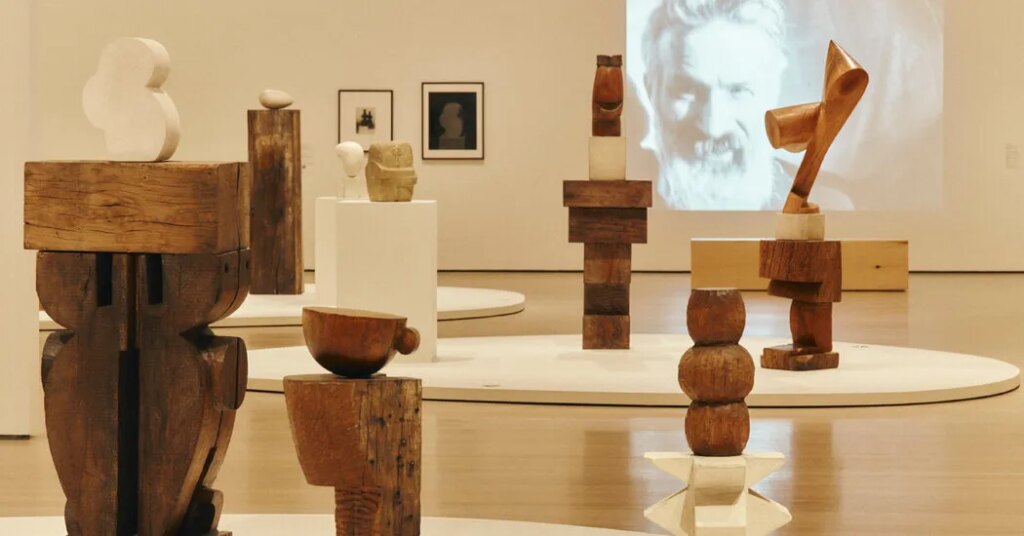
A walk-in replica of his studio and home is planted in the middle of the exhibition, and though the walls are transparent scrims with no more sensuality than a floor plan, the front entrance comes with a massive door frame that was carved from hard oak and provides enough in the way of chunky, rough-hewed allure for the whole show. Through the door, you can see into a room that Brancusi reserved for his sizable collection of chisels and other tools. His friends recalled that he talked to his tools and even sang to them. He used to say good night and wish them a restful sleep so they would be ready to return to work in the morning.
About a dozen choice tools occupy their own walls or platforms in the exhibition, which was expertly organized by a team of curators headed by Anne Umland, a former anchor of MoMA’s painting and sculpture department. On one wall, two extra-long saws hang vertically, beside an old-fashioned caliper, a measurement device with a curving, bulb-shaped silhouette. Displayed as if they were art objects, with a generous allocation of space and light, the tools lose their workaday familiarity and acquire an aesthetic charge. They seem at once elegant and poetically resonant.
Granted, MoMA’s pristine installation style could elevate a lowly toe clipper into an object of visual fascination, but in this case the emphasis on tools feels aesthetically right. Looking at the axes, you realize that they yoke elemental metal shapes (for the blade) to wood (for the handles) and thus echo the nature of Brancusi’s work. The zigs and zags of his “Endless Columns” suggest the toothy edge of a saw. A conscious borrowing or mere coincidence?
It matters that he grew up on a farm and had parents who encouraged his love of making tools as a child. He was born in 1876, in the village of Hobita, south of the Carpathian Mountains. At age 28, after completing his education in Bucharest, he moved to Paris and claimed that he walked the entire way, which took him more than a year.
He ended up in the red-hot center of the Parisian avant-garde, as an assistant to Auguste Rodin, the French master sculptor who was then in his 60s and renowned for his emotive depictions of the human figure. Brancusi quit after a few months, commenting, “Nothing can grow in the shadow of the great trees.”
At times he was less discreet, disparaging Rodin’s work as “beefsteak and muscle.” In truth, Brancusi seized on the word beefsteak as an all-purpose insult that he also applied to Michelangelo and any artist who worked in a figurative style — any artist, that is, who refused to put form on a stringent diet.
His first major sculpture, “The Kiss,” was a direct challenge to Rodin’s carnivorous “Kiss” (1882), a marble sculpture of a couple entwined in a naked embrace. In a breathtaking reduction of complex ideas, Brancusi sculpted his “Kiss” (1907-8) from a small block of marlstone that encases the heads of two lovers in profile, merged into a single form. Their skinny arms encircle the stone block as if they are actually keeping it from coming apart or crumbling. The MoMA show includes many versions of “The Kiss,” including one in volcanic rock that comes affixed to an iron ring and could pass for a giant’s keychain.
Unlike Picasso, who arrived in Paris at about the same time and was always pushing on to the next innovation, Brancusi had a finite set of motifs. Over the years, he returned to kisses and birds and sublime heads lying on their sides, heavy with the imagined weight of sleep and dreams. The forever lovely “Mademoiselle Pogany,” a nervily abstracted portrait bust of a Hungarian art student with exaggeratedly large, E.T. eyes, pops up in this show in three versions made between 1912 and 1933. How do they differ from one another?
It would be interesting to see the variants side by side, to contemplate their sibling-like affinities, as the Pompidou did in its 2024 retrospective, “Brancusi: Art Is Just Beginning.” Instead, MoMA has arranged the sculptures in loosely chronological order and mounted them in mixed groups on oval platforms that keep viewers at a distance. The installation is striking and rhythmic, but emphasizes the forest over the trees.
In place of a traditional catalog, MoMA has compiled a handsome book of historic photographs taken by Brancusi that allow you to understand how much he liked changing the arrangement of his sculptures in a process that blended redecorating with performance art. He disliked pedestals, and designed his own as one-of-a-kind objects in wood, limestone or plaster.
Though Brancusi has long been celebrated for his monoliths, his pedestaled sculptures are essentially hybrids, and they fascinated me at the MoMA show. Consider “Cup I” (1917), which balances an oversize teacup carved from fruitwood on top of an angular pedestal. The rigor of the base highlights the rotundity of the cup, which feels less like a piece of dishware than a planet tilted on its axis.
Brancusi’s bases were not always valued. When the art historian Sidney Geist published a historic monograph on Brancusi, he scissored the bases out of the photographs, like someone who eats the top of broccoli and throws the stems away.
But time changes how we see artists, and Brancusi, long revered for seeking platonic essences, speaks to us today for other reasons. His sculptures, with their gloriously mismatched bases, suggest that he prized disjunctions and gaps. In this way he has influenced a generation of contemporary sculptors known for mixing dissimilar materials and textures, including Arlene Shechet, Rachel Harrison, Carol Bove and Ugo Rondinone.
Although my father, like his generation of Modernists, loved Brancusi for the self-contained perfection of his carved marble eggs, his art was never as pure as we thought.
Brancusi: The Artist and His Studio
Members, Oct. 22-24; opens Oct. 25 — Feb. 27, 2027, Museum of Modern Art, 11 West 53rd; moma.org.
The post If You Think You Know Brancusi’s Sculptures, Step Into His Studio appeared first on New York Times.