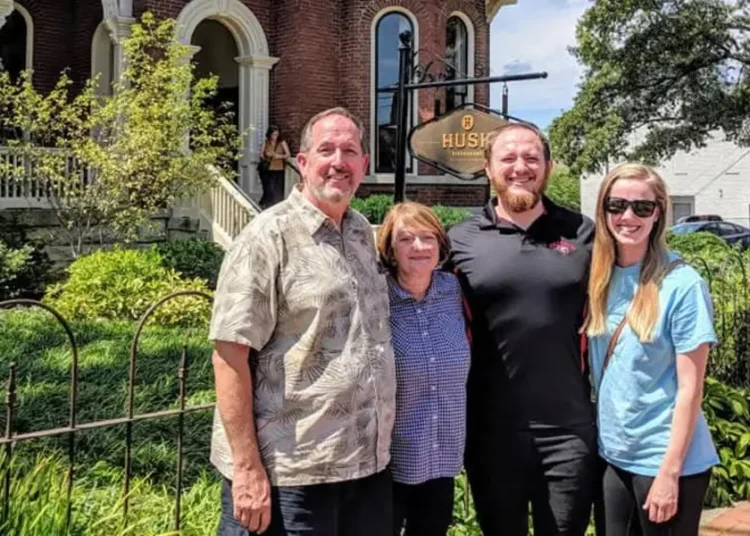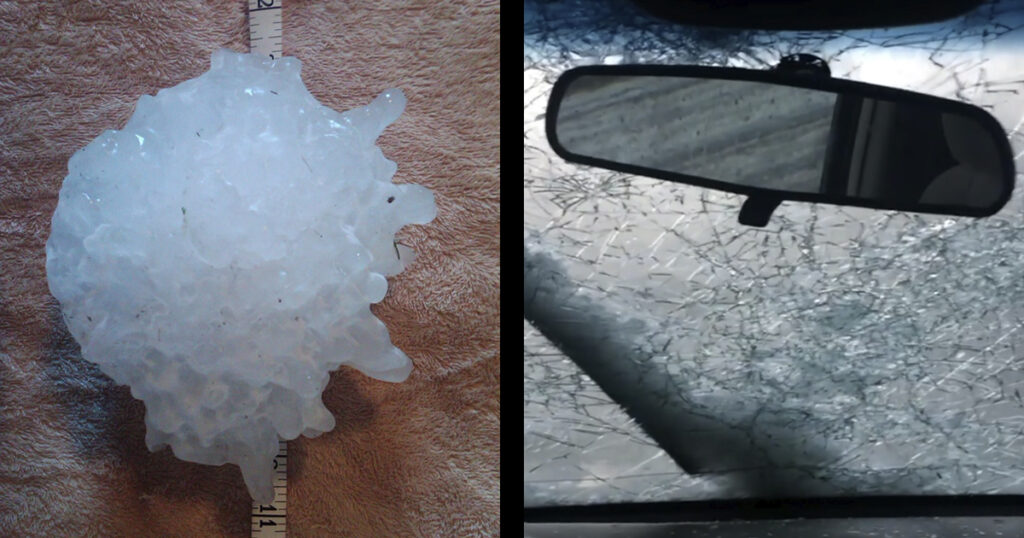
Sixteen years after Les Scott found America’s largest hailstone, he can still feel the divots the storm hammered into the ground when he mows his lawn. He can see the pockmarks on his car and holes in the roof of his shed.
Vivian, a small South Dakota town of just 98 people, has not forgotten the hot and humid day in July 2010 when ice fell from the sky, including the record two-pound hailstone the size of a dodgeball.
Across the country hail causes billions of dollars in damage every year, and scientists believe that climate change will make things worse. Hail is getting bigger, and hailstorms are becoming larger and more frequent.
“A lot of people talk about tornadoes and hurricanes and wildfires but when you look at these natural perils that impact society, hail produces the most amount of insured loss every single year,” says Victor Gensini, a professor at Northern Illinois University and director of Center for Interdisciplinary Research on Convective Storms.
These chunks of ice that crash down on cars, crops, buildings and people are formed when a thunderstorm produces a strong updraft that lifts raindrops to high altitudes, where they coalesce around dust particles and freeze. When they grow too heavy for the updraft to keep them aloft, they fall to earth.
“It is quite remarkable feat of nature,” says Gensini, “to think about the energy and the power that it takes to create those hailstones to me is just scientifically remarkable.”
As the climate warms, Gensini says, thunderstorms will create stronger updrafts that hold hailstones in the air for longer allowing them to grow bigger — and fall harder.
There’s still a lot that scientists don’t know about hail because it is notoriously hard to study. It often melts too fast to collect accurate samples and because of the vagaries in predicting where or when a hailstorm will happen it’s difficult to place instruments inside one to collect atmospheric data and samples.
But last year, a group of over 70 researchers from 15 institutions spent six weeks and drove over 15,000 miles across at least 12 states to give it a try.
Project ICECHIP, funded by a $11 million dollar grant, is the first major study of hail in over 40 years. The team succeeded in finding hail and now scientists are studying the data and samples to identify what patterns may help, among other things, predict where and when hail forms.
Leading the analysis of the samples at a cold facility in Colorado, Anthony Bernal Ayala, a senior research associate with Atmospheric and Environmental Research, a part of Janus Research Group, says there’s a lot we can learn from them. As the stones grow they create layers similar to rings of a tree. He calls them “a chronicle of time” as they “preserve its history within each crystalline layer.”
Some of Bernal Ayala’s research could be used to help determine what materials can withstand the increasing sizes of hail.
“Hailstorms are unfortunately getting more expensive and they’re projected to be even more expensive in the next decade or so,” he said.
Denver got a preview on May 8, 2017.
Evening rush hour was just starting when hail as large as baseballs started to fall. Drivers pulled over as their windshields cracked, workers inside a mall looked up to see hail shattering its skylights and city streets and parking lots were blanketed like snow.
“It looked like big huge snowballs coming down from the sky, ” Lisa Hyatt, a medical receptionist at Lutheran Medical Center in Wheat Ridge, told 9NEWS. Hyatt was at the hospital when the hail hammered down, breaking windows and damaging the roof. “ It sounded like everything was just going to crumble down on you,” she said.
The hailstorm was one of the costliest in U.S. history, causing nearly $2.3 billion in damage according to Rocky Mountain Insurance Agency Association (RMIAA).
According to the risk management firm Aon, “severe convective storms” which include hail, thunderstorms and tornados have caused around $60 billion in annual losses in recent years. In 2023 is caused $64 billion in losses and $57 billion in 2024. Hail generally accounts for somewhere between 60 to 80 percent of that, said Antonio Elizondo, associate catastrophe insight analyst at Aon.
The hardest-hit states are Colorado, Nebraska and Wyoming, according to the National Severe Storms Laboratory. But the entire Great Plains are at risk, from Texas to Canada.
“Hail is a much bigger driver of losses than wildfire in Colorado,” says Michael Conway, the Colorado insurance commissioner. It’s also the number one cost driving up premiums.
According to a survey from Conway’s office of 20 homeowners insurance carriers, hail accounts for largest portion of their premiums, significantly more than wildfire.
But it’s not the large hailstorms such as the one that hit Denver in 2017 or the large stones like the one in Vivian that are driving up these costs, Conway says. It’s the frequency of hail as many Coloradans are living in more hail-prone areas along the base of the Front Range of the Rocky Mountains.
“When it comes to wildfire, it’s this big scary thing that when it hits it takes out homes,” he said. “But with hail it is kind of a death-by-a-thousand-cuts type of an issue.”
According to the State Climate Extremes Committee at the National Oceanic and Atmospheric Administration (NOAA), the Vivian hailstone found in 2010 still holds the record for heaviest and largest diameter hailstone ever recorded in the U.S.
Scott watched the storm from the kitchen door hearing what sounded like someone throwing bricks at the side of his house. His wife Deb and their kids sheltered in the basement, fearing a tornado.
When the hail stopped, Scott said he was left “shaking and in awe.” He ran outside and found the massive stone with spikes on his lawn. He brought it inside and and shoved it in his freezer.
David Hintz, warning coordination meteorologist with NOAA in Aberdeen, South Dakota, heard about the stone while surveying tornado damage while in the area, and found Scott. NOAA weighed, measured and ultimately made a plaster cast that’s on display in a local historical museum.
But all these years later, what Scott still cares about most are his neighbors and his town. While no one suffered serious injuries, everyone had pay thousands of dollars to replace their roofs.
He doesn’t believe in climate change, but he was humbled by the destructive power of nature. “It was a very scary experience. I’ll never want to go through it again.”
The post Hail causes billions in damage — and climate change is making it worse appeared first on Washington Post.