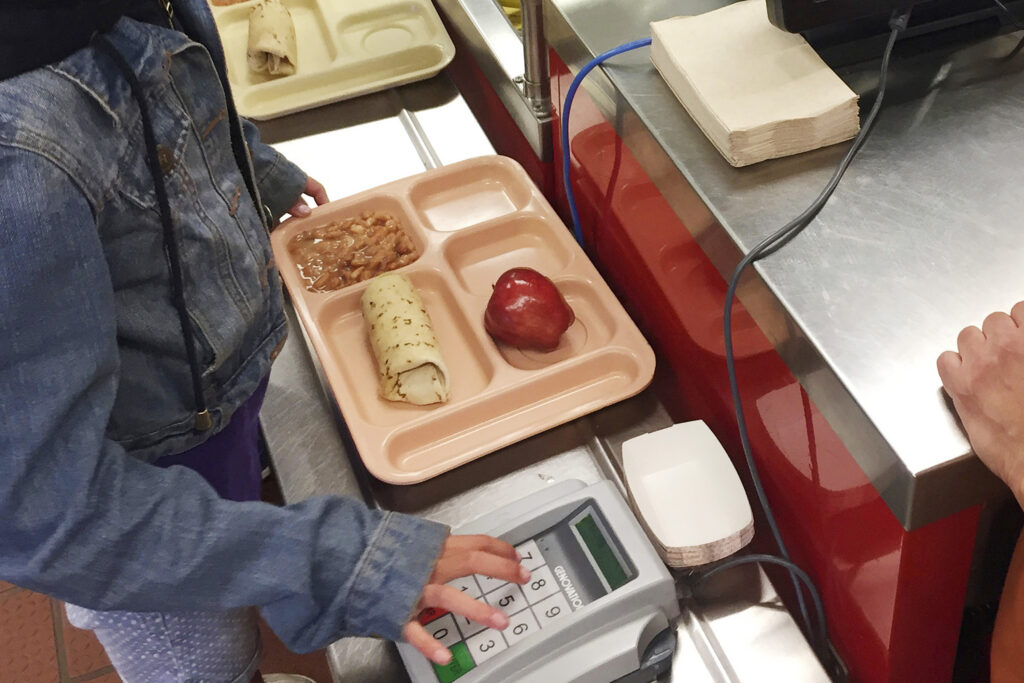
Every day, the food service director in Knox Community School Corporation, a rural district in northwest Indiana, checks the school lunch balance. The district of roughly 1,700 children has racked up $10,000 in lunch debt already this school year.
Kasey Clark spends much of her day trying to get the unpaid amount families owe for lunch under control. Last year, two-thirds of the district qualified for free and reduced-price meals.
This year, 44 percent of students qualify, a drop of about 22 percentage points. And it’s not because families aren’t struggling. “We are truly a poverty-stricken school [district], where we are truly at that 66 percent,” Clark said.
Due to last year’s Republican-led budget reconciliation bill, the Supplemental Nutrition Assistance Program, also known as SNAP or food stamps, is undergoing the deepest funding cuts in the program’s history and tighter eligibility rules.
Since SNAP recipients are automatically eligible for free school meals, fewer children are now getting the free food which has led to climbing lunch debt and the elimination of universal free meal programs on some campuses.
More than 5 million people, including an estimated 2 million children, have lost SNAP benefits since last year, said Katie Bergh, a senior policy analyst at the Center on Budget and Policy Priorities. In Indiana, SNAP participation fell by 15 percent, according to the think tank.
When children who receive SNAP and other benefits make up at least 25 percent of the student body, the school can participate in the Community Eligibility Provision (CEP) which provides a federal reimbursement to offer free school meals to all students.
The SNAP cuts mean some CEP schools will no longer meet that threshold and lose eligibility entirely. Other schools have opted out of CEP because the drop in SNAP participation means less federal reimbursement, leaving schools unable to cover the remaining meal costs. Schools are reimbursed based on the share of children on public assistance.
The Agriculture Department, which runs the National School Lunch Program, said eligibility rules for meals have not changed. “Families that qualify based on income will continue to be eligible for free or reduced-price school meals,” a spokesperson said in a statement.
But advocates and nutrition officials say the changes to SNAP have made it harder for districts to offer free meals at a time when many families are struggling to afford necessities. Experts warn the problem will worsen in the coming years, as the consequences of the budget bill continue to come into focus and as more school districts decide whether they can keep serving free meals to all students.
“We’re just at the tip of the iceberg,” said Erin Hysom, senior child nutrition policy analyst at the Food Research and Action Center, an anti-hunger nonprofit.
Free meals account for about 70 percent of school lunches served daily, preliminary USDA data from last fiscal year show. Between fiscal years 2025 and 2026 — which include most of the 2024-25 and 2025-26 school years — the average number of students receiving free lunch at school dropped by 600,000, from 21.3 to 20.7 million.
More than 55,000 schools participated in CEP last year, according to a database by the Food Research and Action Center. The schoolwide free lunch program stops meal debt from accumulating, reduces stigma associated with public benefits, and removes the need to collect and verify meal applications for four years — reducing the paperwork burden on families and schools.
Under a traditional school lunch program, low-income families that are not on SNAP must apply annually for free or reduced-cost meals.
In Knox, Clark has spent much of this school year convincing those families to complete their meal applications. Schools will feed students even if they can’t pay, so the district will have to find money elsewhere in its budget to cover the costs.
“It’s robbing Peter to pay Paul,” Clark said. She’s begun asking local churches and charities for donations. “The kids are paying the price in the long run.”
In Northern Virginia’s Rappahannock County Public Schools, meal participation at the start of the school year was “lower and less predictable” than normal as officials urged families to complete meal applications, said Jackie Tederick, the school nutrition director.
The district dropped CEP this year because the share of children on public assistance has been shrinking, making the program more expensive to run.
In some parts of the country, SNAP participation had been ticking downward as people returned to work and saw their wages increase after the pandemic, Bergh said. But the trend accelerated this past year.
About 30 schools in North East Independent School District in San Antonio, where the share of students on SNAP and other benefits has been falling for about four years, are no longer eligible for CEP, said Sharon Glosson, executive director of school nutrition.
This year brought more declines: At one elementary school, the share of children on public assistance dropped 9 percent between this school year and last. Districtwide, the number of CEP schools fell from 48 to 16, Glosson said.
It’s been a challenge to encourage low-income families to apply for free and reduced-cost meals, she said. School lunch debt reached more than $25,000 during the first six weeks of school — 83 percent higher than last year.
“From conversations, I believe we will have to make similarly hard decisions for next school year,” Glosson said. She later added the school board will have to determine whether the district can keep absorbing families’ unpaid lunch bills or if it will “have to make changes in extending that benefit of continuing to feed students regardless of if they bring money or not.”
The White House has saidSNAP cuts are intended to eliminate waste. SNAP, it says, is supposed to assist families temporarily, but has “become so bloated that it is leaving fewer resources for those who truly need help.”
Now, SNAP participation is at its lowest point in 17 years, Bergh said. “It’s very unusual to see caseloads dropping this quickly, even in times when the economy is improving.”
In Houston Independent School District, 26 schools that previously provided free meals to all students under the CEP program are no longer eligible, a spokesperson said in an email.
Traci Riley, who has two elementary-schoolers in the district, said the change has introduced “financial constraints that I didn’t have before.” She pays full price for her children’s lunches.
“No matter the socioeconomic level, everyone is stressed about having to pay for lunch,” she said. “It is just a shift in the culture of the campus.”
Houston’s public schools remain “committed to ensuring that all students have access to nutritious school meals,” the spokesperson said.
Miami-Dade County Public Schools, which previously provided no-cost lunches to every child across 349 schools, according to a FRAC database, scaled back to 121 schools. Officials in a statement pointed to changing demographics, including fewer immigrants and falling enrollment.
Fewer eligible immigrants are applying for SNAP because they are afraid it could jeopardize their citizenship, said Paco Vélez, president and chief executive of the Feeding South Florida food bank, where demand for food has exploded.
Before July 2025, one of the food bank’s locations served between 20 and 40 families per day, he said. Now, more than 260 families come in daily for help, a change Vélez attributes to SNAP and Medicaid cuts and the Trump administration’s decision to end temporary protected status for thousands of Haitian immigrants — who make up a large community in South Florida.
“It’s been getting out of control since last year,” he said. “It’s all created a situation where families are needing more and more assistance.”
The post Free meal programs vanish and school lunch debt climbs after SNAP cuts appeared first on Washington Post.