A video production student accused of hurling cobblestones at the police and helping to build a barricade.
A teenager accused of throwing bottles, setting off fireworks and carrying stolen goods, including seven pairs of glasses.
Two friends who admitted that they had helped themselves to whiskey bottles from a ransacked supermarket to celebrate one of their birthdays.
These were among the carousel of people being tried in expedited and sometimes tumultuous fashion on Tuesday in a large glass tower of the Tribunal de Paris, France’s biggest courthouse. After days of chaos spurred by the country’s largest riots in years, this was the front line of the French state’s attempt to reassert control and punish people involved in the unrest.
By Tuesday, more than 2,500 people had been detained across the country, including about 550 in Paris. They were a small minority of the more than half a million people who joined protests on Saturday. There were still so many of them that the courthouse doubled the number of courtrooms that it typically reserves for a form of fast-track trial often used for lower-level crimes in which someone is caught red-handed.
The justice minister, Gérald Darmanin, has instructed prosecutors to seek harsh sentences. He promised to come down hard on those who turned largely peaceful protests into riots that led to attacks on government buildings and the looting of more than 3,000 businesses. He called the first convictions this week “just the beginning of the guilty verdicts.”
Mr. Darmanin has been so outspoken that on Tuesday, dozens of defense lawyers in their black capes crowded before the panel of three judges in one courtroom to denounce his actions as the politicization of justice. They reminded the judges that the protests started in September with teenagers demanding better conditions in their schools.
Through days of speculation, the country had learned little about the detainees’ identities. The government repeatedly blamed far-left insurgents and opportunistic delinquents. On television, Mr. Darmanin said that 95 percent of the detainees were men, that 70 percent were adults and that they included “people from immigrant backgrounds, people who are foreigners,” as well as “people who are fully integrated and who are French.”
The cases we observed on Tuesday — in courtrooms packed with journalists and the accused’s friends and relatives — provided some of the first glimpses of who was arrested.
Each trial lasted less than an hour, offering only snippets about a defendant’s background, making it hard to draw conclusions about them as a group.
Of the 14 cases that we followed closely, 10 involved young men, often from working-class suburbs on the edge of Paris.
Case 1: The video production student
Among the first tried on Tuesday was Victor Bertois, 21, the video production student, who lived with his parents in a suburb north of Paris.
He arrived in the glass box reserved for defendants with a purple bruise under one eye and wearing the black T-shirt that he was arrested in.
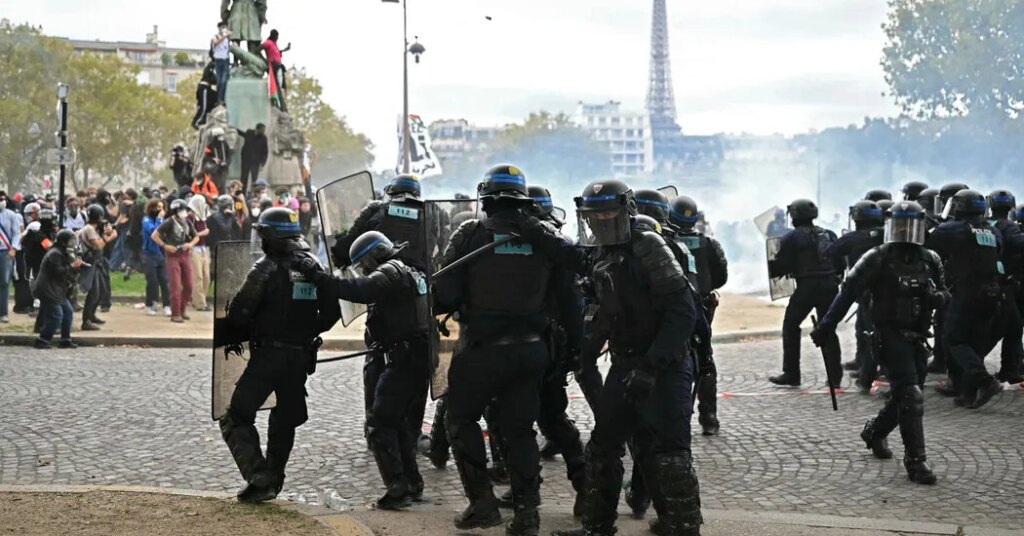
Mr. Bertois said he had joined a march on Saturday with his girlfriend to protest as a student. He said they had found themselves funneled by police officers into a central square where cops in riot gear were in a standoff with agitators.
Prosecutors accused Mr. Bertois of helping build a barricade, throwing paving stones and other projectiles at the police and screaming an abbreviation of a slur about the police. He was carrying a smoke flare, the prosecutors said.
Responding quietly, Mr. Bertois told the three judges that he didn’t throw anything, didn’t yell anything and didn’t build a barricade. His only intervention, he said, had been to pull a plank from a burning trash can to stop it catching fire. Mr. Bertois said that police officers had then charged at him, and he had fallen to the ground, where officers beat him, causing him to briefly pass out. The police were not represented in court and the interior ministry did not immediately respond to a request for comment.
Mr. Bertois’s lawyer, Tristan Lawless, said his client was simply “at the wrong place at the wrong time.” Mr. Bertois, like other defendants we saw, had no criminal record.
His parents, visibly wracked with worry, were in the room. “I don’t understand what he is doing there,” his father told the judge. “I’m quite distressed.”
The head judge, Sylvie Moysan, moved quickly, allowing the father to make a witness statement from the gallery.
Fast-track trials in France are usually for lower-level crimes like traffic violations, theft or assault, often when the accused has been caught in the act. Judges have little time to cross-examine witnesses or dig into testimony. Court-appointed lawyers often have less than an hour to prepare.
In some cases on Tuesday, lawyers hadn’t met their clients. And Judge Moysan told the court that judicial staff had not had time to provide background reports on some defendants — “too many people in the holding cells.”
After less than 40 minutes, Judge Moysan adjourned Mr. Bertois’s hearing, leaving him to wait hours in a holding cell for his verdict.
Case 2: The tile setter
In the second case, Moustapha Dembele, 18, struggled to explain why he was at the protests.
“Work,” Mr. Dembele mumbled from the glass box. “Prices.”
Mr. Dembele told the court that he lived with his parents and siblings in a working-class suburb south of Paris. He has been in France since he was 8, when his family moved from Senegal, once a French colony. Citing Mr. Dembele’s case file, Judge Moysan said he was training to set tiles in buildings, but had been unemployed, supported by his parents, since an injury.
Mr. Dembele was arrested in eastern Paris around 11 p.m. on Saturday. The police said he had been throwing bottles and setting off fireworks at officers, and had screamed for help from other agitators while being arrested. He was found with seven pairs of stolen glasses and a new designer T-shirt. He said he had found them on the street.
“I didn’t know they were stolen,” he told the court.
He said he didn’t see any heavy-duty fireworks being shot at the police, nor any tear gas. “Why were you wearing a mask, then?” the judge asked.
He offered no answer.
The prosecutor recommended a 10-month prison sentence. William Word, Mr. Dembele’s court-appointed lawyer, called that “socially isolating” and “completely disproportionate” for a man with no criminal history.
After 38 minutes, the court moved onto another case.
Case 3: The friends
Haïté Langeron, 21, and Dalvys Mboukou Samba, 20, were among the last to stand trial on Tuesday. They were arrested together and tried together.
They both stepped into the box wearing black hoodies and black pants — an outfit often worn by French teenagers, and so common among the accused that it started to seem like a uniform.
Mr. Langeron had turned 21 in a holding cell, awaiting the trial.
The two friends, both from the Parisian suburbs, were arrested while running with a crowd down a street in the Marais, a chic, gentrified area of Paris.
They were carrying bottles of whiskey that they admitted they had taken from a grocery store that had been looted early in the afternoon, just after the city’s main demonstration was starting nearby.
The store owner’s lawyer told the court that the owner had barricaded himself in the basement for hours, while up to 130 people ransacked his shelves. He estimated the damages at 45,000 euros — about $50,000.
Mr. Langeron said he and his friend had found the store open and “walked around,” taking the alcohol to celebrate his birthday.
The judge noted that the police had found Mr. Langeron carrying a “window breaker,” without giving further details. Mr. Langeron said it was a “work tool.” Mr. Langeron works as a delivery driver and Mr. Mboukou Samba is looking for work.
In other cases, the evidence presented publicly was largely based on police reports. In this case, the judge pored through messages from the defendants’ phones.
“We will loot everything,” Mr. Mboukou Samba had written on Snapchat.
“I stole lots of bottles,” he wrote in another message. “We’re going to have a drink.”
Both men apologized in court.
“It’s not good what we did. Next time, we will focus on our future,” said Mr. Mboukou Samba.
“There won’t be a next time,” Mr. Langeron said.
The Verdicts
At different points on Tuesday night, all four men returned to the glass box, alongside other defendants, to hear the judges deliver verdicts in multiple cases.
All four were found guilty and given suspended prison sentences of between six and eight months, meaning that they will only be sent to jail if they are convicted of another crime in the next five years.
A civil trial was set for May to decide what compensation Mr. Langeron and Mr. Mboukou Samba should pay the store owner.
It was past 11 p.m. when the court adjourned. There were already more speed trials on the docket for Wednesday.
The post What We Saw at Fast-Track Trials of Riot Suspects in France appeared first on New York Times.