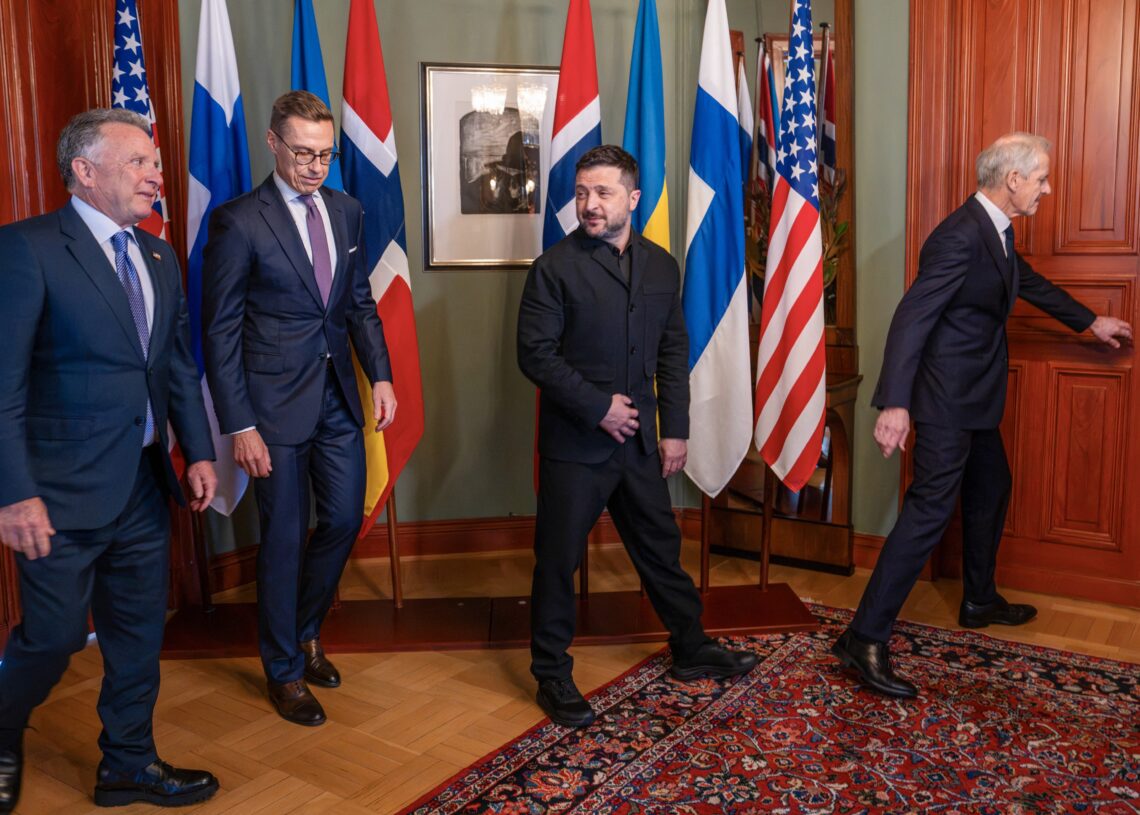
As President Volodymyr Zelensky met with U.S. and European officials Tuesday in Oslo to discuss formulas for ending the brutal war in Ukraine, observers must have been asking the same question I have been puzzling over: Is this U.S.-led peace effort for real?
My answer is yes and no, based on reports from people close to the negotiations. On the positive side, U.S. and European envoys have worked with top Ukrainian officials to frame an agenda for talks with Russia that would explore mutual security guarantees for Kyiv and Moscow, plans for postwar economic integration and reconstruction, and territorial compromises.
The reason to doubt this process is that it’s one-sided. The negotiation track has support from Ukraine but none so far from the aggressor, Russia. The Kremlin hasn’t even agreed to talk about talks. A real peace pact would be a symphony. But we have the sound of one hand clapping.
Soon we’ll all have a better sense of whether this is real. U.S. emissary Steve Witkoff traveled to St. Petersburg on Wednesday to brief Russian President Vladimir Putin on the plan. His fellow envoy Jared Kushner, at home in Miami, sick with the flu, was to join by teleconference.
The St. Petersburg meeting was sweetened by Russia’s release of Stephen Hubbard, a retired American teacher whom Russia had been holding on charges that he was a mercenary for Ukraine. Trump had asked Putin to free Hubbard. The hostage release is good news for Hubbard’s family, and a nice bouquet from Putin to Trump, but it does nothing to advance peace.
If Putin agrees to Witkoff’s request to move to negotiations, then this will become a serious process. Next would come trilateral talks among Russia, Ukraine and the United States about a ceasefire line, monitoring mechanisms and the future status of occupied territories. Multilateral talks, meanwhile, would bring European officials to the table as well — to discuss region-wide issues of reconstruction and postwar economic relations between Russia and Europe, especially on the key issue of energy.
If Putin rejects the framework — or, more likely, demands unreasonable changes — then the world will at least know who blocked the fledgling peace effort. A negative reaction from Putin also might finally convince President Donald Trump to stop feeding concessions to a Russian leader who had spurned an initiative developed by Trump’s longtime friend and his son-in-law.
The Oslo participants were upbeat Tuesday. U.S. officials were encouraged that leading European nations and Ukraine were aligned with Washington on a path forward. They were also relieved that the joint negotiating effort had survived 10 days of sniping between Trump and Zelensky — and Trump’s misguided decision to lift sanctions on Russia and to buy its diesel oil.
Zelensky was on his best behavior Tuesday. “We are ready for negotiations, and it is important for us to demonstrate any signs of de-escalation,” he said. “That is why there are certain proposals for different ceasefire formats.” He noted the meeting had explored a U.S.-European offer of NATO-like security guarantees and “sensitive issues,” including territory.
Finnish President Alexander Stubb, who helped host the talks, said that “genuine progress” was made and that it was “a good day for peace.” He didn’t elaborate. In addition to Stubb, who is probably Trump’s favorite European, the Oslo meeting included senior officials from Norway, Britain, Germany and Italy, as well as representatives of the European Union and NATO.
What makes the Ukraine negotiation process so confusing is that it’s regularly disrupted by Trump’s zingers at Zelensky. Relations have survived the acrimonious Oval Office meeting in February 2025 and the Anchorage summit at which Trump seemed ready to settle the war on Moscow’s terms. Zelensky has tried to mend fences, but lately he has been more willing to defy Trump.
What seems to have lit Trump’s fuse this time was Zelensky’s rejection of his requests, starting late in the summer, to halt drone attacks on Russian refineries as a way to lower U.S. fuel prices as the midterm elections approached. Zelensky had asked to “allow Starlink access for our deep strikes into Russia. If this was allowed … attacks would be limited to precision strikes on ballistic missile and drone production facilities,” according to Ron Wahid, whose company, Magellan Investments, has a subsidiary called Arcanum that works closely with special operations forces in Ukraine.
After assessing costs and benefits for Ukraine, Zelensky decided to keep attacking Russia’s refineries. That angered Trump, who responded with his diesel deal and subsequent waiver of a Russia sanctions law that he had just signed. Zelensky derided Trump’s actions as “weak,” which boosted his popularity in Ukraine but further enraged Trump.
What frightened Ukrainians were reports that, amid the Trump-Zelensky quarrel, the U.S. had halted early-warning intelligence about Russian ballistic missile attacks and that Starlink guidance links were curbed for fast-moving Ukrainian drones. Those events remain murky, but a U.S. official told me Tuesday that intelligence was now flowing freely to Ukraine.
Forgive the analogy to another blood feud, but Trump’s attempt to mediate between Ukraine and Russia reminds me of similar fruitless efforts to resolve the Israeli-Palestinian conflict. For a generation, U.S. officials who came to be known as “peace processors” tried to broker talks even as the enmity between the two sides increased and the death toll rose.
My fear is that Putin has been leading Americans down a negotiating path with hints of concessions that he is not actually prepared to make, much as Israeli and Palestinian leaders did for decades. But we’ll find out soon enough. With Witkoff in Russia carrying a proposal endorsed by Europe and Ukraine, it’s showtime.
The post The world will soon know who is stalling the Ukraine peace talks appeared first on Washington Post.