Democrats are salivating over, and Republicans are bracing for, a potentially massive blue wave. One GOP pollster is urging everyone to calm down.
Patrick Ruffini, a founding partner at Echelon Insights, has been loudly throwing cold water on Democrats’ hopes of sweeping the red state Senate seats that have become battlegrounds in a worsening national environment for Republicans.
“The polls are, I think, intentionally inflating the size of the battleground,” Ruffini told POLITICO.
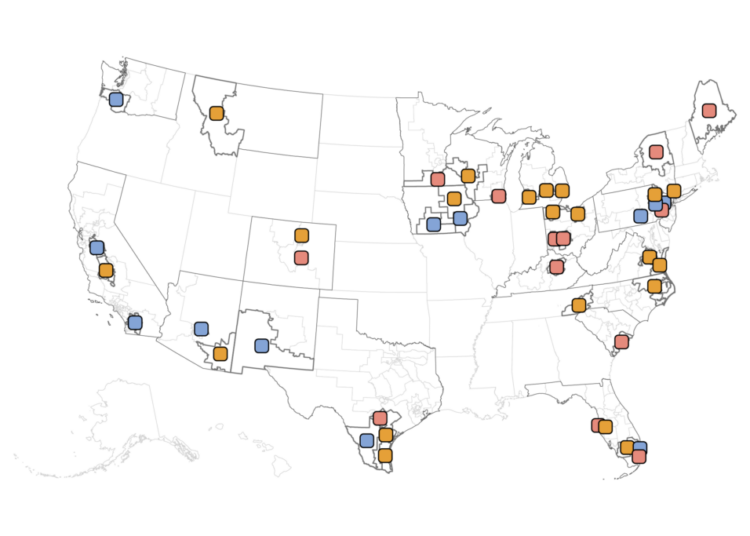
Democrats are pushing to flip Senate seats in Iowa, Texas, Ohio and Alaska — all states that President Donald Trump won by at least 11 points in 2024 — with dreams of going even deeper into the map Kansas, South Carolina and even Mississippi. Sensing a potential disaster, Republicans have significantly curtailed their investments in North Carolina and Georgia to direct resources elsewhere.
Ruffini, who isn’t polling for candidates or party committees in any federal races, said he’s skeptical of Democrats flipping some of those seats, particularly in the Midwest, and gives the GOP a coin flip’s chance at keeping control of the Senate.
If a blue wave were to come, he said it would defy the ingrained partisanship in deep-red states that has mirrored growing political polarization around the country.
“I think it would be somewhat of a historic shift if that were to happen,” he said.
Here’s more from POLITICO’s chat with Ruffini, edited for length and clarity. A more condensed version of this interview ran in POLITICO’s Morning Score campaign newsletter.
You’ve been pretty publicly skeptical of polling that indicates a big tsunami for Democrats in November. Why is that?
I think we can read the environment right, but the map wrong.
The pretty large shift towards Democrats that we’re seeing on the generic ballot and in a lot of individual races, I’m not saying that’s not going to materialize. What I am more skeptical of is… the ability of any major party in this polarized era that we’re in to rack up significant gains in states that went double digits for the other side.
I’m not ruling out — I think there will be some [examples]. I think Alaska is one where it’s both an idiosyncratic state, and [Democratic nominee Mary] Peltola has shown some specific candidate-centered strength. Nor would it shock me if [Democrat] James Talarico wins, despite the history in Texas. That would not surprise me, just given the candidate quality disparity, particularly on the Ken Paxton side.
Where I get more skeptical is when you move into the Midwest, where there has historically been pretty large polling errors [overstating Democrats’ chances] in states like Iowa, Ohio. And I think you can extend that to the Democratic enthusiasm around Kansas.
Is your skepticism coming more from the quality of the individual polls that you’re seeing that are showing massive Democratic surges in the Midwest, or is it the history of these states that you’re betting will ultimately win out?
I think fundamentals are going to play an important role, particularly in states where there was a solid Trump advantage. We’re not talking about a state like North Carolina or Georgia that’s only for Trump narrowly, where Democrats, at least in the Senate races, are clearly favored.
Historically the presumption is that states tend to converge on their base partisanship in the closing days of an election, but especially that’s been the pattern in the Midwest.
Specifically as it relates to the polls this year, I think any pollster you would talk to, including myself, is experiencing significant non-response bias favoring Democrats.
When you’re seeing high-propensity Democrats [responding to polls] at twice the rate of high-propensity Republicans, when we know that the turnout on both sides would be roughly evenly paired, that’s a warning sign for polling in this cycle.
It seems like there’s some GOP internal polling saying that Republicans are worried about these states, because they are moving money around to triage certain races. I’m curious if you feel like they’re wrong to be making those decisions?
Absolutely not. They’re not wrong. You do have to take the polls somewhat seriously in the sense of, if you do get a poll that’s within the margin of error, I think you’re duty-bound to spend money in those places and not to ignore what could be a potential signal.
I think that control of the Senate comes down to Texas, so they’re right to be spending money there. If you just look at the amount of money being spent in Texas versus Kansas, obviously it’s a much, much bigger state, and you need to spend much more money.
But it’s not something along the lines of ‘the battleground has shifted. It’s a foregone conclusion. Democrats are going to win the Senate,’ and then the battleground entirely shifts to a state like Kansas or to Iowa, right? I don’t think we’re seeing that.
It sounds like the issue you have is how the broader public is interpreting these polls rather than the polls themselves?
The polls are, I think, intentionally inflating the size of the battleground. And to some extent it’s happening both ways. The polls showing a margin-of- error race in Minnesota is possible, right? I’m not as concerned about a polling error in Minnesota as I am in Kansas.
But because of the number of Democratic internals and because of the incentive of Democratic internals to show close races across the battleground, what you generally tend to see is more of an inflated sense of how big the battleground actually is. A lot of these races just break a certain way.
We’ve reported that Republicans are privately conceding that the House is lost. Is that your reading of the data too?
That’s the best reading of the data. That said, if there’s a three-point polling error or something, then I think it gets very, very tight and anything can happen. But I think that’s the most likely outcome.
What is your prediction for the number of Senate seats Republicans will have?
My prediction for both the probability and the seat count is 50-50. There’s a 50-50 chance Republicans hold the Senate. I think if they do, it’s with 50 seats, probably. But obviously, that can tilt very easily.
Which of these states do you think are going to flip for Democrats?
Alaska is clearly favored. I mean, I don’t know if it’s clearly favored, but I think it’s at least still Democrat. I think Texas is going to be very, very close. I just think the partisanship of the state is — people forget it’s a little bit more Republican than it was back in 2018. I think Republicans are probably being underestimated in Ohio because of the past Midwestern polling error.
At the same time, I would say it’s still uphill in Maine and Michigan to some degree. I think Susan Collins has really been the lone bright spot, at least in terms of the conventional wisdom, the narrative in the Senate for Republicans. I think she has a fighting chance, but I think Republicans are still probably under a 50% chance in both Michigan and Maine, just due to the nature of their partisan lean.
If at the end of all of this it is a real blue wave in the Senate, what will have happened to have made you wrong?
If that happens, we will have seen a level of depolarization in the electorate that we haven’t seen since around 2012. You really have to go back in history for a state like Kansas to flip.That would be pretty unique historically, where it’s a flip where you have an incumbent losing.
That’s the kind of thing that used to happen in Senate races a lot, and then things, starting with Trump, got a lot more polarized. So what that would mean is, maybe this is the start of a new political era. But I think it would be somewhat of a historic shift if that were to happen.
The post ‘A warning sign for polling’: Why one GOP pollster thinks a blue wave may fall short appeared first on Politico.