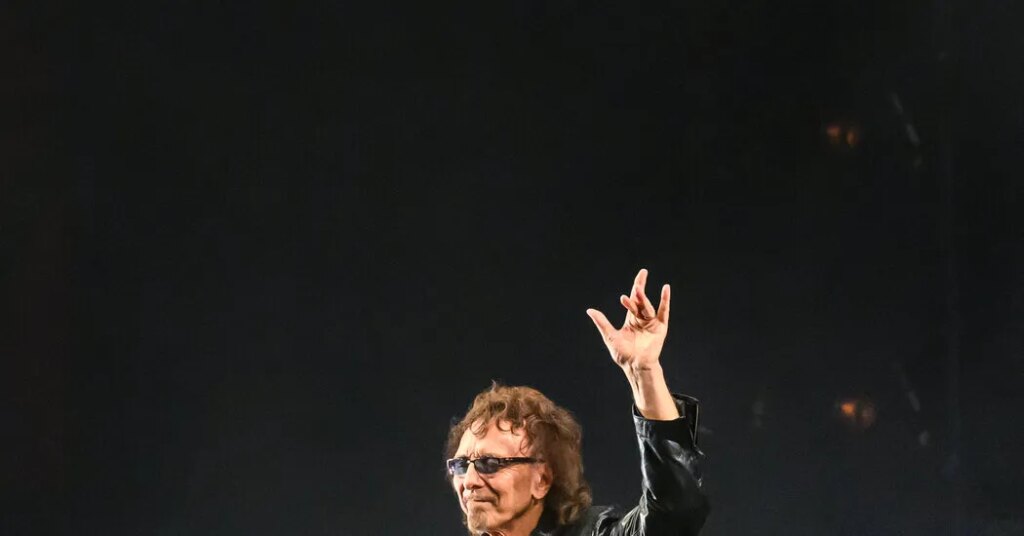
For Tony Iommi, 2025 was a momentous year, marked both by the final live performance of Black Sabbath, the pioneering heavy-metal band he co-founded close to 60 years ago, and the death of the group’s iconic frontman, Ozzy Osbourne. After all that, one might assume that the guitarist, 78, would be eager for some downtime.
Hardly: On Friday, Iommi will reveal “From the Dark,” his first solo album in more than 20 years, and a font of weighty inventions from the man whose riffs powered “Iron Man,” “War Pigs” and “Paranoid.”
“I just can’t imagine myself stopping unless I had to,” Iommi said in a video interview from his home in England. “It’s a necessity for me to have to play. It’s like eating; I have to do it,” he continued in a Brummie-accented register as gentle as his music is forbidding. “I enjoy doing it. I enjoy keeping my mind going, coming up with ideas.”
Written in collaboration with Iommi’s longtime producer Mike Exeter and the Norwegian singer Jorn Lande, who handles all vocals and lyrics, the new LP features a variety of moods and tempos but gravitates toward the low-and-slow register that is Iommi’s wheelhouse.
“I just like the idea of big riffs,” he said, sporting his signature goatee and purple-tinted glasses, and speaking in front of an array of axes including the cherry-red Gibson SG model he has played since the late ’60s. “I always have done.”
Midway through “Legacy,” the album’s closing track, Lande sings what feels like a mission statement for the entire LP.
“This is my legacy / I bring you fire,” he roars over a particularly Stygian Iommi riff. “Can’t let my destiny fade or expire.”
As Lande explained in a video interview from his home in Sweden, he intended the song in part as a tribute to Iommi’s “positive, young energy.”
“He’s not retiring or trying to do something that fits his age,” he said. “He’s still dedicated and passionate about making the best record of his life.”
Iommi credits early inspirations like the Shadows, a British instrumental rock combo popular in his youth, and John Mayall and the Bluesbreakers, which featured a young Eric Clapton, for instilling his love of the riff. But the sound Iommi put forth on Sabbath’s self-titled debut (1970) was far more imposing, actively intended to inspire terror à la the midnight horror movies Iommi and the band’s bassist Terence Butler, known as Geezer, were fond of checking out.
“We liked the vibe that the movie would give you,” Iommi said. “Sort of scary, bit edgy.” They hit upon the idea of “doing something that was like a film in music.” The vision crystallized on the eponymous opening track of “Black Sabbath,” a sonically ghastly tale of a visit from a Grim Reaper-like apparition, its title — and later the band’s name — taken from a 1963 Mario Bava horror anthology film.
The influence of Iommi’s early creations is incalculable. As the guitarist Zakk Wylde, who played Iommi riffs for decades as a member of Osbourne’s solo band, put it in a phone interview, “I would say he’s the Henry Ford of hard rock.” Wylde was among the players at the final Sabbath show, in July 2025, which doubled as a heavy-metal summit and will hit theaters as a concert film on Oct. 28. Running down the lineup, he said: “From Tool to Metallica, to Pantera, every band that was on that thing, they’re an offshoot of the Model T.”
For Iommi, Sabbath’s finale was gratifying but fraught. It marked a reunion of the band’s original lineup after the conspicuous absence of the drummer Bill Ward from the group’s last album in 2013 and the extensive international touring that followed. But from the moment rehearsals began, Iommi had been concerned about the condition of Osbourne, who suffered from numerous health issues in his later years including Parkinson’s disease, and performed the show seated in a custom-made throne.
“I knew he’d got problems, and he’s had problems for a long time,” Iommi recalled. “But when I actually saw him when he came in the room, it was almost like life had been sucked away.” “He just looked not the same,” he added, “and all of us, Geezer and Bill, we were just in shock.”
Onstage, too, Iommi felt disoriented.
“It was a real difficult gig for me, because I’m so used to seeing Ozzy running around,” Iommi said. “It was almost like you’re on your own there, because always in the past, Ozzy would run up and pull a face to me or Geeze, jokingly. We’d have a little laugh onstage. And here we are doing a show playing with Bill, who we haven’t played with for 20 years live, and Ozzy in a throne at the front. It was just a weird feeling, and it was sad, really.”
Iommi praised the completed film of the event and the other bands’ performances, but reviewing the footage recently, he said, “I couldn’t help but get that feeling again of sadness.”
Iommi was Sabbath’s sole consistent member. For years after the band’s initial split with Osbourne in 1979, he held it together amid countless lineup changes. (One incarnation, fronted by the former Rainbow singer Ronnie James Dio, began life at the turn of the ’80s as Sabbath 2.0, but eventually grew into a separate project called Heaven & Hell.) Throughout Sabbath’s life span, he released only three solo albums, all made in close collaboration with other vocalist-lyricists: “Iommi,” in 2000, featured an array of prominent younger singers from the worlds of metal and alternative rock, and two LPs with the former Deep Purple singer Glenn Hughes, who had appeared on an obscure mid-80s Sabbath album.
Since Sabbath stopped touring in 2017, Iommi had been stockpiling riffs as usual and mulling the idea of a new solo project. In 2021, he released “Scent of Dark,” the first of two new instrumentals paired with fragrances he helped design for an Italian perfume company. He and Exeter, who also added keyboards and orchestrations to the new album, considered continuing in that vein but, as Exeter explained in a video interview, “Then you get the odd song where it’s like, ‘This needs a vocal.’”
Lande, a veteran of many European hard-rock and metal projects, first entered Iommi’s orbit during the demo phase for “Fused,” the guitarist’s 2005 album with Hughes. None of those trial recordings ever surfaced, but Iommi and his team kept the singer in mind, and in 2010, they invited Lande to front Heaven & Hell at a live tribute to Dio, who had recently died. In 2024, Iommi’s manager, Ralph Baker, got back in touch, asking Lande to write vocals and lyrics for two new songs, both of which ended up on the album, and set the direction of the project.
“For any singer of my genre — plus, minus my generation — this is probably the most significant gig you could get,” Lande said.
His fiery, dramatic approach places the new album firmly in the Heaven & Hell lineage. Much as Dio did, he uses his raspy belt to bring pathos to Iommi’s seismic crunch on album standouts such as “Black Times” and “Death Wake.”
“I like how he sings,” Iommi said. “He’s passionate. He gives everything. He puts life into it.”
Lyrically, Lande opted for classic metal themes of struggle and triumph, mixing in a bit of commentary on the dire state of the planet.
“I just believe that if a singer does his own lyrics, he can put things over more powerful, like Dio did,” Iommi said. “There’s certain words that they can pronounce that gives it that guts.”
Rounding out the album cast are the Birmingham bassist Becky Baldwin, whose online covers of Sabbath songs and other metal classics impressed Iommi and Baker, and Karl Brazil, a drummer friend of Exeter who tours with the British pop star Robbie Williams.
Iommi relished the mix-and-match approach of his first solo album, but here, he said, “I wanted a band situation.” Instead of name recognition, he added, “I wanted people who really love playing, who believe in what they’re doing, and believe in the songs.” (Another better-known believer: the Queen guitarist Brian May, a longtime friend, who contributes a guest solo on “Death Wake.”)
Iommi isn’t sure at this stage if the band will perform live. “The main thing for me was to do the album and enjoy it,” he said. That one-day-at-a-time ethos comes in the wake of the heaviness of Sabbath’s end, as well as a 2012 lymphoma diagnosis and subsequent treatment, which he said has left his cancer in remission.
Iommi’s positive outlook aside, the overall mood of the project is the same one he’s been mining since Sabbath’s earliest days. So what keeps him returning to the dark?
“I don’t know really,” Iommi said. “Maybe I’m grim.” Then he broke into a wry chuckle, quickly debunking his theory.
The post Tony Iommi Keeps Looking for Joy in the Darkness appeared first on New York Times.