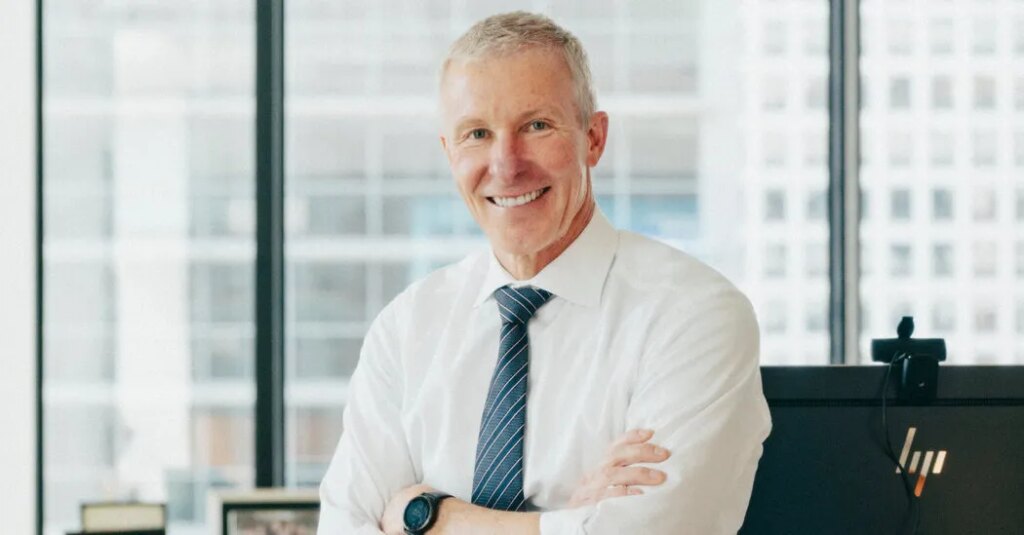
Scott Kirby wants to be known as someone who moves on quickly after a disappointment.
Ten years ago, he was let go from American Airlines after being passed over for the top job. He was furious. But after telling his wife, his next call was to a board member of United Airlines. He was hired at United in 2016 and named chief executive in 2020.
His goal was to best his former employer.
“For a long time, I said our goal is to be the best airline in the history of aviation,” Mr. Kirby, 59, said. “I think we’ve become the best, not at everything, but in totality, I think we’re the best.”
Mr. Kirby took over at United during the Covid-19 pandemic, the worst crisis the airline industry had faced since 9/11. Things have largely turned around for the industry since then, and United’s stock has risen more than 300 percent during Mr. Kirby’s tenure.
While things may be looking up for United, for many travelers, flying is miserable: delays, lost luggage, chaotic boarding processes and cramped seats.
It’s United’s job — and his — to take stress away, Mr. Kirby said. As a father of seven children, Mr. Kirby often looks at air travel through a parent’s eyes. Investing in better Wi-Fi, having more movies and TV shows available and developing a user-friendly app, he said, all help reduce the stress of traveling, especially with children.
But Mr. Kirby pushed back on one common customer gripe: rising airfares, which nationwide were up more than 22 percent in September from a year earlier. He said that fares are still lower in inflation-adjusted terms than they were in 2019.
Unlike many chief executives of large public companies, Mr. Kirby seems to relish expressing contrarian opinions. He defends fees for aisle and window seats. He dismisses most of the ways that people use artificial intelligence as “ridiculous.” And he endorses the idea of a national wealth tax — not your usual C.E.O. stance.
This interview was edited and condensed.
Air travel can be arduous and frustrating. If you’re not a frequent flier with United, you have to pay $70 to not be in a middle seat. How do customers without frequent-flier status fit into your strategy?
We made a lot of investments in premium, but most of investments we’ve made apply to every single person on the airplane. We’re going to have fast, free Starlink. Seat-back entertainment for every customer.
Some people just want to get from A to B at the cheapest price possible. There are some customers who want to sit in a window seat or a better seat, and that costs money to deliver. The way to give everyone what they want is to charge for the services and products that those customers want.
Then do you disagree with the premise that the frequent fliers are the haves and other travelers the have-nots?
I would never describe it that way. There are customers that pay more that get more.
With the war in Iran, fuel prices have risen and airlines, including United, have raised prices. Where will we be on prices long term?
Prices have gone up this year, but the truth is they’re really bouncing off an artificial low from Covid. This year, Spirit Airlines shut down. Four out of the eight publicly traded U.S. airlines are going to lose money this year. We have to charge enough that it covers the cost of flying, and it’s expensive to fly airplanes.
What’s your management style? It’s been described as brusque.
People confuse management and leadership. Management is about compliance.
Leadership is about inspiration and vision. I’m more focused on leadership today than I was in the past. As C.E.O., if you are making too many decisions, you have to make all decisions. Everything gets punted to you. My job is really to make five decisions a year — the big decisions with no clear right or wrong answer that only the C.E.O. can make.
Was that hard to learn?
That was hard. But once I started doing it, you realize how much better the team around you gets.
What was the inflection point?
One was going through the experience of being told you’re going to be the C.E.O. and then, “Oh, I changed my mind and now you’re fired.”
At American Airlines?
At American.
The biggest thing I’ve changed is realizing that even when I know the right answer, taking the time to make sure everyone else feels good about the answer is 100 times more effective.
You’ve been at United for 10 years. Does how it ended at American still sting?
Stinging isn’t the right word. It felt more like a betrayal. I wanted to go somewhere else and prove something.
So what’s your advice on moving past a bad work experience like that?
I am a better C.E.O. of United Airlines because of what happened than I would have been a C.E.O. of American. It did force introspection.
I firmly believe in no excuses, and when bad stuff happens to you, it doesn’t matter if it’s fair, it doesn’t matter if somebody treated you wrong, it doesn’t matter why. The only person that can make it better is you.
Do you have any concern that the general public seems to have less trust in C.E.O.s, and do you have any responsibility for dispelling that?
Wealth inequality has become a danger to our society, and we need to address that.
We should have a national wealth tax — it won’t work by state because people will just move. And I think we should have inheritance taxes that get close to 100 percent at some level. I would pay them.
How are you personally using A.I.?
The way that most people use A.I. is ridiculous.
Say more.
Using A.I. to summarize is like reading a summary of the CliffsNotes. I want to read a book because the interesting stuff is in the spaces in between. I want to find the things that nobody else has figured out.
I think A.I. is incredibly powerful for a certain class of problems. I actually hired an A.I. tutor to learn to program.
Like a human tutor? We have to clarify these days.
Yes. I took three one-hour lessons. It was eye-opening. That made me an evangelist for using A.I. for programming in particular.
Let’s rewind. You grew up outside of Dallas. Tell me about your upbringing.
I have five brothers and sisters. I hit the jackpot on parents. My mom was the most involved mother you could be. She raised six kids, and, when she was in her 40s, she went back to law school, graduated summa cum laude and became a lawyer.
My dad was an accountant. What he gave me, which I now really appreciate, was time. His mother lived in a place called Goldsboro, Texas, and had cattle. We would go at least every other weekend, help with the cows, hunt. In fourth grade, I got my first shotgun.
You have seven children yourself. You live in Dallas, but United’s headquarters are in Chicago. What does work-life balance look like for you?
I am really efficient with time. My normal schedule, I sleep eight and a half hours a night. I work out every day for about an hour. I read three hours a day. I limit myself to no more than four hours of meetings on average a day, usually a lot less. I spend a lot of time calling people and talking to them.
My job is not to work hard. My job is to think hard.
I also spend lots of time with my kids when I’m at home. We have a routine at night: I start the putting-to-bed process — it’s about an hour — and we play hide-and-seek and chase and we read books. We tell spooky stories.
What is it like to travel with your family?
It’s not easy, but I get a lot of help.
Let’s go to the lightning round. What’s the first thing you look for when boarding a plane?
Smiling, positive flight attendants.
When interviewing someone for a job, what’s the most revealing question you ask?
The only question I ask every single person is: What advice do you have for me? Are they willing to tell me things that they think we can do better?
What’s the last question you asked A.I.?
My son started buying baseball cards, and he wants to try to sell them. I asked about the best place to buy and sell cards.
It gave bad advice.
What’s your most contrarian take?
I don’t know if this is contrarian or not: I think A.I. is going to be really powerful, but we are in an investment bubble. There’s just no way it’s going to generate that amount of revenue.
Give me one more.
I think the future of the United States is incredibly bright. I am not down in the dumps like a lot of people. I think, by the way, people on both sides of the aisle want to do the right thing for the country.
What’s your biggest pet peeve as C.E.O.?
I cannot stand anything that wastes time.
Do you always fly commercial?
Almost exclusively. I occasionally fly private. It’s rare, but if I do, it has a P.R. risk.
It’s important to fly commercial: I’m seeing our product. I fly other airlines, too. I see competitors’ products, and I learn a lot.
The post United’s C.E.O. Says It Should Cost More Not to Sit in the Middle Seat appeared first on New York Times.