Wandering the cobbled streets of old Córdoba, I’m drawn to a commotion on a square. It’s almost midnight — everyone’s out, savoring a cool evening. Short men with raspy tobacco voices and big bellies — called curvos felicidad (happiness curves) — jostle and bark as a dozen little schoolgirls rattle a makeshift stage, working on their interpretation of “sultry.” The scene takes me back to my earliest visits to southern Spain, when the region was far more rustic, even exotic-feeling, to my American eyes. But tonight it’s clear that even in the era of smartphones and straightened teeth, Andalusia’s flamenco culture still thrives.
While Córdoba is among Andalusia’s top three cities for sightseeing (with Granada and Seville), most visitors come just to see its famed Mezquita — a vast mosque with a cathedral built in its middle and one of the glories of Moorish Spain. The Mezquita is surrounded by a zone of shops and tour-group-friendly restaurants, but beyond that, the city has almost no crowds. And late at night there are fewer tourists yet.
Meandering the virtually empty residential back lanes of old Córdoba, you can catch an evocative whiff of the town when it was largely untouched by the modern world.
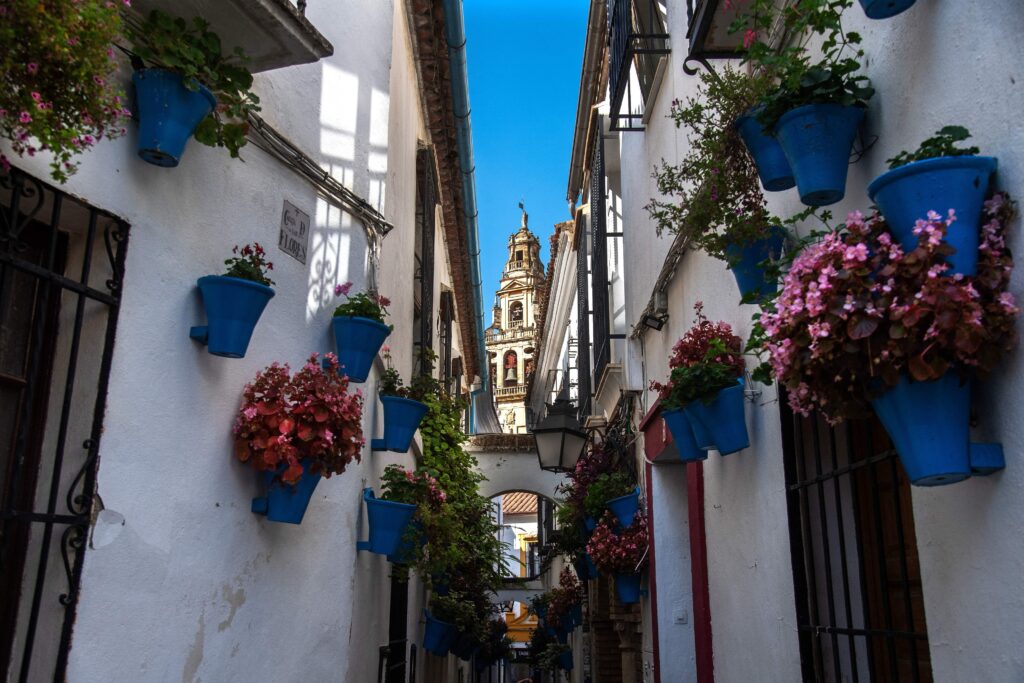
Streets are narrow — designed to provide much-appreciated shade — and thick, whitewashed walls offer a kind of natural air conditioning. Brightly painted doors and window frames pop amid the monochrome whitewash. The iron grills covering most windows — the older ones more artistic, the newer more practical — are reminders of the persistent gap through the ages between rich and poor. Stone bumpers on corners protect buildings against reckless drivers, and keen observers may note that many are scavenged ancient Roman pillars. Lanes are cobbled down the middle with rounded stones from nearby rivers, arranged to drain water while flanked by smooth stones that stay dry for walking. Remnants of old towers from minarets survive, built into today’s structures. Muslim Córdoba peaked in the 10th century with an estimated 400,000 people … and lots of now-mostly-gone neighborhood mosques.
In Córdoba, domestic life revolves around each home’s patio — a common feature of houses throughout the region. The distinctively Andalusian patio evolved from the atrium of occupying Romans, and the Moors added lush, decorative touches. It’s long functioned as a quiet outdoor living room, an oasis from the heat. Inside elaborate ironwork gates, roses, geraniums and jasmine spill down whitewashed walls, while fountains play and caged birds sing. Some patios serve as communal courtyards for several homes, and patios also grace public buildings such as museums and convents. And in Córdoba’s old town, their beautification is taken very seriously — especially in May, when a fiercely competitive contest is held to pick the city’s most picturesque.
If you stroll Córdoba’s backstreets, pop your head into any wooden door that’s open, as homeowners enjoy showing off their picture-perfect paradises (inner iron gates stay locked). A concentration of Córdoba’s previous patio contest award winners runs along Calle San Basilio and Calle Martín Roa, just across from the Alcázar’s gardens.
As the sun goes down, the flowers’ colors fade, but the cultural colors grow brighter as the Spanish day picks up energy. Admittedly, I’m not keen on napping through key sightseeing hours, but in Spain I find that an early evening siesta lets me recharge enough to enjoy the late-night fun that most tourists miss.
It’s always striking how, anywhere in Spain, a restaurant recommended in all the guidebooks can feel like a tourist trap at what most non-Spaniards consider dinnertime … but by 11 p.m., the same space feels like a local secret. After virtually all the tourists have long since headed back to their hotels, locals retake their turf. Outside the restaurants and bars, Spaniards of all ages gather in squares and stroll promenades. This phenomenon seems especially stark in well-touristed, yet still deeply traditional, Andalusia.
Despite my decades of experience with late-night Spanish exuberance, it still often catches me by surprise. On one visit, after a morning spent marveling at Córdoba’s sights, an afternoon exploring its countless back lanes, and a convivial night crawling its tapas bars, I went to bed well after midnight. The city finally seemed quiet. Just as I dozed off, a noisy and multigenerational parade rumbled down the cobbled lane that I’d thought promised a good night’s sleep. Standing in my underwear and wrapped in the drapes, I peered furtively out my window. Below, a band of guitars and castanets with a choir of those raspy voices funneled down my narrow alley. I watched as grandmothers — guardians of a persistent culture — made sure the children were picking up their Andalusian traditions. I felt like a peeping Tom … until one woman looked up at me, caught my eye, and nodded, seemingly satisfied that I was witnessing the enduring richness of their heritage.
This article is used with the permission of Rick Steves’ Europe. Rick Steves writes European guidebooks, hosts travel shows on public TV and radio, and organizes European tours.
The post The joys of strolling Córdoba’s cobbled backstreets appeared first on Washington Post.