PHOENIX — As the campaign team for Arizona’s attorney general crafted a recent attack ad denouncing her opponent’s “extreme record,” they weighed two options.
They could zero in on their Republican opponent’s stance on abortion — one of Democrats’ strongest and most impassioned issues in recent election cycles. Or they could hit him on water policy, a perennial snooze-inducer.
They went with water.
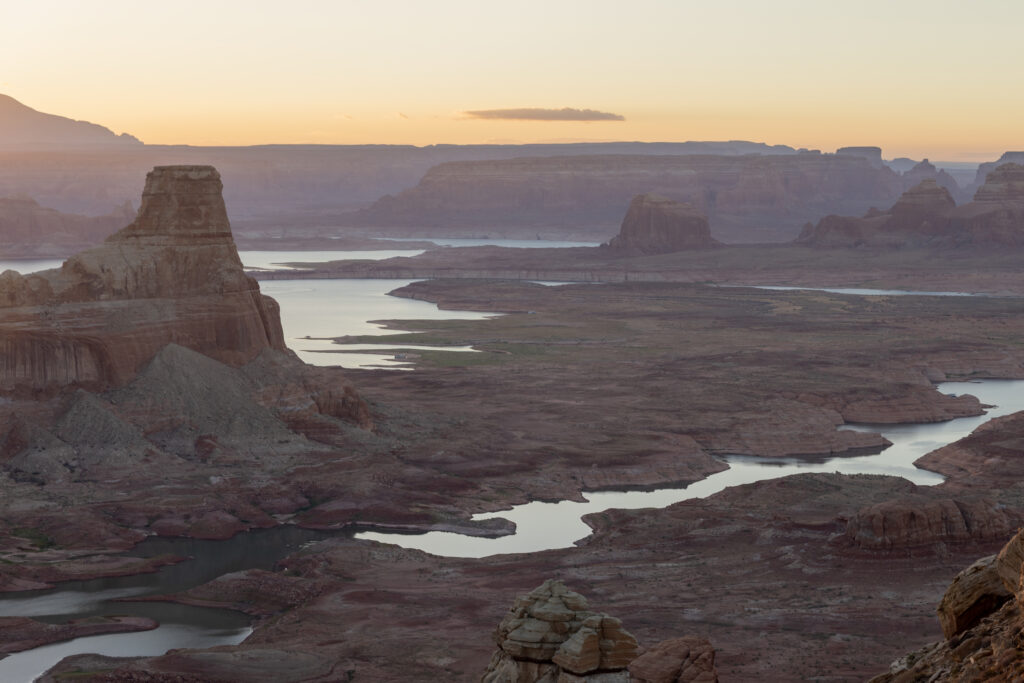
The ad pans over parched desert and plays audio of state Senate President Warren Petersen asserting, “We have plenty of water.”
“I don’t go to a single event where water is not brought up in some way,” the candidate behind the ad, Democrat Kris Mayes, said in an interview. “This is not an esoteric, academic issue. This is a kitchen table, existential economic issue that is facing Arizonans.”
As the Colorado River shrinks and a Southwest “megadrought” drags on, water is top-of-mind in this sun-seared state. Cities are bracing for cutbacks. Farmers are letting fields go fallow. Neighborhoods are revolting against data center projects they say will hog resources.
And politicians are talking about water like never before. The traditionally wonky topic has become a major issue in midterm races, showcasing just how concerned the public is about the Southwest’s water future.
Gov. Katie Hobbs (D) and her allies are spending millions on ads saying she will “fight to ensure Arizona’s water is for Arizonans.” Her challenger, Rep. Andy Biggs (R), has blasted Hobbs’s handling of Colorado River negotiations and discussed the merits of “desal” — short for desalination — from the debate stage. Mayes, the attorney general, has mentioned water in almost all of her ads this election cycle and plans to focus on it in her closing spot this week.
Asked about the top issue facing Arizona, voters were more likely to pick water than they were to pick inflation, education or housing costs, one recent poll found — a shift from previous election years. Anxiety about the issue crosses party lines and demographics.
“There’s panic,” said pollster Chuck Coughlin, whose firm worked on the survey. A large swath of Arizonans don’t believe the state has the water to sustain its economic growth, he said.
Whether that fear is justified is a point of debate. Biggs, the Republican nominee to lead the state, accuses the Democratic incumbent of sowing unnecessary alarm. Arizona has plenty of water underground, he often says, and the state needs to tap into more of it.
Hobbs, the incumbent, is “engendering panic,” Biggs said in an interview, “and I’m engendering leadership and optimism.”
Hobbs talks more about the need to conserve and has pushed for regulations she says are necessary to safeguard the water stored underground.
“Arizona has some of the strongest water protection in the country,” she said, and Biggs’s approach is “just absolutely irresponsible.”
Arizona has had droughts throughout its history, but with the aid of massive federal water projects, has more than tripled in population in the last 50 years to more than 7.6 million people.
Worries flared up this year as the federal government laid out a new plan to manage the dwindling Colorado River, cutting water to Arizona, Nevada and California.
Taps won’t go dry, experts say, in part because Arizona has already reduced its water use over the years. But the federal plan leaves the door open to steeper reductions that Arizona officials warned could be catastrophic and sued over last week. Arizona holds more junior rights to the river, so it’s especially vulnerable to further cuts.
Reservoirs have already fallen perilously low — with one lake so dry this year that a small town nearby let its Little League field go dry and temporarily forbade residents from washing cars or watering lawns. Some farmers stopped getting water.
Lots of water is “banked” in aquifers under Phoenix and Tucson, said Sarah Porter, director of the Kyl Center for Water Policy at Arizona State University. But she likened those aquifers to an emergency savings account.
“It might be a pretty healthy emergency savings account, but once cuts occur, that’s the shift from building up that emergency savings to depleting it,” she said. “And that’s really the concern.”
Celinda Lake, a pollster for the attorney general, said she was stunned by the intensity of voters’ feelings on water. Independents are “really hot” on the issue, she said; focus groups of Fox News-watching men were fired up about “the way our water is being stolen and taken and misused.”
Mayes and Hobbs have both touted their role in cracking down on a Saudi-owned farm that used copious water to grow alfalfa shipped abroad — a controversy that made headlines and that many voters remember.
Other candidates have tied water to voters’ broader cost-of-living challenges.
Anti-Hobbs text messages criticize rising water bills. Biggs has accused the Hobbs administration of driving up home prices with stringent water requirements that stalled new buildings in parts of the Phoenix area.
In an affordable housing crunch, state authorities pushed to “stop building where we need it most,” said Jonathan Riches, vice president for litigation at the Goldwater Institute. The organization sued on behalf of home builders and got the new rules blocked in court.
Hobbs’s team notes that the Phoenix area is still one of the top spots in the country for new home construction. “We are showing that we can continue to grow and support the growing economy while continuing to save water,” the governor said.
But voters are anxious.
Melanie Lawrence, a 68-year-old independent, worries about wells going dry in her area near Willcox, where the groundwater grew so depleted that the land started to crack.
“We’re in a world of hurt … trying to put our finger in the dike,” Lawrence said.
The post In a thirsty swing state, the hot-button issue is water appeared first on Washington Post.