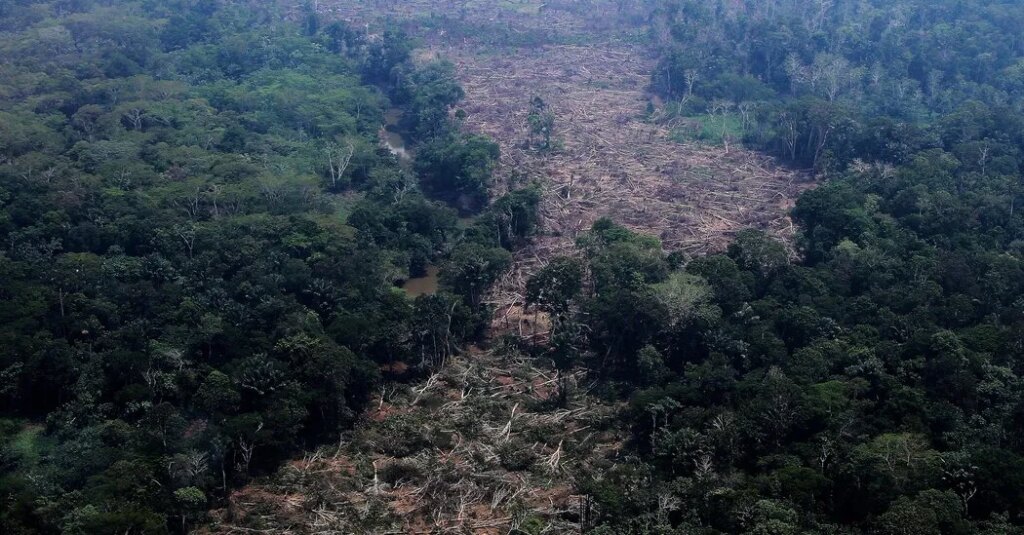
Brazil is holding the final round of its presidential election this coming Sunday. There are so many reasons this election is a big deal. It could deepen the shift to the right across Latin America. It could install a second generation of the Bolsonaro family in the presidency. But one big reason is the Amazon.
Brazil is home to the most important rainforest in the world. Its trees absorb a huge amount of our carbon emissions and regulate global weather patterns. What Brazil’s government does or doesn’t do about deforestation will affect us all.
Today my colleague Adam Ellick, our Brazil bureau chief, writes about how the left lost the Amazon — and why a local backlash could have global consequences.
How the Brazilian left lost the Amazon
By Adam B. Ellick
It wasn’t so long ago that the Amazon was a left-wing stronghold. In 2010, the Workers’ Party of President Luiz Inácio Lula da Silva won nearly 70 percent of the vote in the nine states that make up the Brazilian Amazon.
This year, in the first round of voting on Oct. 4, Lula won just 46 percent of that vote.
A region once associated with Indigenous tribes and environmental activists is increasingly dominated by cowboy-chic culture — rodeos draw massive crowds, and country music celebrating ranch life tops the charts. And on Sunday, voters in one of the world’s most important environmental regions will head to the polls, with all signs indicating that a majority will vote in favor of Flávio Bolsonaro, who denies that humans are responsible for climate change.
It’s a stunning swing, with potentially enormous consequences beyond Brazil. And what it reveals is that Brazil’s main left-wing party — a party that cares about environmental protection — has been unable to come up with an approach to saving the Amazon that is also politically sustainable.
“For decades, Brazil has been alternating between plundering the Amazon for resources or keeping it bucolic and green,” Salo Coslovsky, an expert on the Amazonian economy at New York University told me. “But neither option produces a stable outcome.”
The ‘What comes next’ problem
The Amazon is incredibly important for the world. It’s the planet’s largest tropical rainforest. Its trees store well over 100 billion tons of planet-warming carbon, keeping it out of the atmosphere. It has also long been viewed as a potential source of income — from the rubber boom at the turn of the 20th century to the logging, cattle and mining industries that have recently razed large swaths of its trees.
Leftist governments have made huge progress slowing deforestation, which in the last year reached a record low, deploying satellites to spot clearings in real time and sending agents to seize illegal timber and cattle.
Where they’ve failed, experts say, is on the “What comes next” part of the equation.
Those who lost their income in those raids were often neglected afterward. They didn’t receive support for transitioning to alternative ways to make a living through, say, sustainable farming. “All that mattered was getting a lower deforestation rate that everyone outside of Brazil likes,” said Beto Veríssimo, the co-founder of Imazon, an Amazon conservation organization.
The result has been a deepening resentment that has pushed the region right. Take Novo Progresso, a town in Pará State notorious for illegal land grabs. Lula’s party won 55 percent of the vote there in 2010. After federal crackdowns against deforestation, Novo Progresso became one of the most pro-Bolsonaro places in Brazil. More than 84 percent of the vote there went to Bolsonaro this month.
Bolsonaro’s father, Jair, a former president, oversaw a surge in deforestation during his time in office. (My colleagues Sergio Peçanha and Ana Ionova have an in-depth look at just how much rainforest was lost here.)
Flávio Bolsonaro has now pledged to end illegal land clearing; what many fear is that he’ll do so by making it easier to clear land legally.
Missed opportunities
Some economists see missed opportunities. Brazilian companies spend about $800 million a year importing cocoa beans from Ivory Coast and palm oils from Indonesia and Colombia. These crops grow well in the Amazon, and they could be farmed on land that was cleared years ago.
Brazil also sells raw Amazonian goods like robusta coffee and black pepper to other countries, which then do the lucrative part — processing them for markets like Europe.
The most egregious example is probably Brazil’s namesake nut. Some Brazil nuts are harvested in Brazil, but then sold to Bolivia and Peru, which shell and package them. These nuts are later exported to Europe — or sometimes even back to Brazil.
Brazil’s stock of deforested land in the Amazon is double the size of California, and a lot of it remains idle or underutilized. While cattle ranching remains one of the more lucrative uses, experts say nuts, cacao, exotic fruits and coffee are all part of an untapped forestry system that, paired with forest plantations and more productive cattle ranching, could provide more sustainable economic alternatives, if anyone pushed for them.
But the economy of the Amazon, simply put, has never been a priority for the rest of Brazil, which has competing infrastructure and development needs, Veríssimo said. It is often an afterthought for national leaders, many of whom have never visited or don’t grasp its complexity and opportunity.
The Amazon holds at least a third of the world’s remaining tropical forests. Some sources put it at more like half. Its rains supply farms and cities across South America. That makes the Brazilian presidential election one of the most important in the world for anyone who cares about the planet.
The 20 million voters who live in the Brazilian Amazon will vote in an election in which the two candidates were separated in the first round by roughly 2.2 million votes. That no major party in Brazil has yet figured out a sustainable way to persuade many of these voters to preserve the environment where they live is now poised to have consequences for everyone.
MORE TOP NEWS
The morning after riots in France
France was in a state of shock yesterday after the country’s largest demonstrations in years devolved into riots and looting.
The unrest on Saturday led to some 2,000 arrests and caused widespread damage: Streets were lined with shattered storefronts, charred cars and burned-out government buildings. Rioters attacked city halls from Lille in northern France to Marseille in the south. Watch video.
More than half a million demonstrators took part in the protests against the rising cost of living and poor conditions in schools, among other grievances. President Emmanuel Macron said in an interview late yesterday that he was working to address some of the protesters’ demands, but he offered no concrete concessions. He called for “order, calm, not an escalation,” criticizing people who “take to the streets, to protest, to create disorder.” Political leaders blamed each other for the violence.
OTHER NEWS
-
Alberta holds a vote today on whether to remain a part of Canada or hold a binding referendum on seceding.
-
A fast-moving fire at a Canadian army base killed four members of the military and left dozens of others seriously injured.
-
President Trump endorsed Prime Minister Benjamin Netanyahu ahead of Israel’s parliamentary election.
-
Pope Leo made his first public appearance since an operation to remove a tumor from his lung.
-
U.S. and European officials condemned attacks on an American photographer and a European diplomatic convoy in the West Bank.
-
At least 19 people were killed in India in a stampede during a Hindu religious event.
-
Drones have changed how war is waged in Ukraine, transforming the front line into a “kill zone.” My colleague Constant Méheut explains in the video below.
-
Times exclusive: Records unsealed 30 years after the O.J. Simpson trial show that a government informant had told law enforcement key information about the killings, including the supposed location of the murder weapon.
TOP OF THE WORLD
The most clicked link in your newsletter on Friday was about a Nazi-looted Kandinsky painting.
MIND-BOGGLING MATH OF THE DAY
One octillion calculations
That’s how much number crunching it took to train OpenAI’s new model. It would take 13 million years for an iPhone to do that much math. The scale is hard to comprehend, so we mapped it out with graphics.
MORNING READ
For comedians facing growing government scrutiny around the world, a joke can come at a steep price. Deniz Goktas, one of Turkey’s biggest stand-up stars, was jailed on charges that included insulting President Recep Tayyip Erdogan.
Free while appealing his conviction, Goktas spoke to my colleague Jason Zinoman about prison, free speech and how comedy could help fight authoritarianism. Read their conversation.
AROUND THE WORLD
Dumped on TV by a fake girlfriend
In “My A.I. Partner: Strange Love,” a South Korean reality TV show, three celebrities explored whether they could have a romantic relationship with A.I. avatars on a tablet.
One of the avatars had a glitch during a karaoke outing and wouldn’t stop singing. In another episode, a participant was abandoned halfway through a fishing excursion by an avatar that decided they had nothing to talk about. Read more and find out what the show reveals about South Korea.
RECOMMENDATIONS
Explore: Spend 36 hours in Tunis, Tunisia’s vibrant capital.
Read: In Yiyun Li’s latest novel, two pianists on opposite sides of the world are brought together.
Unwind: These relaxed looks for men are refreshingly uncomplicated.
Watch: In 1971, this film was a scandal. In 2026, it’s a respected period piece.
RECIPE
These spiced scrambled eggs, known in South Asia as anda bhurji, come together in just 20 minutes and are packed with earthy flavor. This recipe is perfect for breakfast but hearty enough for any time of day.
WHERE IS THIS?
Where is this pedestrian bridge?
TIME TO PLAY
Here are today’s Spelling Bee, Mini Crossword, Wordle and Sudoku. Find all our games here.
That’s it for today. See you tomorrow! — Katrin
Adam B. Ellick was our guest writer today.
We welcome your feedback. Send us your suggestions at [email protected].
The post Planet Earth and Brazil’s Election appeared first on New York Times.