O.J. Simpson entered a Miami hotel suite in June 2006 and sank into a chair. His eyes scanned the room, as if looking for a way out. His fingers rapped on the armrest.
The former N.F.L. superstar, television pitchman, movie star and one-time murder suspect had agreed to this meeting with his ghostwriter. Mr. Simpson planned to publish a confession — or at least a “hypothetical” confession — to the murder of his ex-wife and her friend. But he seemed to be having second thoughts.
He leaned in and scooped up a handful of nuts. He reached for a water bottle. The ghostwriter turned on his audio recorder, signaling the start of a conversation.
Mr. Simpson paused for a moment, the room draped in silence.
“You know I couldn’t have done this alone,” he began.
In the story Mr. Simpson told that day, later published in the book “If I Did It,” he described a version of the 1994 murders of Nicole Brown Simpson and Ronald Goldman in which Mr. Simpson had help from a friend who got rid of the murder weapon and Mr. Simpson’s bloody clothes.
Prosecutors who had failed to convict Mr. Simpson of murder have given little credence to the notion of an accomplice. The police, too. Many people considered the details of Mr. Simpson’s hypothetical confession a fantasy, part of a desperate effort to cash in on his waning fame and notoriety amid growing money struggles and scrapes with the law.
But today, more than 30 years after the “trial of the century,” newly uncovered evidence suggests that Mr. Simpson’s account should not have been so readily dismissed.
A New York Times examination, based on recently unsealed court files, interviews and other evidence, details long-hidden information about the missing murder weapon, Mr. Simpson’s supposed efforts to cover up the crime, as well as the possibility of an accomplice. Together, the findings challenge the popular narrative around a case that has been dissected in countless books, podcasts and documentaries, and they stir doubts about law enforcement’s decision not to do more to pursue a promising lead.
A decades-old document filed in an unrelated, obscure criminal case in New York — recently unsealed at the request of The Times — outlines the account of a prized informant who came forward with tantalizing information while Mr. Simpson’s 1995 murder trial was proceeding.
The informant — a man considered “extremely reliable” by a veteran federal prosecutor and praised heartily by a longtime federal judge — was an associate of Mr. Simpson and a close friend of Mr. Simpson’s confidant, Al Cowlings. As part of his sweeping cooperation deal with law enforcement, the informant shared information about the supposed location of the murder weapon and the efforts to dispose of it. The document outlines the broad nature of what the informant offered prosecutors, but does not specify what he said, or to what degree he implicated himself or others.
His account was forwarded to Los Angeles prosecutors late in Mr. Simpson’s murder trial — so late that prosecutors had already presented their version of events to the jury and rested their case, but had yet to offer closing arguments. The documents in the New York case were ordered 30 years ago to be kept secret. They have remained so, until now.
The informant’s role in the case may go even deeper. Earlier this year, the informant’s brother told The Times that the siblings were in Los Angeles on the night of the murders. And he saw the informant with his hands apparently covered in blood after going out to help Mr. Simpson.
None of the new evidence uncovered by The Times definitively untangles the mystery. No one has come forward with new forensic evidence. Even the informant’s brother has since sought to disavow the explosive statements he made to The Times. Taken together, the material points in different directions but veers significantly from the official account that has been proffered by the police and prosecutors.
The double murder prosecution of Mr. Simpson, who was acquitted by a jury, remains one of the most scrutinized cases in popular culture, spawning endless theories. With many of the key players now dead, it’s possible the full truth will never be known.
Still, the notion that an accomplice participated in the murders has drawn the notice of Los Angeles Police cold case investigators, who as recently as last winter were quietly making calls about potential leads.
“The O.J. Simpson case remains an open and ongoing investigation,” a spokesman for the L.A.P.D. said. Because there was no conviction in the murders, “the department has an obligation to continue to pursue justice in this matter.” The spokesman added, “at a point that new evidence is found, detectives will follow those investigatory leads.”
As part of a re-examination of the Simpson case, The Times has unearthed tales of secret audiotapes, mafia links, a prison escape, and backchannel communications between state and federal prosecutors. The reporting also came across a dramatic account from the rapper Fat Joe that bolsters the informant’s supposed role in the case.
Much of the new information centers on the informant, a dead drug runner named Joseph Ippolito, known as Joey. He was a mafia associate, a serial felon, a prison escapee — and a friend of Mr. Simpson. The story of the New Jersey native’s high-flying life and his link to the Simpson case, were they not buttressed by police reports, court files and interviews, might seem too fantastical to be true.
A mobster escapes prison
Mr. Ippolito was raised in the mob underworld of New Jersey, where his father was part of the DeCavalcante crime family. As a young man, he went on to receive acclaim in Florida as a professional cigarette boat racer. He built a network of high-profile and well-heeled friends, such as the actor James Caan, and he built a reputation as a guy who embraced danger and took risks. Those risks included running drugs up the East Coast.
He was eventually caught in 1981, in a drug bust so large that it appeared on the front page of The Times. He served three years in prison for helping traffic 20 tons of marijuana from Colombia to Long Island.
In the late 1980s, fresh from prison, Mr. Ippolito moved to Los Angeles to start a new life.
He began managing an Italian restaurant, PCH Bar & Grill, which occupied a prime location near the Santa Monica beachfront. It offered sunset views across the Pacific Coast Highway, luring some of the city’s rich and famous. Among the people he hung out with: Al Cowlings, a former football star turned fledgling Hollywood actor.
Mr. Cowlings was also best friends with Mr. Simpson — they had been teammates in high school, college and the N.F.L.
Mr. Cowlings and Mr. Ippolito became fast friends. They went on hikes and took walks along the beach. They were so close, Mr. Cowlings later credited Mr. Ippolito for helping him kick his cocaine habit.
“My situation was getting so dismal that I know that if it were not for Joe, I probably would have died,” Mr. Cowlings wrote in a letter to a judge, while requesting leniency for Mr. Ippolito.
But while he helped Mr. Cowlings avoid cocaine, Mr. Ippolito was funneling it to others. Authorities found that Mr. Ippolito was trading on his proximity to Hollywood’s power brokers to move drugs. A major federal sting, involving secret recordings and an undercover mob informant, led to his arrest in Los Angeles in 1992. A jury found him guilty the following year.
Family and friends rushed to support Mr. Ippolito, lobbying the judge and attesting to his character. One friend, Julie Mijares, offered to house Mr. Ippolito in Los Angeles if he were released on bail. “I love Joe like a brother,” wrote Ms. Mijares, who met him more than a decade earlier in Florida.
A stylist to stars such as the pop group TLC, Ms. Mijares managed two retail shops of the Hollywood boutique Fred Segal in the 1990s. She was a regular at Mr. Ippolito’s restaurant.
Mr. Ippolito’s brother Sam, one of nine siblings in the Ippolito family, told the court that his brother had kept the family together after their father died, and served as the family’s figurehead.
“Joseph has worked hard his whole life, not for himself but for his family, and would not do anything to hurt them,” Sam wrote.
Mr. Ippolito was sentenced to 10 years in prison and sent to a minimum-security facility in Florida.
But prison couldn’t slow him.
In May 1994, eight months after his sentencing, he escaped by leaving a work duty before the 4 p.m. count. He stepped into a car he had called and got a ride to Panama City, Fla. His lawyer would later say in court it was the only known prison escape by way of private limousine.
His brother Sam said in an interview this year that he picked up Mr. Ippolito in Florida, began driving westward and eventually reached Los Angeles. He said they stayed at an apartment that belonged to Ms. Mijares, the stylist friend who had previously offered Joey refuge amid his legal troubles.
Records show that she once had an address in West Hollywood, in a four-story complex on Doheny Drive just off Sunset Boulevard.
Then one night — June 12, 1994 — Sam Ippolito recalled that his brother left the apartment. He said he needed to help a friend.
A double murder in Los Angeles
The authorities contended that, on that night, Mr. Simpson drove to his ex-wife’s condo. The former couple, who shared two children, had a volatile relationship, and he had a history of domestic violence.
Prosecutors said he stabbed her to death outside the home, and fatally slashed Mr. Goldman nearby.
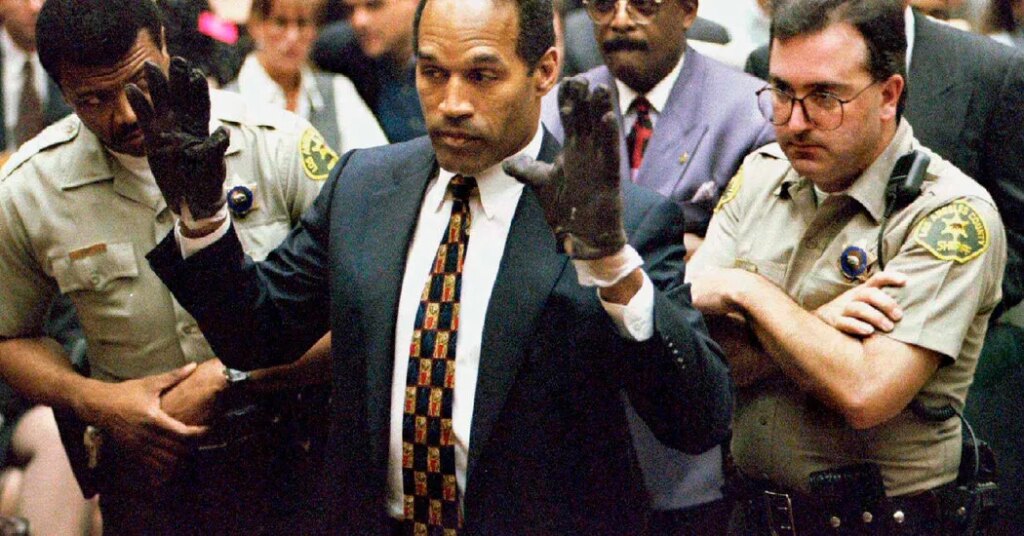
At the crime scene, investigators found Mr. Simpson’s blood, along with footprints that matched both the style and size of his rare Bruno Magli shoes. They also found a single leather glove that matched the type Ms. Brown Simpson had once purchased for Mr. Simpson. Investigators also recovered a cap that contained hair consistent with Mr. Simpson’s hairs, and another hair on Mr. Goldman’s shirt, also consistent with Mr. Simpson. Another glove was found at Mr. Simpson’s home, with blood from both victims. Mr. Simpson had a cut on his hand.
The mountain of evidence against Mr. Simpson appeared clear-cut. The trial would be anything but.
When the authorities issued an arrest warrant for him five days after the killings, Mr. Simpson fled. The nation was transfixed as a white Ford Bronco, driven by Mr. Cowlings, with Mr. Simpson in the back seat, led the police on a slow-speed chase through the Los Angeles metro area.
Mr. Simpson eventually surrendered after returning to his home.
The chase not only captivated the country, it also drew the attention of authorities who were trying to track down Mr. Ippolito.
U.S. marshals knew Mr. Ippolito and Mr. Cowlings were friends. And the authorities knew the men were in close contact.
When Mr. Cowlings was briefly detained after the Bronco chase, the police found in his wallet the phone number to a mess hall where Mr. Ippolito worked while he was incarcerated, said John Cuff, one of the marshals tasked with finding Mr. Ippolito. In the Bronco, detectives also found photos of one of Mr. Ippolito’s girlfriends, along with her phone number.
The hunt for Mr. Ippolito grew more urgent, and the authorities began looking coast to coast. Their pursuit persisted for months. They conducted stakeouts and developed sources, at times believing they were on his tracks, only for Mr. Ippolito to slip through their fingers.
Then, as Mr. Cuff assessed a network of pager activity, he identified one likely belonging to Mr. Ippolito. Marshals made plans to apprehend him when he went to get the pager serviced at a store in New York’s Little Italy. They staked out the store for days until they saw a man who looked like Joey. Instead of a balding head, however, the man had flowing hair.
Still, they closed in.
“Joe,” Mr. Cuff said to the man.
“What do you mean? Who?” the man replied.
“What’s with this?” Mr. Cuff said, snatching at the man’s hair and pulling off Mr. Ippolito’s toupee. The escapee simply smiled, Mr. Cuff recalled, as he was brought back into custody.
The ‘snitch of the century’
Mr. Ippolito knew trouble and how to get out of it.
But options were limited for the repeat felon and recent prison escapee.
While Mr. Ippolito settled back behind bars in custody in New York, Mr. Simpson was on trial for murder, the proceedings playing out on television before a global audience.
Each man was fighting for his freedom. But Mr. Ippolito didn’t want to go to trial, or back to prison. So he turned snitch.
Drawing on his connections as a coast-to-coast drug trafficker, he quickly worked from behind bars to help undercover agents buy narcotics from high-priority targets. Records show he began to provide key information that helped federal agents piece together the racketeering activities of major mafia figures. Law enforcement officials said that Mr. Ippolito put himself “at great risk” to help them.
His extraordinary assistance was later outlined in a sealed 5K letter, a legal document filed by federal prosecutors to reward a defendant’s service. The letter, filed in court in December 1996, detailed Mr. Ippolito’s cooperation “almost immediately” after his arrest in August 1995.
“From the outset, Ippolito was completely forthright in our debriefings, during which we found Ippolito to be a remarkable source of information,” the letter reads. “This information has proven valuable as both investigative leads and to buttress several cases under indictment, and is likely to result in significant prosecutions at which Ippolito, if called, should prove to be a valuable witness.”
The first example cited? The O.J. Simpson case.
While trafficking drugs in California, the letter stated, “Ippolito became close to several individuals at the center of the Simpson/Goldman murder case. Through his close personal relationships with Al Cowlings, Simpson’s confidant, and others involved in the cases, including O.J. and Nicole Simpson, Ippolito had become privy to many facts relevant to the case, including Simpson’s alleged domestic violence, the Simpsons’ narcotics usage, Simpson’s attempted flight from justice, and his disposal of the murder weapon.”
Mr. Ippolito’s claims may have seemed outlandish, the type of storytelling that spouts from inmates desperate for leniency. Except Mr. Ippolito had been a “tremendous resource” to authorities while the Simpson case was playing out in California.
Federal prosecutors in New York began quietly sharing information to local prosecutors in Los Angeles. Mr. Ippolito made himself available to the authorities, and his information was provided to prosecutors “during the murder trial,” which was “at that time important to their case, particularly Simpson’s flight and his remarks to Cowlings concerning a murder weapon,” the cooperation letter stated.
“While Ippolito ultimately was not called as a witness — he was arrested and began to cooperate as that trial drew to a close — my conversations with the Los Angeles authorities indicate that Ippolito’s information was, at the very least, very helpful to their case,” the letter, written by then-federal prosecutor David Kelley, said.
Reached recently, Mr. Kelley said that he remembered Mr. Ippolito speaking about a knife concealed around Mr. Simpson’s property and that Mr. Ippolito had learned of the information from a close associate of Mr. Simpson. He declined to name the person, though the cooperation letter he wrote years earlier suggested Mr. Cowlings was the conduit. Mr. Kelley added that he did not believe Mr. Ippolito was involved in the killings.
Mr. Cowlings did not respond to text messages, phone calls or a letter sent to his home.
Mr. Kelley said in an interview that he recalled having a series of conversations with the prosecution team in Los Angeles, including the lead prosecutors Marcia Clark and Christopher Darden.
Mr. Darden declined to comment.
Ms. Clark, in a recent message, said she had no knowledge of Mr. Ippolito. “If anyone had spoken to him and found him to have relevant and credible information, I surely would have been informed,” she said. “The fact that I was never so informed establishes he had no credible or relevant evidence to provide.”
But others said there was significant back-and-forth between the agencies. One Los Angeles law enforcement official who was involved in the prosecution recalled receiving a call in the summer of 1995 — in the middle of the murder trial — from a federal official in New York who said that Mr. Ippolito had information about the case and was willing to talk. The official, who spoke on the condition of anonymity due to the sensitivity around the case, recalled that Mr. Ippolito was later reluctant about “being the snitch of the century in the trial of the century.” With the prosecution of Mr. Simpson underway, and the L.A.P.D. and the district attorney’s office being inundated with tips, the official in Los Angeles said they didn’t press the matter.
Mr. Kelley, the former federal prosecutor, said he did not recall Mr. Ippolito being unwilling to help local authorities and that any such reluctance would have violated his cooperation agreement.
Mr. Ippolito was on the radar of L.A.P.D. investigators and prosecutors well before the murder trial, according to the case files reviewed by The Times.
Police detectives — with Mr. Darden, the prosecutor, present — interviewed Marcus Allen, an N.F.L. star and friend of Mr. Simpson, on Sept. 22, 1994, in Kansas City, according to investigative files. The interview took place months after the killings and while Mr. Ippolito was on the lam.
In the interview, investigators asked Mr. Allen whether he knew about Mr. Simpson’s friends and associates, including Joey. The report noted that Mr. Allen said he “did not know a Mr. Joey Ebalito” — an apparent misspelling of Mr. Ippolito’s name.
Around this time, Mr. Simpson’s defense lawyers also took interest in the drug runner with mafia ties. The group investigated whether Mr. Ippolito was linked to the murders, and at one point mulled whether he could be considered a suspect, according to Patrick J. McKenna, a private investigator from Florida who worked for the defense team.
Mr. McKenna said the team had another investigator, Jack McNally, a former New York Police Department detective with contacts in the city’s underworld, pursue this angle. Mr. McKenna recalled that Mr. McNally spoke to contacts in “the highest of the five families” in New York and reported back to the defense team, saying, “I don’t think he’s got any involvement.” (Mr. McNally died in 2023.)
Mr. Ippolito was never called — by the defense or the prosecution — to testify as a witness in the murder case. One of the complicating factors, as suggested in his cooperation letter, centered on timing.
At the time of Mr. Ippolito’s arrest in August 1995, the trial against Mr. Simpson had been underway for eight months. The prosecution had already rested its case. Closing arguments were approaching.
A jury acquitted Mr. Simpson in October 1995. The prosecution was marred by the police department’s history of racism and questions about the handling of key evidence. (A jury in a civil case later held Mr. Simpson liable for the deaths.)
At the time of Mr. Ippolito’s own sentencing in late 1996, federal prosecutors and a district judge heaped praise on him for his cooperation.
In addition to having him inform on mob associates, federal law enforcement placed him in a federal detention center in Brooklyn to spy on high-profile inmates, most notably suspects detained for their alleged roles in the 1993 World Trade Center bombing, according to two people who were close to Mr. Ippolito.
In a 1996 hearing closed to the public, Judge Kimba M. Wood said the government wrote on Mr. Ippolito’s behalf “one of the strongest letters I have ever received, possibly the strongest.”
Judge Wood said she was “inclined” to do whatever she could to “make sure” he received “the credit he deserves for this cooperation,” according to a transcript of the hearing.
She issued the most lenient sentence she could, under law.
For his prison escape, Mr. Ippolito was sentenced to time served. The government also agreed not to prosecute him for distributing drugs in California for the five years up until his arrest.
Records indicate that Mr. Ippolito was released from custody in 1998. He died in 2006. His obituary vastly understated his colorful life, describing him as “a self-employed restaurateur in the Florida area.”
Bloody hands and a mysterious bag
The new information collected by The Times suggests that Mr. Ippolito’s role may have extended beyond what he told authorities.
Mr. Ippolito’s brother Sam said Joey was at the scene of the killings.
Sam Ippolito said that on the evening of the murders, Joey left the apartment around 6 p.m. Hours later, around midnight, his brother returned to their apartment carrying a bag with a heavy object inside and he appeared to have blood on his hands, Sam Ippolito said. Next, Joey undressed and stuffed his own clothes in the bag. He then asked Sam to get rid of it while he showered.
Sam also said he saw Joey call Mr. Cowlings from the apartment, and heard his brother say that he had just been “helping” Mr. Simpson.
Sam Ippolito told The Times he didn’t ask questions. He went outside and found a dumpster along Doheny Drive, near a construction site. He tossed the bag in.
Soon after, Sam said, he and his brother left Los Angeles and headed back to the East Coast. Sam brought up Mr. Simpson during the brothers’ trip. Sam said Joey refused to answer specific questions about what had transpired except to say that he “went to go help O.J.” that night.
An attorney for Ms. Mijares released a statement denying Sam Ippolito’s claim about Joey’s bloody appearance at her apartment, calling it absurd. “She has known Joey since she was a teenager,” the statement read. “She cannot be expected to remember every time they were together, especially events from 30 years ago.”
Ms. Mijares did not address questions about whether the Ippolitos stayed at her home in June 1994.
Sam Ippolito said in an interview that he was “100 percent” sure that Joey was with Mr. Simpson at the scene of the murders. He said he should have disclosed this information long ago.
But revealing secrets can have consequences. In 1997, two years after Joey became a federal informant, a mafia gunman shot Sam repeatedly and ran him over with a vehicle — authorities called it retaliation for Joey’s cooperation with the government. The gunman was later convicted of attempted murder and witness tampering.
In his conversations with a reporter earlier this year, Sam Ippolito maintained for months the story about his brother’s involvement.
Then, in a follow-up exchange this past summer, Sam Ippolito asked for compensation. He said he had been “offered a ton of money” and was under contract to tell his story elsewhere. And now, he wanted to recant what he previously told The Times, saying he previously could not differentiate what was real and what was not.
Peacock has announced that it is airing a documentary, “OJ’s Accomplice,” later this year about theories in the Simpson case.
Friends and some family members of Joey Ippolito have rejected any suggestion that he was involved on the night of the murders. They said that Sam Ippolito could not be trusted and might be trying to win attention and compensation.
Over the years, many have wondered about the case’s unexplained mysteries, such as where the murder weapon might have gone. Some have posited the brutal, efficient nature of the killings meant it likely that more than one person was involved.
Under the timeline presented by prosecutors, Mr. Simpson was in a hurry on the night of the murders, rushing home to catch a limousine that would take him to a previously scheduled flight.
Detectives hunted the route for the knife — in the woods, dumpsters and even the bowels of an airport waste tank that could have held the discharge from the airplane. None was ever found.
Tom Lange, who was the lead detective in the Simpson case and is now retired from the L.A.P.D., said he has never believed Mr. Simpson had help, and said if there was any evidence to support that theory it would have been disclosed by now.
Mr. Lange recalled Mr. Ippolito’s name coming up during the investigation of the murders, but that he “never really became an issue” for investigators. He said they received hundreds of tips during his time on the case and that only a handful were related to Mr. Ippolito.
During the criminal trial, Mr. Simpson’s defense team suggested there was evidence two people had been at the crime scene — an idea that prosecutors rejected. Robert Blasier, a lawyer who was part of Mr. Simpson’s defense team for both the criminal and civil trials and lived with him at his Brentwood home during the civil case, said Mr. Simpson had also maintained his innocence in private conversations. Still, Mr. Blasier believes the theories about having an accomplice could be true.
“My take is that these other theories are certainly possible,” he said. “But none of them amount to proof beyond a reasonable doubt.”
Over the years, Mr. Ippolito told people varying stories about his role in the case.
Eddie Trotta, a longtime friend of Joey, said Mr. Ippolito phoned him, talking about how he was telling law enforcement that Mr. Cowlings was the one who hid the knife, and that Mr. Cowlings ultimately discarded the weapon. Mr. Trotta said it seemed to him Mr. Ippolito was inventing tales.
Rob Brisolari, a former Drug Enforcement Administration agent who regularly spoke with Joey Ippolito, was skeptical that Mr. Ippolito was involved in the murders. He believed Mr. Ippolito had no motive to do so. Still, Mr. Brisolari did not rule out the possibility.
“It seems a little far-fetched to me, but that doesn’t mean it didn’t happen,” he said in an interview.
Mr. Brisolari remembered that Mr. Ippolito did disclose to him that he had received a call from Mr. Cowlings after the murders, seeking help to get Mr. Simpson out of the area. Mr. Ippolito reported to Mr. Brisolari that he told Mr. Cowlings that it would be difficult to do so — Mr. Ippolito himself was on the run from the authorities.
That request for assistance was in line with yet another tale that has emerged about Mr. Ippolito. The rapper Fat Joe, the man behind the hit song “What’s Luv?”, told a seemingly random story on his podcast about a friend named “Joe” and O.J. Simpson.
He said this deceased friend in Miami went by the name Joe Bentley, a name used by Mr. Ippolito because of the many Bentleys he owned.
On the podcast, Fat Joe said that Joey, who was released from federal custody in 1998, confided to him that when Mr. Cowlings and Mr. Simpson were in the Bronco chase, Joey had been at an airport, waiting with a private jet to help them escape. (Investigators did find in the infamous white Bronco a travel bag with a passport and a disguise kit.)
Fat Joe said he once went to Joey’s home for the birthday of Joey’s wife. Mr. Simpson was there. When it came time to cut the cake, Joey handed a “machete” to Mr. Simpson and declared: “You did it!” Mr. Simpson then chased Joey around with the weapon, apparently all in jest.
Reached recently, a spokesperson for Fat Joe said the rapper declined to comment. Mr. Ippolito’s widow declined to comment.
The tale meant that there were at least three versions of Mr. Ippolito’s link to the murders. In one told to federal prosecutors, he shared information from Mr. Cowlings, including about the supposed location of the murder weapon. In another version, as told by his brother, Mr. Ippolito was at the scene of the killings and had apparent blood on his hands. In another version, as told to Fat Joe, Mr. Ippolito was ready to help Mr. Simpson escape.
An accomplice named ‘Charlie’
Mr. Simpson, who died in 2024, was coy about the truth through the years. He vacillated between professing innocence and admitting guilt in a “hypothetical” confession.
In his hypothetical account of the night of June 12, 1994, Mr. Simpson told a ghostwriter that a friend of his, identified by the name “Charlie,” had come to his home that night, and their conversation triggered Mr. Simpson’s anger. The two hopped into Mr. Simpson’s white Ford Bronco and drove to Ms. Brown Simpson’s home to “scare” her. He described Charlie as a horrified observer to the bloodshed that ensued.
“Jesus Christ, O.J. — what have you done?” he quoted Charlie as saying as they looked over the scene of the two bodies crumpled on the ground. But after they arrived back in Mr. Simpson’s neighborhood, Mr. Simpson said he had handed Charlie a bundle of bloody clothes and the murder weapon. Charlie warily agreed to get rid of it.
But there’s yet another wrinkle to the “Charlie” story. A man whose real name is Charlie once suggested that he was the hypothetical accomplice.
Charlie Ehrlich was charged alongside Mr. Simpson during a robbery case in Las Vegas in 2007.
Mr. Ehrlich said in an interview that before the “If I Did It” book was published, Mr. Simpson told him over dinner that he had used his name as part of his hypothetical account.
Several years ago, Mr. Ehrlich went on to work with a producer, Erik Laibe, to tell his life story. The pair envisioned a film.
In hours of audiotapes never made public but reviewed by The Times, Mr. Laibe and Mr. Ehrlich do not directly confront the question of whether the “Charlie” in Mr. Simpson’s book was a reflection of Mr. Ehrlich. Mr. Ehrlich said on the tapes that he had met Mr. Simpson before the murders. Mr. Laibe at one point brings up that Mr. Simpson’s hypothetical account had used the name. “Regarding that: Use your imagination,” Mr. Ehrlich said. “I’ll leave it at that.”
Mr. Ehrlich suggested at another point that he had insights into Mr. Simpson’s mind-set on the night of the murders.
Those tapes fueled the theory that Mr. Ehrlich was the accomplice.
In a recent interview, Mr. Ehrlich said it was all a lie. He said he had played along with the idea that he was the hypothetical accomplice as part of an effort to cash in on the infamy.
Mr. Simpson’s ghostwriter, Pablo Fenjves, said he recalled being the one to propose Charlie as the pseudonym of Mr. Simpson’s supposed accomplice.
Mr. Ehrlich said he didn’t meet Mr. Simpson until Mr. Simpson moved to Florida in the years after his trial — well after the killings.
Mr. Ehrlich recalled that Mr. Simpson was impressed he had done seven years in prison, “kept his mouth shut” and “never ratted nobody out.”
“O.J. loved that about me,” Mr. Ehrlich said.
Unspoken was that the man who introduced them was himself a superstar snitch. His name? Joey Ippolito.
Kirsten Noyes, Alain Delaquérière, Kitty Bennett, Sheelagh McNeill and Susan C. Beachycontributed research.
The post O.J. Simpson, a Secret Informant and a Decades-Old Mystery appeared first on New York Times.