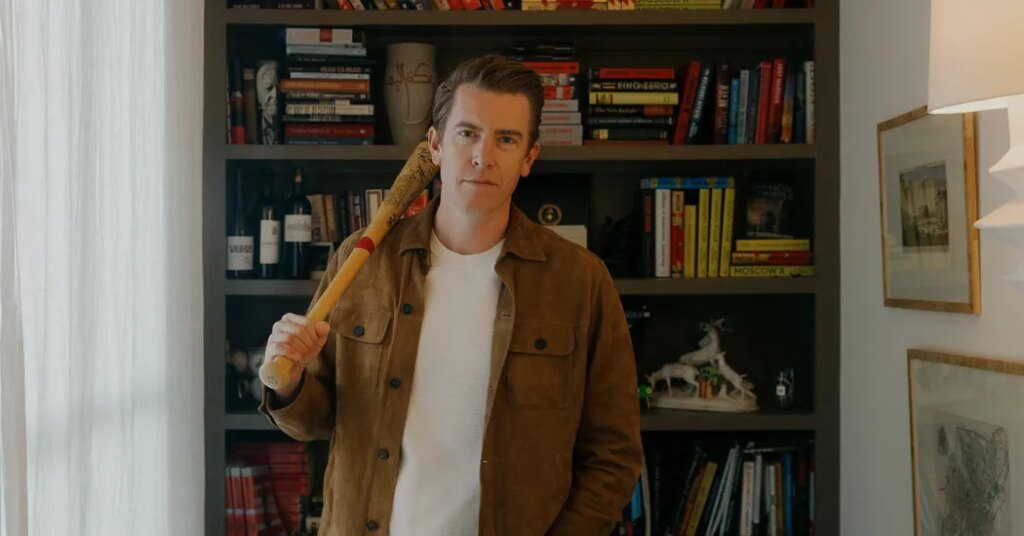
After he left the C.I.A. but before he began publishing spy novels, David McCloskey worked as a management consultant at McKinsey & Co. The job gave him a useful window into the childish habits of powerful people.
Once, he was in a meeting when the client, the chief executive of a large company, became fixated on an open can of Diet Coke left on a table by a subordinate. “What the (expletive) is this?” the executive shouted, gesticulating at the Coke. While everyone looked on in embarrassed horror, the executive summoned the offender back into the room, pointed out that his wife was not there to pick up after him and made him carry the can to the bin.
Luckily for his readers, McCloskey has a fine sense of the absurd and a keen eye for detail. He repurposed the scene for his latest book, “London Station,” awarding the C.E.O.’s behavior to the newly appointed burn-the-place-down C.I.A. chief, a building magnate who has no experience in government or intelligence.
“London Station” imagines a provocative scenario: What would happen if the relationship between the C.I.A. and its British counterpart got so bad that the two agencies started actively working against each other? The idea is not entirely far-fetched, given how the current administration treats its allies, though McCloskey has carefully set his book in a nebulous post-Trump future.
He was drinking a late morning cup of coffee in the immaculate living room of the house in East Dallas that he shares with his wife, Abby, an economic adviser and columnist for Bloomberg Opinion, and their three young children.
“I didn’t want it to be some kind of overt commentary on the Trump years,” he said, of his new book. “But I also couldn’t get to a proper dramatic falling-out unless I had a really abrasive and unqualified leadership team in one of the two services, and it’s obvious that it makes more sense to do it in the American service.”
“London Station” is the fourth book in a loose series that began in 2021 with “Damascus Station,” set during the Syrian civil war. A fifth book, “The Persian,” is a standalone novel set, presciently, in the midst of the Iran-Israel shadow war and starring a dentist recruited by the Mossad. McCloskey’s profile has grown steadily with each new book, bolstered by “The Rest Is Classified,” a podcast he co-hosts with Gordon Corera, a former BBC security correspondent.
His novels are intricately plotted, filled with internecine disputes. He isn’t averse to dispatching his characters in creative ways. (“I do love a grisly death,” he said.) But they’re not what he called “guns and gear” books, the kind packed with preternaturally skilled special forces operatives, cartoonishly sadistic villains, and weapons and military hardware so lovingly described as to be almost erotic.
Tall, lanky and youthful at 40, McCloskey looks too clean-cut and honest to have ever been a spy. The son of evangelical Protestant parents whose own faith remains central to his life, he was raised mostly in Minnesota and attended Wheaton, a Christian college near Chicago.
After an alumnus who worked at the C.I.A. visited one of his classes, McCloskey applied for a summer internship at the agency. It was a long shot: His job experience at the time consisted mostly of working the cash register at a Wendy’s and digging holes for a sprinkler company.
But it turns out that attending a strict religious institution is helpful if you’re applying for a job where polygraph tests are part of the vetting process. As McCloskey said, “You haven’t done any of the things — drugs, major crimes — that would disqualify you.”
The internship led, after graduation, to a full-time job as an analyst assigned to the C.I.A.’s Syria desk. Among McCloskey’s duties: delivering classified testimony in Congressional hearings, briefing officials in the White House and preparing material for the President’s Daily Briefing. During the Arab Spring, he worked in field stations throughout the Middle East and briefly lived in Damascus. (Operational note: True spies refer to the agency as “C.I.A.,” without the “the,” he said.)
He left the agency after eight years. “I was ready to stop working on Syria because it got really grim,” he said. “But also I was feeling a bit of an itch to try something new.” He took the McKinsey job, moved to Dallas and soon found himself at a local coffee shop, sketching out some fictional ideas based on his time in Syria. A few years later, when McKinsey gave him a six-month sabbatical, he returned to his writing and produced a draft of what would be come his first novel.
He found a literary agent through his wife. The manuscript went out to many editors, but only one was interested: Star Lawrence, the legendary editor in chief of Norton, who gave it an initial edit so thorough it knocked McCloskey back. “To be honest, I don’t think he said anything positive,” McCloskey said. “At one point, he circled a whole paragraph, crossed it out, and just wrote, ‘Jesus, no!’”
From the outside, Lawrence was a tough-love editor, said Tom Mayer, the executive editor at Norton, who inherited McCloskey after Lawrence’s death last year. But within the company, he was already raving about the new book. “He handed it to me and said, ‘You have to read this,’” Mayer recalled. “‘I think he’s the next John le Carré.’”
“Damascus Station” marked the debut of an indelible character: Artemis Aphrodite Procter, a gifted spy whose foul language, self-destructive habits, hatred of incompetence and mistrust of authority make her more like Mick Herron’s Jackson Lamb than le Carré’s George Smiley. In the new book, she plunges into intrigue as the C.I.A.’s new station chief in London.
McCloskey can’t reveal any trade secrets. But he’s full of great stories about the supreme weirdness of the C.I.A. How, when he returned to Langley once to discuss his writing, the agency reimbursed his travel and lodging expenses by handing him a fat wad of cash. How there’s a gift shop in Langley peddling spy swag: C.I.A. mugs and T-shirts; bottles of “Classified Hot Sauce” that say “Do Not Remove From C.I.A. Cafeteria”; luggage with “C.I.A.” stenciled on the outside in gold letters. (Oddly, “There was a little tag underneath it that basically said, if you work here, then we would strongly discourage you from purchasing this,” McCloskey said.)
Like all book-writing “formers,” as McCloskey calls ex-C.I.A. officers, he sends his novels to the agency’s Prepublication Classification Review Board for vetting. It’s a strange process, he said: The manuscripts come back as PDFs, with the whole thing rendered in capital letters and the parts that ran afoul of censors redacted in black, as in a spy thriller featuring fictional classified documents.
McCloskey is in the process of signing a further three-book contract at Norton; a TV series is also in the works. He has started writing his next book: a sequel to “Damascus Station,” which is to be set in the waning months of the Assad regime and will contain a fanciful, alternate-history element that reflects his own wishful thinking.
“In ‘Damascus Station,’ I had a scene where a bomb almost detonates and almost kills Assad,” he said. “I’ve been kind of thinking about it since then: how I would kill him.”
The post America’s Answer to John le Carré appeared first on New York Times.