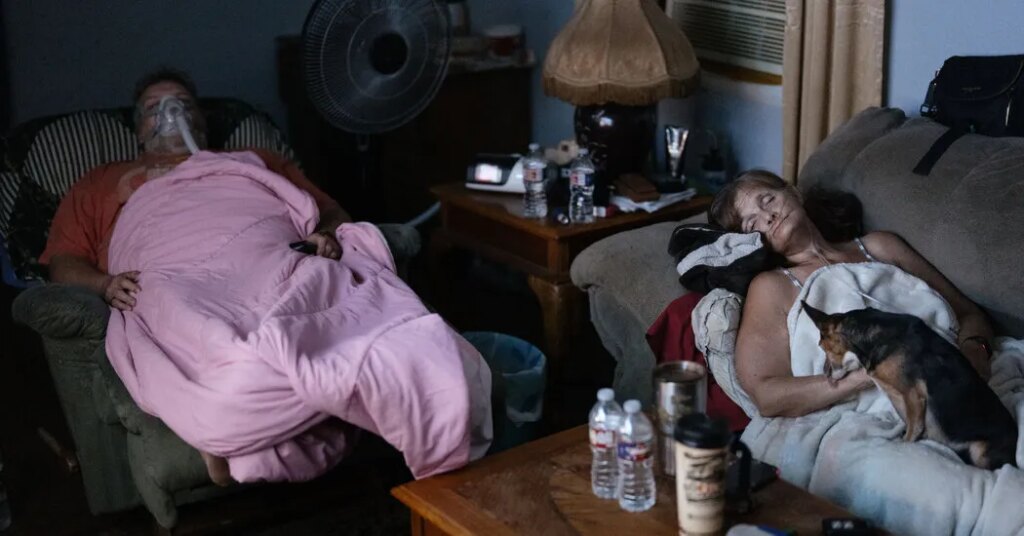
The worst of the heat was just beginning to lift when Genia Weitz, 58, walked into the stubborn Oklahoma sun last month and found the next emergency waiting in her mailbox. “Disconnection notice,” the letter began. She scanned her electric bill and saw a total balance of $1,340.96, far more than her monthly income. State rules prevented the power company from shutting off someone’s electricity when the heat index was above 101 degrees, but now it had dropped to 99 in September, and Weitz had nine days to pay.
She went back inside, where the window shades were drawn and heavy blankets hung across the halls and doorways to trap cool air. The house had three bedrooms and two bathrooms, but for the past several months Weitz and her husband, Daryl Mason, had mostly confined themselves to their 300-square-foot living room, letting the rest of the house bake to save money on electricity. They had an air-conditioner mounted to the window that rattled all day. They had her oxygen machine plugged into the wall and his CPAP machine for sleep apnea hooked up in the corner.
Weitz had been sleeping on the couch while Mason slept in the recliner. Sometimes, their grandchildren would pile onto mattresses in the living room. On the most humid nights, the heat index outside barely dropped below 85, and their machines ran until morning.
“I can’t breathe if I don’t have my oxygen,” Weitz said, as she handed the bill to Mason. “I don’t think I’d last a single night.”
“We’d probably stroke out anyway in all this heat,” Mason said. “If we lose this room, we’re not going to make it.”
As fall sets in across the country, the bill is coming due for the hottest summer on record in the United States. The last three months were about three degrees above average, hotter than the Dust Bowl summer of 1936 and the heat dome of 2021, and tens of millions of people can’t afford to pay for the air-conditioning that helped keep them safe in the deadly heat. About one in six U.S. households is already behind on its utility bills, according to federal data. More than a dozen hot-weather states like Arizona, Georgia, Virginia and Oklahoma restrict shut-offs during the most dangerous heat, so disconnections tend to peak in October, when a climate crisis turns into a collection notice.
The Public Service Company of Oklahoma (PSO) had disconnected Weitz’s power before, so she knew the shut-off notice wasn’t an idle warning. PSO had told customers it was also facing rising costs: for fuel and equipment, for investments to update an aging power grid, for the rising demands of extreme weather and new large-load customers, including data centers being built for artificial intelligence. The company’s rates were still below the national average, and it attributed much of the summer’s higher bills to temperatures that kept air-conditioners running around the clock.
Weitz studied her bill and saw she was paying nearly $500 each month to live in a single room. “Turn the lamp off, Daryl,” she said. “Stop running the ceiling fan.”
She’d read on Facebook that power companies sometimes offered 30 days of relief to people with serious medical conditions, so she printed a form to bring to her doctor. “Please be advised that a life-threatening situation does not cause the debt to be forgiven, but merely postponed to a later date,” it read.
Their car was broken down in the driveway, so she boarded a shuttle bus and looked out the window at the faded brick buildings of McAlester. It was a town of 18,000 people built on a coal rush and sustained by an ammunition plant and the state penitentiary. Weitz had always known it as a hard place to live, but after five decades she also knew almost everyone, including the shuttle driver, Sondra Beck.
“Never thought I’d need to see the doctor just to keep my lights on,” Weitz said.
“I owe $700 by Friday,” Beck said. “Everybody’s getting shut off lately.”
They had worked together for several years at a nearby chicken plant, where Beck was a supervisor and Weitz worked on the deboning line. Weitz had stood in the refrigerated plant and deboned as many as a dozen birds a minute, hundreds an hour, thousands in an average 12-hour shift. She dug her fingers under the meat, peeling each fillet off the rib cage until her wrists went numb and her fingers swelled inside her gloves. Now she had arthritis in both hands, two artificial knees, a damaged back and $860 a month in government disability payments. She missed her job. She missed the chill of the factory floor.
The shuttle stopped at the clinic. Weitz tried the front door, but it was locked. A sign on the window said the office was closed for lunch. She went back to the shuttle, took out her phone and eventually texted her eldest daughter.
“You know I hate to ask,” she wrote.
Weitz’s daughter Shenia Mick put on a business suit and a necklace and left home in the dark to drive to her office in Tulsa. Mick, 36, had always believed in showing up early for her job at GasTech Engineering, but lately she was stretching her hours from 6 a.m. until early evening. What her bosses attributed to ambition and work ethic was also basic math. Her office was air-conditioned, and somebody else paid the bill.
Her house had been dangerously hot for much of the summer, as her two aging wall units failed to keep up with 17 consecutive days of 100-degree heat and high humidity. She pushed the AC to its limit around the clock and ran up electric bills of more than $500 each month, but her indoor thermometer rarely dipped below 80 degrees. She set up fans in her bedroom and still awoke sweating in the night. Once, she tried to cook dinner on the stove and became dizzy and then nauseated, suffering from what she believed to be heat stroke. Her boyfriend got her into the shower, and the ice-cold water felt hot against her skin.
She worked in her office until lunch, when she saw a text message from her mother in McAlester. Mick was already helping to pay for her mother’s water bill and car insurance, and here was a photograph of her mother’s electric bill.
“These numbers are getting crazy,” Weitz wrote.
“It’s bad here, too,” Mick wrote. “I’m constantly paying for something. I’m at work right now.”
“You’re doing so good. I’m proud of you.”
Her mother said it often and to everyone: Her eldest daughter had escaped McAlester and become the town’s most unlikely success story. Mick had dropped out of high school, run away from home several times, and returned with two children and a DUI before she turned 18. She lost years to alcohol and heroin before going into liver failure, and then she’d walked out of a Tulsa hospital in her mid-20s and somehow started clawing her way back: to a methadone clinic every day, to a G.E.D., to a manager’s job at IHOP. She signed up for college classes and went to night school for seven years, earning three associate degrees and eventually a job at GasTech.
She started in the shop, wearing T-shirts and jeans as she helped build equipment for natural gas plants, until a manager noticed Mick was organizing and running a team like a seasoned boss. The manager offered Mick a job on the business side, lent her a wardrobe of professional clothes and helped her pay back years’ worth of court fines. Now she was a senior buyer in the purchasing department, earning more than $80,000 a year to negotiate deals with suppliers around the world, with a LinkedIn profile her mother showed off around McAlester. She had her hair highlighted, her facial piercings removed, her suit jacket tailored. “A results-driven professional,” the profile read.
But lately it seemed to Mick as if the reward for so much transformation was more of the same bills, the same stress, the same debts that kept accumulating as she paid almost $1,500 for her own rent and just as much each month to help support her family in McAlester.
In August, she made three separate payments to PSO for her own electric bill, sending $150, $194 and then $101.42. After she became dizzy from heat in the kitchen, she borrowed money from an online lender to buy an extra portable AC unit for $379. The unit cooled parts of the house but drove up her electricity costs. Now she had another bill from PSO, and she would have to borrow to pay that balance, too.
Mick texted her mother with a photo of her own bill: $589.51. “Avoid disconnection,” the bill read. “Pay at least $169.59 to keep your power on.”
“I’m paying this every month, and it’s still so hot in our house,” Mick wrote.
“That’s way too much,” Weitz wrote.
“Is there anyone else who can help?” Mick asked her.
The heat held in the 90s. The window unit kept rattling in the living room. Weitz went back to the clinic and had her doctor sign and mail the medical form, certifying that losing power would be life-threatening. That bought her another 30 days, but her oxygen machine kept running and her debt continued to grow. One afternoon, she showed her electric bill to her daughter-in-law, Autumn Cooper, 24.
“I still don’t know what I’m going to do,” Weitz said.
“Even looking at that number gives me a heart attack,” Cooper said. “I’d panic if I was dealing with those big amounts.”
Instead of being billed hundreds of dollars each month, Cooper had switched to a prepaid plan with PSO so she could make small payments to her account every few days. As long as her account had a positive balance, she had power to cool her house, wash laundry and cook for her five children.
For the last month, she had been washing dishes by hand in the dark and still burning through an average of $12.29 in electricity each day as she monitored her balance constantly. Whenever it dipped below zero, PSO cut her off within a few days. She had received more than a dozen low-balance warnings over the course of the summer. Now she checked the latest balance on her phone and showed it to Weitz: $2.46, enough for a few more hours of power.
“See, that would stress me out even more,” Weitz said. “It’s hanging over your head every minute.”
“I can always come up with a few bucks,” Cooper said. “But every day is a hustle.”
Cooper was going to school to pursue a nursing certification during the week while her husband stayed home to care for their children — a 6-year-old, a 4-year-old, 2-year-old twins and an infant. On weekends, she worked back-to-back double shifts at the New Hope Retirement and Care Center, where she earned $16 an hour to bathe, feed and change residents in the memory care wing. She scraped together a little extra money by selling used baby gear online, borrowing from friends and doing odd jobs for a construction company. If everything went exactly right, she made just enough to keep her power on. One day in July, she sent PSO three separate payments: $7.15 in the morning, $3.65 a few hours later and another $3.14 before she went to bed.
She had come to believe that any real solution would take more than a few dollars at a time, so she went online to start researching electricity charges. Oklahoma was emerging as a major hub for data centers, luring companies like Google and Meta with the promise of tax breaks and cheap land in an effort to become “the high-tech data center capital of the world,” Gov. Kevin Stitt had said in 2025. One proposed data center outside McAlester would use more electricity each week at full capacity than all the homes in McAlester used in an entire year.
PSO was planning to invest $1.2 billion in new power generation and storage to keep up with the rising demands of a growing population, new homes and new businesses. A new state law aimed to make the largest new consumers pay their share, but some of the costs of adding more power had already fallen on ordinary customers.
PSO had cut off power 58 times for every 100 residential customers in 2024, the most recent year with federal data. It was the highest rate of any investor-owned utility in the country, and the company said most of those disconnections were on a small number of prepaid accounts like Cooper’s that shut off when they dipped below zero and then came back on within minutes of payment. On and then off again. On and then off.
PSO had promised to waive some late fees on high summer bills and offer extensions and payment plans. The company had written a public letter to customers saying “affordability is important” and “we do not take any change to customer bills lightly,” but Cooper went on social media and found hundreds of Oklahomans complaining about a similar crisis.
“My bill is unreal. I guess I’ll just burn up.”
“I use a flashlight on my phone before I turn a light on, and I pay $100 a week.”
“Single mom here. Cried on the phone with them last week because mine is so high.”
“My monthly bill is almost 900. I know it’s hot, but this is like an AC bill on Venus.”
Cooper read through the complaints in mid-September and started a petition online to demand more affordable and transparent electric bills. “We, the customers of PSO, are speaking up,” she wrote. “We want our voices heard and our concerns addressed.”
Now she sat in Weitz’s living room and checked the petition on her phone. It had 24 signatures.
She switched to her PSO account. “Urgent: low balance warning,” the app read.
“Here we go again,” Cooper said. “I could be waking up in the dark tomorrow.”
“They might cut you off before me,” Weitz said.
“Guess I have to figure this out,” Cooper said.
They got into Cooper’s car and drove into downtown, passing the cluster of churches that were losing members even as more people came to their doors for help. Cooper watched her gas gauge dip below the empty line as she pulled up to the post office. She had cut a deal online to sell 30 baby outfits to a buyer in Texas for a total of $10, but she wouldn’t get paid until the clothes arrived.
“How long until it gets there?” she asked the clerk.
“Two days, maybe three.”
“Nothing faster?”
“You could overnight it, but that’s not going to be cheap.”
Cooper shook her head and went outside. “It’s time to get creative,” Weitz said. She knew people in town who hired drivers for odd jobs and businesses that bought scrap metal or paid cash for gift cards. She knew all of the aid organizations in town and how much they gave to whom. Just a few weeks earlier, she had gotten almost $500 in energy assistance from a federal program for low-income families.
“Let’s try the churches,” Weitz said.
“I already feel guilty about not going to church,” Cooper said. “I don’t want to ask for help.”
“You have a better plan?”
Cooper stood in the parking lot for a moment and then got back into the car. They drove to the charity Shared Blessings, where the administrator said it had resources to help 10 people with electric bills each month, and Cooper’s request was the 43rd. They continued to All Saints Episcopal Church, where a woman came outside with her cellphone pressed to one ear and waved them away. “Sorry, all out,” she said. They walked a few blocks to Mike’s Club, a thrift store where the owner, Mike Brown, sometimes took money out of his register for families in need.
“I’ve got employees who’ve had their power cut,” Brown said. “The whole town’s going dark. I’m sorry, but I just can’t.”
Cooper thanked him and went back to her car. She started to drive home, but Weitz pointed to a building up the street. “Last stop,” she said.
Cooper groaned but then turned into the parking lot for First Baptist Church. A woman at the front desk greeted them with two bottles of water and a package of snack foods. “Let me guess — electric bill?” she said.
“I really just need maybe $10, $20 to keep my lights on,” Cooper said.
“I get it,” the woman said. “Let me talk to the pastor.”
Cooper and Weitz waited as she disappeared into the back of the church. A few minutes later, the pastor came out to the lobby, shaking his head. “My bill last month was $1,800, and I live in a double-wide,” he said. “We’re all out for the day. Will you try us again?”
“Sure,” Cooper said. “I’ll be in the same situation tomorrow.”
She drove back to Weitz’s house, parked out front and checked her account. “To prevent disconnection, please make a payment immediately,” the app read.
“The kids might stay over here with you for a few nights,” Cooper said.
“Of course,” Weitz said, and they walked through the dark house, past the hanging blankets and back into the living room.
The post After the Hottest Summer Ever, the Bill Comes Due appeared first on New York Times.