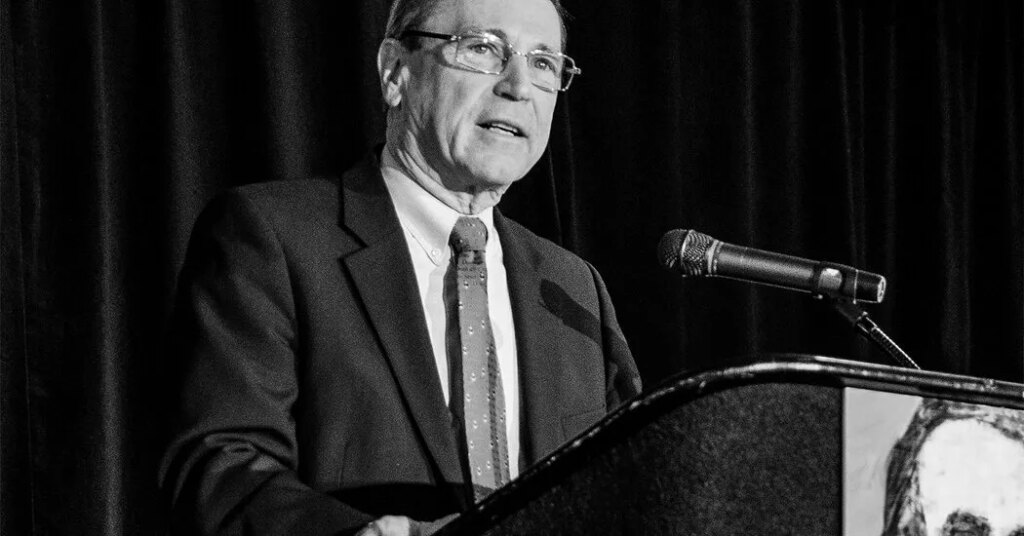
Craig L. Symonds, a prizewinning historian whose books conveyed the critical role played by U.S. naval superiority since the Civil War, died on Tuesday at his home in Annapolis, Md. He was 79.
The cause was complications of kidney cancer, his wife, Marylou Symonds, said.
Professor Symonds, who taught at the U.S. Naval Academy for three decades, was writing a book about the 12 most decisive maritime engagements in history; it was the 21st volume he had either written or edited. His death coincided with the 251st anniversary of the founding of the U.S. Navy.
In 2023, he won the Pritzker Military Museum and Library Literature Award for lifetime achievement in military writing. His book “Lincoln and His Admirals” (2008) won the Gilder Lehrman Lincoln Prize, and his “Neptune: the Allied Invasion of Europe and the D-Day Landings” (2014) received the Samuel Eliot Morison Award for Naval Literature.
“Craig L. Symonds’s books on Civil War generals and admirals, on naval history and on World War II entitle him to first rank among military historians,” James M. McPherson, the Pulitzer Prize-winning historian of the Civil War with whom Professor Symonds shared the Lincoln Prize, told The New York Times in 2014.
Harold Holzer, a historian who serves as the director of the Roosevelt House Public Policy Institute at Hunter College in New York City, described Professor Symonds as “unique because he addressed two separate conflicts: the Civil War and World War II.”
“As his many honors demonstrate, he was the very best naval historian in the country, not to mention so graceful a writer that he made even landlubbers comprehend the most technical material,” Mr. Holzer said.
Mr. Holzer and Professor Symonds edited “The New York Times Complete Civil War, 1861-1865” and, with Frank J. Williams, “The Lincoln Assassination: Crime and Punishment, Myth and Memory.” Both were published in 2010.
“His overarching premise was: First, that the naval branch’s contributions to U.S. military success has always been underestimated,” Mr. Holzer said in an interview.
“Without Coral Sea, or Midway, or Leyte Gulf,” he continued, “without Monitor steaming to the rescue at Hampton Roads, Va., to stop the Merrimack’s destruction of the U.S. fleet, without naval technological advances like the aircraft carrier, submarines, precision torpedoes, and without naval convoys protecting troop and supply ships bound for Europe, we might not have survived as a country.”
Professor Symonds emphasized the role of bottom-up logistics over grand strategy.
In “The Battle of Midway” (2011), about the brutal fight in June 1942 for control of Midway Atoll in the mid-Pacific, he maintained that it was a turning point in World War II, because the Imperial Japanese Navy was never able to launch another strategic offensive.
In that book and in interviews, he challenged a conventional view that the American victory could largely be credited to a miracle of good fortune. “Asserting that the American victory at Midway was all, or even predominately, the result of luck,” he wrote in 2019, “demeans the bold decisions and brave actions of the participants.”
He attributed the American victory to the superior military methods employed by Adm. Chester A. Nimitz and his battle commanders and to advances by code breakers.
“Symonds make clear that while luck played a part, the American victory was mainly the result of careful planning, the effective use of radar (which the Japanese did not have) and superior intelligence,” Professor McPherson noted in an afterword to “The Battle of Midway.”
In another contrarian view, he wrote in “Decision at Sea: Five Naval Battles That Shaped American History” (2005), that the Union’s naval superiority and success in blockading Southern ports were crucial to winning the war, and that secession later proved to be a blunder by the Confederate states in more than military terms.
“It is one of the many ironies of history that the South’s decision to secede and fight a war of independence,” he wrote, “generated far more sweeping changes in southern society and culture and was far more destructive of ‘state rights’ than would have been the case if southerners had simply acquiesced to Lincoln’s election.”
In “Neptune,” Professor Symonds contrasted the military and popular perceptions of the D-Day invasion of June 6, 1944, from the British and the American perspectives. The British had endured defeat at Dunkirk and punishing bombing at home before finally launching a major offensive at Normandy.
To Americans, he wrote, “the invasion was not to ratify a victory already won; it was to seize that victory by brute force. To the British, it was to be a victory lap; to the Americans it was a death grapple. In the long history of the alliance, this gap in perceptions was never bridged.”
Ian W. Toll, a military historian, said in an interview that Professor Symonds, “by spending his entire career studying and thinking about these different eras, appreciated the through lines, the ‘eternal verities’ — everything about naval warfare changed, but the sea always remained the same.”
Craig Lee Symonds was born in Long Beach, Calif., on Dec. 31, 1946, and raised in Anaheim. His father, Lee Symonds, was a commercial real estate broker, and his mother, Virginia (Garrison) Symonds, was a public school tutor in Anaheim.
Mr. Holzer said Mr. Symonds’s later career grew partly from his childhood reading of Bruce Catton’s Pulitzer Prize-winning Civil War history, “A Stillness at Appomattox” (1953), and C.S. Forester’s Horatio Hornblower novels about a swashbuckling British naval officer during the Napoleonic Wars.
Professor Symonds received a bachelor’s degree from the University of California, Los Angeles, in 1967 and a master’s degree from the University of Florida in 1969, both in history. He joined the Navy Reserve in 1971 and served at the U.S. Naval War College in Newport, R.I.
After rising to the rank of lieutenant, he returned to the University of Florida and earned a doctorate in naval history in 1976.
He was named an assistant professor at the Naval Academy that year and was promoted to full professor in 1985, led the history department from 1988 to 1992, and, according to the academy, was the first person to win its teacher and researcher of the year awards. In 1989, he received the Navy Meritorious Civilian Service Award.
After retiring in 2005, he returned to the academy to teach for a year in 2011 and was a visiting professor at the Naval War College from 2017 to 2020.
In 1969, he married Marylou Hayden. Besides his wife, he is survived by a son, Jeff; and two grandchildren.
Before starring in the 1992 film adaptation of Tom Clancy’s thriller “Patriot Games,” Harrison Ford shadowed Professor Symonds at Annapolis to experience a history professor’s life at a military college.
Some scenes in the movie, in which a dashing intelligence analyst named Jack Ryan turns to teaching, were even shot in the professor’s classroom. But Professor Symonds insisted that the similarities between the Ryan character in the book and film and himself ended there.
When colleagues ribbed him about the comparison, he would typically reply: “I am not and have never been a member of the C.I.A.”
The post Craig Symonds, Prizewinning Military Historian, Is Dead appeared first on New York Times.