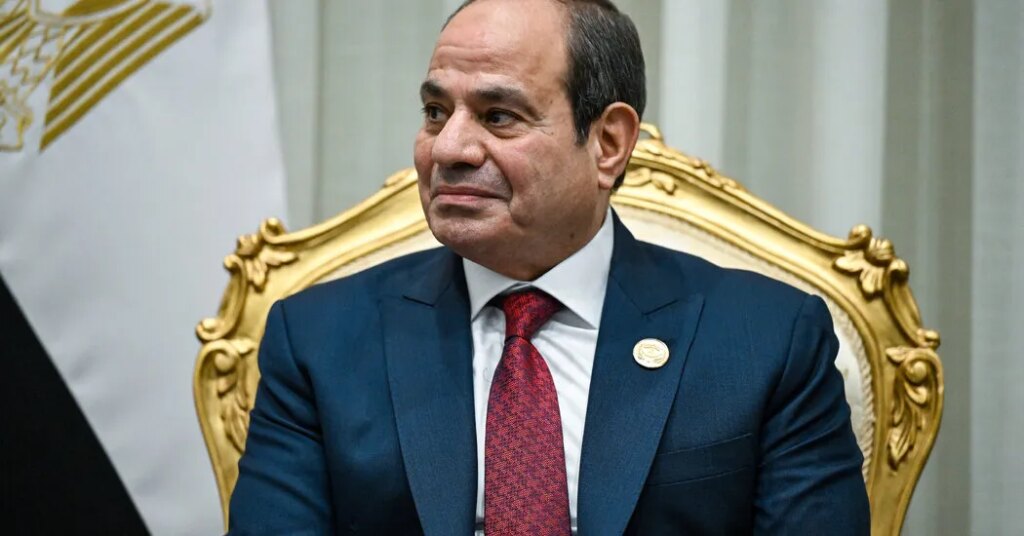
President Abdel Fattah el-Sisi of Egypt said on Saturday that he would leave office when his term ends in 2030, renewing a pledge to respect constitutional limits that were previously changed to prolong his rule.
Speaking at a military graduation ceremony, where he also pledged support for Saudi Arabia against attacks by the Iran-backed Houthis, Mr. el-Sisi said the end of his presidency was “completely settled” and that the Egyptian Constitution “would not be touched.”
He outlined a plan that would continue to give the military a prominent role in the political process, saying the country’s military academy would train potential future presidents and other senior government officials. He provided few details, however, on how they would go on to become candidates.
The comments followed renewed calls from some supporters to amend the Constitution so Mr. el-Sisi, 71, could remain in office beyond 2030 — a move not without precedent.
His presidency has already been prolonged once before through constitutional changes that human rights groups have criticized as entrenching authoritarian rule. In 2019, amendments lengthened presidential terms to six years from four, and allowed him to seek a third term.
A former army chief, Mr. el-Sisi rose to power in 2013 after leading a military coup that deposed Mohamed Morsi, Egypt’s first democratically elected president. He won the presidency the following year and then set about consolidating his rule through a sweeping crackdown on dissent. His government has imprisoned political opponents and journalists, and severely restricted political competition, according to human rights groups.
Earlier promises Mr. el-Sisi made to respect presidential term limits have raised questions about whether he will honor his latest pledge.
In a 2017 interview with CNBC, he repeated that he would not seek a third term and would respect the constitutional limit. Less than two years later, his allies in Parliament proposed the amendments that, once adopted, allowed him to remain in power until 2030, while also strengthening the military’s political role and his influence over the judiciary.
H. A. Hellyer, a senior associate fellow at the Royal United Services Institute, a research center in London, said the latest pledge should nonetheless be taken seriously, because Mr. el-Sisi appeared to have made it of his own accord.
“There’s no need for him to have done any of this, at all,” he said. “There’s no pressure on him.”
Mr. el-Sisi on Saturday also said he would seek parliamentary approval to help defend Saudi Arabia if it requested assistance in its fight with the Iranian-backed Houthi militia in Yemen. Parliament later scheduled a Sunday session in response, according to Al-Ahram, the state-run newspaper.
“It is inconceivable that we would allow Saudi Arabia, its security or stability to be harmed,” Mr. el-Sisi said.
Saudi Arabia has been a major economic backer of Egypt since the 2013 coup that brought Mr. el-Sisi to power, supporting the country through aid and investment. Alongside other Gulf states, the kingdom supplied Egypt with fuel and wheat after Mr. Morsi’s ouster.
Saudi Arabia intervened in Yemen in 2015, leading a military coalition supporting the Yemeni government against the Houthis, who had seized Yemen’s capital, Sanaa. A U.N.-brokered truce in 2022 brought years of relative calm, but fighting has intensified again in recent months amid the wider regional fallout from the U.S.-Israeli war with Iran.
The U.N. envoy for Yemen, Hans Grundberg, warned this month that the country had returned to a state of full-scale war, with fighting spreading across several fronts and increasingly brazen Houthi attacks hitting civilian infrastructure in Saudi Arabia.
The post Egypt’s President Says He Will Leave Office in 2030 appeared first on New York Times.