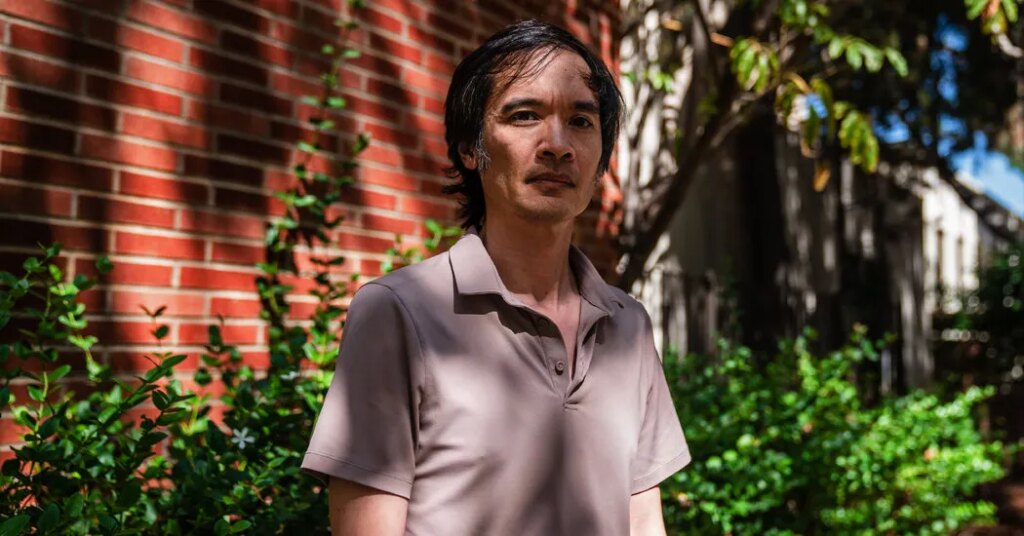
Terence Tao is typically described as one of the world’s greatest living mathematicians, but right now he is doing very little math.
“I’m on a war footing,” he said while grabbing coffee during a two-day math workshop at the University of California, Los Angeles, that was rife with talk about the existential crisis that artificial intelligence has created in his field.
Days earlier OpenAI had announced that it had solved the Navier-Stokes problem, one of seven “Millennium Prize problems” that had stymied the greatest minds in math for nearly a century.
“There are no rules any more,” Dr. Tao, 51, said in an interview before the workshop in his modest office on the U.C.L.A. campus, his home since 1996, when he arrived after completing his doctorate at Princeton at the age of 20. “I’m just numb to what would have been jaw-dropping events for me a year ago. At some point, maybe I’ll get hit by a whole wave of PTSD.”
Instead he was hit by a bigger bomb on Oct. 6, when OpenAI released more than 350 findings in nearly every subfield of the profession, including algebra, number theory, theoretical computer science, mathematical logic and topology. Stunned mathematicians, some who were close to solving problems they had worked on for years, found themselves beaten in an instant by A.I.
Dr. Tao, who has been a tenured professor since the age of 24, said senior academics like himself are not as threatened by A.I. as those starting out. But the math world is looking to him for answers. He has accepted that his celebrated status has made him an unofficial spokesman for the field, a job that for now is consuming most of his time.
Until recently his job was as a bridge between the slow-moving world of higher math and the scorching speed of A.I. Dr. Tao, who uses A.I. as an assistant to run calculations, write code, search vast troves of literature and brainstorm ideas, has been experimenting with OpenAI’s models since 2023. He was an enthusiast for a “best of both worlds” future.
OpenAI’s releases have now left him feeling used. “As recently as a year ago, I had a pretty good relationship with many employees at OpenAI,” he said in a recent phone conversation.
“A lot of people I interacted with shared a very common vision of how A.I. should be used — you know, to empower scientists.” But the rush to publish new findings, he said, shows their true purpose. They “used math for what they needed, which was to evaluate their models,” he said. “At this point, I don’t see a way to constructively engage.”
His anger was clear in a post on the widely read math blog Proofs and Prompts after OpenAI’s Oct. 6 release. “I am horrified by the many person-years” of research, particularly by young mathematicians, “being casually disrupted or destroyed,” he wrote.
“Much as one cannot unhear a movie spoiler or a crossword clue, one cannot explore a problem as profitably and richly once one is aware of an existing solution.” He mourned, he added, “the path not taken, and the opportunities lost in the frantic race to develop this technology.”
As Much Art as Science
At the heart of the crisis in the profession is a menacing question. If solving hard problems is a mission of math, what happens when machines can do it faster? So much of higher math — hiring, promotions, graduate training and acclaim — is based on the difficulty, quality and the impact of papers (the written documents explaining proofs) that a mathematician produces.
The consensus is that A.I.-assisted problem solving is the inevitable future, but no one knows exactly what that new world will look like. “Deep uncertainty will persist in these next years,” a draft report by a group of mathematicians meeting at Harvard on Ph.D. education concluded last month.
A.I. does offer “exciting new possibilities” the report reassured. But implicit in its pages was the sense of loss among humans drawn to math for the intellectual adventure of problem solving — often deeply frustrating, sometimes thrilling and euphoric if a personal breakthrough leads to an advance in the field.
“You’ve had epiphanies, right?” Ravi Vakil, a prominent Stanford mathematician and the president of the American Mathematical Society, asked in an interview. “Suddenly everything in the room becomes clear.”
Theoretical, or “pure” math — the math of Dr. Tao — is loved as much for its art as its science. Its primary goal is to add to the understanding of the vastness of math itself. Unlike applied mathematicians, who have generally embraced the power of A.I. to help them solve practical problems in engineering, finance, weather forecasting and other sciences, pure mathematicians study shapes, structures, numbers and abstract concepts.
Still, pure math ultimately has led to, among many other advances, the creation of the internet, microchips, GPS, cybersecurity, encryption, CT scans and other medical procedures. In 2006 Dr. Tao and three partners created the mathematical theory of compressed sensing, which sped up the scan times of MRIs. Today MRIs can produce real-time images of the beating heart, and many children can be scanned without sedation.
‘Screaming for Help’
He may say he is battle ready, but Dr. Tao hardly projects as a warrior. In his office, he spoke softly in a lilting Australian accent, was self-deprecating, occasionally funny, upset about the relationship he once had with OpenAI and far from the stereotype of a tortured, brooding math genius. He is known for his sunniness in the rarefied realm of pure math, and students remark on his modesty.
He was dressed in faded blue jeans and a loose polo shirt that seemed to hang absent-mindedly from his slight frame. A blackboard that ran nearly the length of the room was covered with computations by one of his three current Ph.D. students, Ben Goldman. Nearby was the bike Dr. Tao had ridden to work, with his lunch from home in a plastic bag strapped onto the rack over the back wheel.
“It’s leftovers from three days ago,” he said.
He spends much of his time in what he calls “community organizing” — pulling together groups of mathematicians, strategizing, responding to the media, delivering lectures on A.I., counseling. “It’s someone screaming for help,” he said. “I can’t help them because I have no bandwidth, but I can identify somebody else they can talk to.”
His own 20-year-old blog has become math’s front page, filled increasingly with guest posts from others but also notes from the graduate class he is teaching and breaking math news. The day he posted a statement he signed along with 24 other winners of the Fields Medal, math’s version of the Nobel Prize, that called OpenAI’s math “detrimental” to the field, his blog shot to 100,000 views.
“My wife says I’m The Huffington Post,” he said.
His lightheartedness faded as he talked about appearing in a promotional video for OpenAI earlier this year. Its roots were in the Trump administration’s suspension last year of $600 million in research grants to U.C.L.A. that threatened the existence of the university’s Institute of Pure and Applied Mathematics, where Dr. Tao is director of special projects.
Dr. Tao reached out to OpenAI as part of an emergency fund-raising drive, and the lab agreed to sponsor a workshop at the institute for what Dr. Tao said was $60,000 to $70,000. It was held in March, when OpenAI conducted an hourlong video interview with him in which he talked about the benefits and risks of A.I.
He expected the entire video to be posted. OpenAI instead cut it to one minute: “I think it’s ready for prime time,” Dr. Tao says of A.I. as he writes rapidly on a blackboard and a soundtrack of joyful music seems to urge him on.
He gave OpenAI permission to use the ad, he acknowledged in his blog. But in retrospect, he wrote, he should have “pushed back harder.”
An OpenAI spokesman, Laurance Fauconnet, said in a statement that “we value our engagement with Terence and the wider mathematics community.” The lab, he said, is “working with the community to turn progress in A.I. into deeper human understanding and new discoveries, and we will continue to act on its feedback.”
(The New York Times has sued OpenAI and Microsoft, claiming copyright infringement of news content related to A.I. systems. The two companies have denied those claims.)
Dr. Tao was not impressed with the writing in OpenAI’s proof of the Navier-Stokes problem. “It is technically readable,” he said. “But no expert I’ve talked to has actually understood the whole argument.” He said the writing is better in the latest release, though he called it a “mixed bag.” Some papers appropriately cited his work, he said, and seemed to have advanced it in a way he thought was plausible. Still, “there is no author that I can have a real conversation with about the results.”
Dr. Tao was aware last month that OpenAI was working on the Oct. 6 release and at the time called the coming results “toxic waste.” Now he calls them “maybe treated waste.”
A 760 on the Math SAT at Age 8
The first day of the math workshop — the topic was the field of partial differential equations “in the age of A.I.” — got underway in a small auditorium at 9 a.m. The institute’s director, Dimitri Shlyakhtenko, welcomed several dozen academics, including a batch from Harvard, Princeton, the University of Tokyo and Sandia National Laboratories, the home of the nation’s nuclear stockpile testing. The room was expectant, waiting to hear from Dr. Tao on what he thought A.I. might have in store for them.
“Our first speaker does not require introduction,” Dr. Shlyakhtenko said.
Indeed he did not. As Dr. Tao popped up from his seat to take his place at the lectern, it is safe to say that most in the room already knew him as a legend. Born to Chinese immigrant parents in Australia, he taught himself to read at the age of 2, scored 760 on the math portion of the SAT at 8 and won his Fields Medal at 31.
The medal was for his advances in harmonic analysis — the study of breaking down complex waves into simpler ones — but also for work in partial differential equations and the fields of additive number theory and combinatorics. The Fields Medal Committee cited Dr. Tao for his most famous work, with the mathematician Ben Green, on what is known as the Green-Tao theorem, which proved that there are infinitely long, evenly spaced sequences of prime numbers — a monumental achievement in the field.
Up at the lectern at U.C.L.A., Dr. Tao began with an apology. His plan, he said, had been to spend the summer developing a “living spreadsheet,” or network, built and maintained by A.I., of academic results about explicit analytic number theory, an unforgiving subfield of math. “But I’ve been a bit distracted in the last few weeks, and I have not actually devoted as much time to this project as I wanted to,” he said.
He finished with another apology. The network was not complete. He had budgeted all of September to get it done, but “some things happened in the meantime.” The crowd chuckled knowingly.
The most intense discussion on A.I. came after lunch. Sometimes it seemed like a group-therapy session.
“As we soul-search about what the role of the human mathematician is, shouldn’t we go back to where mathematics came from?” said Tatiana Toro, the director of the Simons Laufer Mathematical Sciences Institute at the University of California, Berkeley.
Andrea Bertozzi, a U.C.L.A. professor of math and mechanical and aerospace engineering, said that one thing she liked about college math was that “you sat down with your pencil” and coffee and paper, “and you could prove things.” She brought up the cost of solving Navier-Stokes, which OpenAI said took a swarm of 10,000 agents 88 hours to produce a 165-page proof. Was it “something like $6 million?” she asked.
“More like 22,” someone in the audience said.
This led to a round of comments that the cost of A.I. is undemocratic, particularly to mathematicians in developing nations. “Half the world is going to fall behind,” Dr. Toro said.
Dr. Tao, who had the last word, agreed that the field needed to do some soul-searching. But, he mused, given how fast things were moving, maybe he was doing “soul-searching at gunpoint.” At that point, the room laughed.
‘The Elephant in the Room’
Mr. Goldman, like Dr. Tao’s two other Ph.D. students, is facing an ambiguous future. He is 25, a graduate of the University of Chicago and now in his fourth year of a five-year program. He doesn’t know what he wants to do after he gets his doctorate, but he said he has long been drawn to the creativity of math research.
“I’m not saying I was necessarily trying to prove the thing that’s going to be in every textbook 30 years from now,” he said. But he would be happy with a proof “that feels like the argument is me somehow, that has my DNA in it and that people will at least for that one result want to know the way I thought about something.”
After the latest OpenAI release, Mr. Goldman said he was plowing ahead with the research for his dissertation, “even if it can be made obsolete by some messy manuscript released by these companies in the next coming months.” He was upset, he said, “to see a field that I love being sort of strip mined.”
Siddharth Mulherkar, a fifth-year Ph.D. student of Dr. Tao, is applying for postdoctoral research jobs for next fall, the next step on the long pursuit of a tenured professorship. Dr. Tao has given him, like the others, the OK to use A.I. in his work. And yet when he discloses on a job application that A.I. helped with the proof he submitted, how will he himself be evaluated?
“Obviously I don’t want to just be pushing buttons and getting answers to problems,” said Mr. Mulherkar, 27, who was born in California but moved to India with his parents and lived there until he arrived at U.C.L.A.
OpenAI’s latest release, he said, has made him even more uncertain. “I’ve spent quite some time training to become a research mathematician in the traditional sense,” he said. He knows he’ll need new skills, but what they are and “what this career is going to look like and what it will value is completely unclear to me.”
Arian Nadjimzadah, 26, another fifth year Ph.D. student of Dr. Tao, said he was shocked by OpenAI’s latest release claiming to have solved the four-dimensional Kakeya conjecture and other problems related to his own work. “I had to take a couple days from working on math,” he said.
He was particularly frustrated, he said, with the writing in OpenAI’s proof explaining the conjecture. “The result is extremely difficult to read and uses very unfamiliar jargon to us in the field,” he said. “That’s the nice thing when a person posts a result. They’re accountable. They give talks about it, and they help people understand.”
Mr. Nadjimzadah is studying this academic quarter at the Institut Mittag-Leffler outside of Stockholm and is looking for a postdoctoral job. At the advice of Dr. Tao, he is including in his job applications how OpenAI’s Oct. 6 release connects to his current work and future plans.
“He just said it’s important to address the elephant in the room,” Mr. Nadjimzadah said.
Therapy Sessions
To Dr. Tao, the next few years will require the reinvention of math, or at least of math education. The Harvard report recommended, essentially, that math become more human-centric: Doctorate degrees should not be rewarded primarily on the text of a dissertation, as they are now, but more on a rigorous in-person defense. Students should regularly show professors they can speak fluently about their work.
Dr. Tao went further last week when he presented what he sees as the future of math in a lecture at the California Institute of Technology. Despite OpenAI’s releases, he said, most problems at the frontiers of math are unsolved, math remains infinite and the difficulty of problems is therefore boundless. Since A.I. has given mathematicians the ability to collect data on such a vast scale, they will increasingly work in large groups collaborating on once-unimagined projects.
Dr. Tao, who sees each of his three students once a week, said every meeting is “increasingly a therapy session more than technical guidance.” His answer to them is that “if you focus on only the things you could do before, it looks bleak.”
So he has offered hope with advice that amounts to acceptance born of necessity rather than fighting a war. Problem solving is not a destination but a journey, and lessons learned along the way are often more important than the answer itself. Rather than solving a single problem on their own, they can use A.I. to solve 10 problems and find new patterns and more questions to ask.
“They will have to use their imagination,” he said. “This is a time for creativity, and I do hope students rise to the challenge. They didn’t ask for it. But I think many of them will surprise us.”
The post ‘I’m on a War Footing’: Terry Tao and the Crisis in Math appeared first on New York Times.