In December 1974, with the U.S. bicentennial just over the horizon, Chevrolet unveiled a TV ad tied to the release of special “Spirit of America” editions of several of its car models, including the Impala. Accompanied by hazy images of nostalgic Americana, a catchy, sing-along jingle lauded the enduring virtues of “baseball, hot dogs, apple pie and Chevrolet.” Our 200th birthday was still months away, but Americans, it seemed, were ready to celebrate.
A sprawling, complicated and rich new photography exhibition at the Smithsonian American Art Museum, “Much Here Is Beautiful: Photography Surveys of the U.S. Bicentennial,” captures both the spirit and the letter of that jingle, along with a whole lot else. You’ll find pictures of a baseball stadium (by Joel Meyerowitz); a roadside hot dog stand (by John Margolies); a grocery store advertising apples for 10 cents apiece — you can’t make apple pie without apples — and, yes, even a Chevy Impala. (The latter two photos were taken by Robert Townsend Jones Jr.)
If you’re looking for other touchstones — along with apple pie, “Mom” is half of another popular aphorism touting old-fashioned American values — the show features her, too. Elinor Cahn’s photo of elderly Polish American mothers of war veterans, posing on the steps of a Baltimore church on Memorial Day, captures American motherhood at its most iconic.
But America is no one thing, and neither is this multifarious show.
“Much Here Is Beautiful” features 225 photographic prints — or 262 photos, if you count Margolies’s projected slideshow of 37 rotating images of vernacular roadside architecture (gas stations and the like). The works were selected by curators John P. Jacob and Krystle Stricklin, mostly from an archive created between 1976 and 1981 by more than 200 roving photographers with grants from the National Endowment for the Arts. Their mission? To create a visual record of the United States — a photographic State of the Union — on the milestone anniversary.
So what did we look like back then?
“Much Here Is Beautiful” doesn’t attempt to address that question, except by reminding us of the answers’ metaphysical unknowability. How could any number of photos capture something so gargantuan, so shape-shifting as America? If anything, the show tells us more about photography than it does about the American people.
Here you’ll see candid, flash-lit snapshots of riders on the New York subway, from a series by Bruce Davidson. A photo of a retired Jewish couple, posing in matching purple bathing suits, on the sands of Miami Beach, by Andy Sweet. A selection of Meridel Rubenstein’s formal black-and-white portraits of Native American, Hispanic and White artisans in New Mexico. The back of a Hoover Co. worker’s blond bouffant in North Canton, Ohio, from Lee Friedlander’s tour of grimy Rust Belt factories. Friedlander, along with Meyerowitz, is among the show’s more famous names.
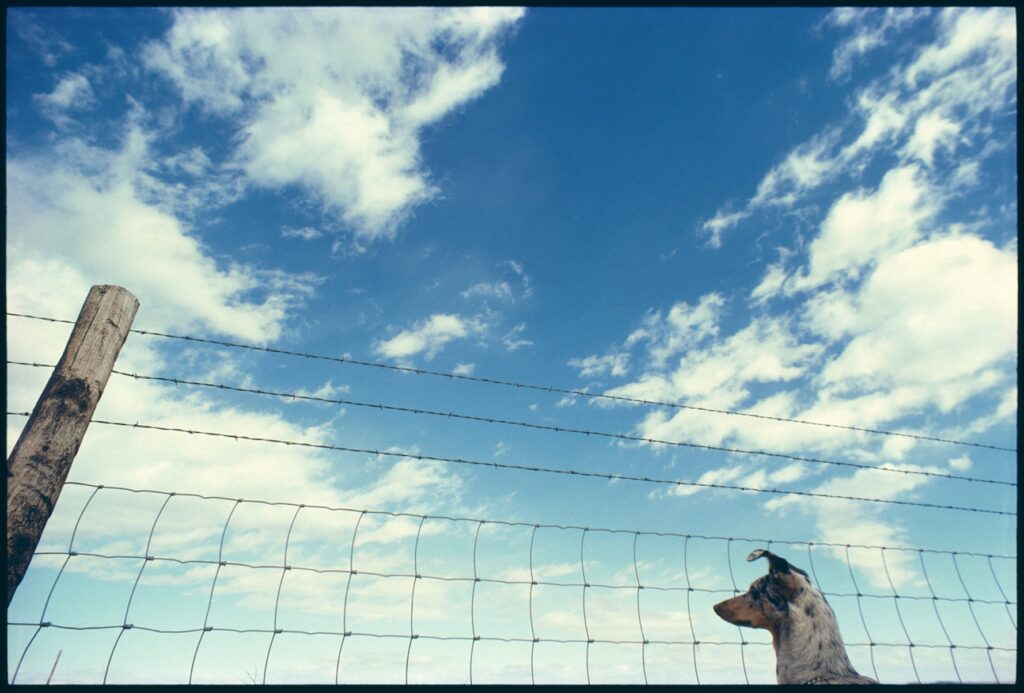
Much of it is black-and-white. Many of the prints are small, inviting close inspection, as with a family photo album. Meyerowitz’s ballpark picture, taken at Busch Memorial Stadium during a 1978 game between the St. Louis Cardinals and the San Francisco Giants, with St. Louis’s Gateway Arch in the background, is, at 29.5 by 34.25 inches, the largest work on view. Urban landscapes mix with the bucolic: concrete canyons, metaphorically, side by side with amber waves of grain.
There is a subtle theme running through the show — of a nation in transition. Buildings sometimes are shown mid-demolition, decaying, brand new or still under construction. Sage Sohier documents Boston’s once-industrial Leather District and Fort Point Channel on the cusp of redevelopment and gentrification. Joan Clark Netherwood shows us what East Baltimore’s Butchers Hill looked like before it became posh.
In 1981, the NEA transferred 1,000 images from the bicentennial survey projects to the SAAM, launching the museum’s permanent photography collection, which is now a world-class repository of photographic art. The exhibition’s title, “Much Here Is Beautiful,” is taken from a 1976 poem by Robert Hayden, written from the perspective of an extraterrestrial in America filing a report to a distant home planet. The wording suggests an implicit disclaimer: Much, but not all, here is beautiful. Some of what we see is banal, or even, in its documentation of poverty, distressing.
Hayden’s poem also contains this description of Americans, written like the fragmentary, sometimes ungrammatical, notes of an alien journalist:
The exhibition is similarly full of strange juxtapositions. It places work from the bicentennial surveys in the context of much older, federally funded photo surveys of the late 19th and early 20th centuries. Reddish-brown photos of rock formations under open skies, by Timothy H. O’Sullivan (the first photographer to join a federally funded survey expedition in 1867) and other photographers, give way to the Farm Security Administration’s well-known documentation of the Great Depression, as memorialized by the greats Walker Evans, Dorothea Lange and others.
The bulk of “Much Here Is Beautiful” is organized by geography, with four large galleries devoted to the Northeast, South, Midwest and West. Directional signage hangs overhead, like wayfinding placards in a train station.
It is, quite literally, all over the map: defined by both its ambitious reach and its inevitable limitations, as curator Stricklin puts it in a video accompanying the exhibition.
That’s not by accident. In his foreword to the show’s thoughtful catalogue, critic Andy Grundberg asks, rhetorically, just what kind of art were these NEA photographers creating? “Given the hodgepodge of ambitions and oversight, and the variation within completed (and a few incomplete) results,” he writes, “an uncharitable observer might say that the overall picture, if seen from a distance, resembles a dog’s breakfast.”
It’s almost too big, too manifold, to digest.
Grundberg continues: “But this drawback — the lack of a single overriding intention or focus, not to mention style — might also be the survey’s greatest strength.”
I’d agree with that. America might be impossible to define, but it doesn’t hurt to try. If any art form were up to the task of expressing that paradox, it’s photography.
“Much Here Is Beautiful” ends with something called the Rephotographic Survey Project, in which 20th-century photographers — Mark Klett, Ellen Manchester, JoAnn Verburg, Rick Dingus and Gordon Bushaw — precisely matched certain 19th-century landscape photographs by O’Sullivan, William H. Jackson and others. Hanging next to each other, these pairings show both transformation and endurance. The more things change, the more they remain the same.
But there’s another paradox at work. What the exhibition perhaps inadvertently captures best is the tension between our nostalgia for an idealized past — a history that we may have in some ways only imagined — and the undeniable realities of the United States.
“Much Here Is Beautiful” is an intentionally multifaceted, even messy show. Its power lies in the serene equanimity of the camera to weigh two different things — say, Ingeborg Gerdes’s photo of the Grand Coulee Dam and Ted Wathen’s picture of the garage of a Jehovah’s Witness in Harlan County, Kentucky — on the same scale. Those two images are not in the same gallery, but as we hold them in our mind’s eye, they invite a question that is impossible to answer: Which one is extraordinary and which one is everyday? It’s arguably one of photography’s greatest magic tricks.
Much Here Is Beautiful: Photography Surveys of the U.S. Bicentennial Through April 18 at the Smithsonian American Art Museum, Eighth and G streets NW. americanart.si.edu.
The post America the beautiful? Depends on your perspective. appeared first on Washington Post.