KYIV — Across the Dnieper River, roughly five miles south of the liberated Ukrainian city of Kherson, lies the town of Oleshky, a cratered wasteland in Russian-occupied territory where residents are starving.
The last food delivery was on May 26. Since then, there had been nothing. No food, no fuel, not a single car in or out of the city.
Cut off from the outside world, trapped inside the deadly belt of no-man’s-land running along the 750-mile front line, Vitaly, his wife, Iryna, and their 13-year-old son survived the summer by sharing one cup of rice or buckwheat between them each day.
On luckier days, they gathered plants and grass to mix in with a cucumber or tomato from their garden. By early August, they had just a month of food left. Time was running out.
“We had lost all hope of help,” Vitaly recalled, speaking on the condition that he be identified only by first name. “We had to save ourselves.”
Vitaly and his family were among several dozen residents who managed to escape Oleshky in recent weeks.
Others trying to flee stepped on mines that now carpet the only road out, and were killed or critically injured, Tetiana Hasanenko, the exiled head of Oleshky’s military administration, told The Washington Post.
Known as the Road of Death, it runs 14 miles southeast to Radensk. It is heavily mined and under constant surveillance by attack drones from each side. The nearby river is also mined.
According to the U.N. Human Rights Monitoring Mission in Ukraine, about 1,700 people remain trapped inside Oleshky. The majority are elderly or disabled. About 50 are children, residents said.
The testimonies of those who escaped, some of the first accounts to emerge from Oleshky since the start of occupation, point to a worsening humanitarian crisis in the town as Russia neglects the residents of an area it claims, illegally, to have annexed.
The town hospital, emptied of medicine, is now filled with people unable to be treated. Dozens of corpses are stored in the hospital’s basement floors, awaiting burial.
Some families have no food, while others have survived on vegetables from their gardens or preserves. People also reported eating snails to survive.
Russian soldiers are also going hungry. According to several residents interviewed by The Post, soldiers have threatened locals at gunpoint with rape or death if they do not give up their food.
In late September, after several failed attempts, Ukraine’s military managed to deliver four tons of food into Oleshky with drones. But Hasanenko said it was not enough to halt the catastrophe facing residents.
“The people who remain there will simply starve to death,” said Myroslava Kharchenko, a lawyer for Save Ukraine, a humanitarian organization that helps to resettle people who have escaped Russian occupied territories. “They won’t survive this winter.”
Occupation
Oleshky has been occupied by Russian forces since the first days of Russia’s full-scale invasion in February 2022.
Located in a part of Ukraine famous for its sand dunes, Oleshky lost its power and water supplies three years ago, after Moscow destroyed the nearby Kakhovka dam, flooding the area.
Some areas were left under 20 feet of water. Hundreds of people drowned. The floodwaters destroyed many homes and parcels of land, leaving much of the ground barren and impossible to cultivate.
Former residents described a nightmarish existence under occupation.
Increasingly, people have been mowed down by attack drones in the streets. Some bled out and died, their bodies left to decompose where they lay. Hungry dogs roaming the streets began to feed on the corpses.
Vitaly said he could smell the stench of the bodies from his home. In the middle of August, he said, a drone ripped through the remains of the family’s home, destroying everything. They moved in with neighbors.
Vlad, the grandson of an elderly couple who also escaped in September, told The Post that his grandparents fled Oleshky after a Russian soldier took over their apartment for 11 days.
“When my grandparents were asleep, he would come in, wake them up and say, ‘Wake up, go cook me something to eat.’ He forbade them from leaving the house,” Vlad said.
The soldier threatened the couple at gunpoint and shot their chickens, he said. His account could not be independently verified but was consistent with the descriptions provided by other residents who escaped.
Occupation authorities also prohibited residents from burying the dead, saying that forensic teams were needed to “investigate Ukraine’s war crimes.” People were forced to place sheets over the rotting corpses of their loved ones.
The discovery that someone was planning an escape or had received humanitarian aid from Ukraine could have terrible consequences, ex-residents said.
“We know of more than one case when people were punished for this, taken to the basement, and the people simply did not return. It was a one-way journey,” Hasanenko said.
Russia has systematically disappearedUkrainian civilians living in its occupied territories, according to Ukrainian authorities and human rights groups.
No help for the living
Oleshky’s former residents and its government in exile are now sounding the alarm about the approaching winter.
Last winter, residents began to freeze in their homes.
One of Vitaly’s diary entries, dated Jan. 1, 2026, which he shared with The Post, paints a picture of the dire conditions.
“The first frosts have set in. It’s -10°C today,” he wrote. “I barely slept all night because I had to find a way to keep warm, and the only way to heat the apartment is by using the remaining gas in the cylinder with a ceramic heater attachment. I heat the room where we sleep for 10 minutes every three hours.”
Since occupation, ATMs in the town stopped working, leaving residents with no nearby access to cash. As food grew more scare, prices soared.
“The prices were outrageous,” Vitaly said. “A kilogram of flour cost 5,000 rubles [about $60]. You could buy a dozen eggs for 3,000 rubles [about $35] — but only through someone you knew. A kilogram of tomatoes cost a fortune, 1,500 rubles [$18].”
Russian and Ukrainian authorities have managed to exchange prisoners of war and return the bodies of killed soldiers. But the crisis in Oleshky highlights how Moscow and Kyiv have failed to find a way to help the living, for example, by negotiating humanitarian corridors.
A similar impasse occurred when Ukraine seized part of Russia’s Kursk region in August 2024, which it then occupied for seven months, trapping hundreds of civilians without regular access to food and medicine.
Russia has long denied that Oleshky is facing a humanitarian catastrophe. On Sept. 21, Kremlin spokesman Dmitry Peskov described the situation as “critical,” but insisted that Kyiv was doing everything to obstruct deliveries while Russian troops were working to facilitate them.
Escape
Early on the morning of Sept. 13, Vitaly and his family set out on foot with their elderly neighbors. They had bundled some clothes, documents and their few surviving family photo albums into bags strapped to two bicycles.
They brought their two cats, one of which was burned when their home was shelled. The family dog was left behind.
“The choice was stark: stay in danger and die, or risk going along mined roads under drones, and have some hope of living and surviving,” Vitaly said in an interview. “We chose the second option.”
“It was a very difficult decision — we were worried about our son — but we decided that we had to keep moving forward,” he said.
As they left, Vitaly looked back at the three-room home where he was born in 1973 — in the Soviet Union — when no border separated Russia from Ukraine.
From the window, he could see neighboring apartment towers and trees. After the invasion, most of his neighbors fled Oleshky via Crimea, leaving just two families, his own, and a woman with her child on the first floor.
Now, their home was a heap of rubble.
It took five hours to walk to Radensk, weaving their way slowly between burned-out vehicles, corpses and mines. After months spent indoors, growing malnourished, the journey was physically exhausting.
Vlad’s grandparents had a harder time. “My grandmother would take 10 or 20 steps, and then feel unwell,” he said. “They rested a little and carried on. In the end, they walked for nine hours.”
When they reached Radensk, his grandmother collapsed. A stranger took the couple in and gave them borscht. They had reconnected to the outside world.
From Radensk, they undertook a three-day odyssey through war-torn territory, switching buses every few hours, to reach the Russian border.
After a lengthy interrogation by Russian security services, they crossed and headed north to Belarus, with the help of an underground network of volunteers. In Belarus, they received so-called “white” passports from the Ukrainian consulate, allowing them into Ukraine.
“You can’t forget that feeling, when you set foot on your native land, when you see the border posts, when Ukrainian soldiers come to meet you,” Vitaly said. “It was an incredible feeling, being home and that this it was all behind us.”
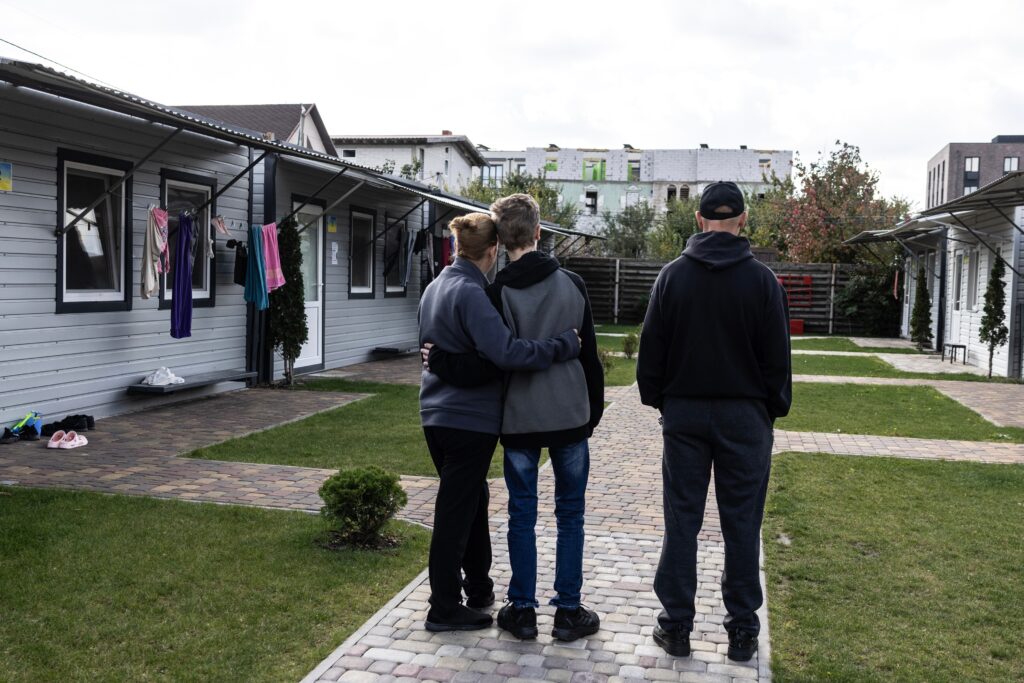
For now, the family has been given temporary housing at a Save Ukraine center on the outskirts of Kyiv. Iryna is still recovering from their ordeal during occupation and their harrowing escape.
They live with others who have escaped occupied territory and who understand and share their ordeal. Vitaly said he hopes to enroll at a university or join the army.
“After four years under occupation, you want something more,” he said. “And it helps to still see life as beautiful. To see positives in the negatives.”
Hasanenko said she is worried for the lives of those who remain in Oleshky.
“Oleshky was a European town, a prosperous town,” she said. “To live there before the beginning of the full-scale invasion was to have everything: the forest, the river, the desert. And now you see what we have.”
She added: “They came to kill us. So why would they save us?”
The post Survivors describe hunger and misery in Oleshky, occupied by Russia since 2022 appeared first on Washington Post.