FREEDOM’S GATE: Maya Angelou, Lorraine Hansberry, Abbey Lincoln, Miriam Makeba, and Nina Simone, Live at the New York Nightclub That Shaped the Civil Rights Movement, by Soyica Diggs Colbert
Soyica Diggs Colbert’s “Freedom’s Gate” is a commendable book, albeit one with a bit of a title problem. First, what it accomplishes: The book is a welcome corrective to masculine castings of the civil rights movement and of Black political and intellectual thought from the late 1950s through the mid-1960s, in both the United States and the African diaspora.
Colbert, a scholar who is currently serving as the interim provost at Georgetown, forages through a fascinating archive of letters, journalism, scholarship and art to uncover the intersecting friendships and political awakenings of five of the most iconic artists of the 20th century: Maya Angelou, Lorraine Hansberry, Abbey Lincoln, Miriam Makeba and Nina Simone.
Focusing on the earliest stages of their careers, Colbert positions her subjects as both emerging artists and activists, whose political consciousness was forming alongside male counterparts such as Harry Belafonte, Max Roach, Malcolm X and James Baldwin, and informing the men’s development in the process. In this way, she makes abundantly clear that these women were not only affected by the struggle for civil rights, but they were also actively shaping it.
Their critical incubator, Colbert argues, was the Village Gate. Founded by Art D’Lugoff in 1958, the legendary venue in Greenwich Village opened on the heels of the Beat era, in the midst of modal jazz’s rise, rampant political suppression, legal and de facto segregation, and the nascent civil rights movement.
Contrary to the cultural ethos of the time, the club featured an interracial roster that included poets, musicians and dancers, some Black (Max Roach, John Coltrane, Miles Davis), some blacklisted (Pete Seeger, Paul Robeson) and others socially out of favor, a category that encompassed virtually all of Colbert’s women subjects.
Despite this storied history, the Gate struggles as a leitmotif. The trope of female friendship among spirited, talented, complex women juxtaposed against an equally electric and iconic locale is tried and true (“Sex and the City,” anyone?). But in order for it to deliver, the Gate has to transcend its function as an occasional site for performance and politics; it has to give main-character energy befitting this ensemble. Here, it’s at best a guest star.
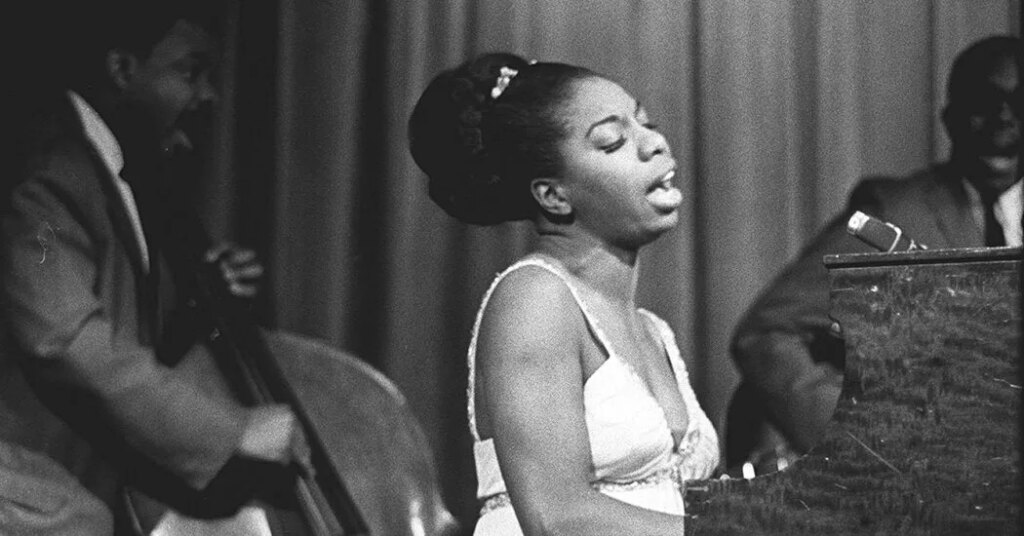
The Gate’s role in each woman’s development varied. A benefit for Martin Luther King Jr. and the Southern Christian Leadership Conference, organized by Angelou and the comedian Godfrey Cambridge with the help of the actor Hugh Hurd, was held at the Gate in 1960. Simone recorded a live album there in 1961, and gave her first performance of “Mississippi Goddam” there in 1964.
Colbert’s account of Lincoln’s contributions to Roach’s album “We Insist! Max Roach’s Freedom Now Suite,” which she performed at the Gate in 1961, is one of the book’s strongest chapters. Colbert carefully contrasts the “collective pain” of Black struggle that Lincoln famously conveys with her voice — the heart-rending screams of the protest song “Triptych” — with the physical pain of her damaged vocal cords, undiagnosed endometriosis and ongoing battles with depression and exhaustion, all of it exacerbated by Roach’s mental illness and the volatility of their relationship.
But Makeba’s New York club debut, in 1959, actually took place at the Village Vanguard, as did Angelou’s local club appearances during her early phase as a calypso performer. D’Lugoff claimed he introduced Hansberry to Simone at the Gate, but the venue’s role in Hansberry’s career was largely tangential.
The genius here is in Colbert’s fix. She shores up her teetering conceit by scaffolding each of her subjects’ appearances at the Gate with evocations not only of the period’s political turbulence but also, poignantly, of the women’s private lives, serving up vivid examples of their efforts to balance their creative work with the fraught realities of marriage, motherhood, queerness, mental and physical illness, exile and racism.
The terrain she covers manages to be simultaneously vast and intimate. We witness Angelou coming into political maturity during her time in Egypt and Ghana in the early 1960s, while navigating financial precarity and a rocky marriage. Hansberry’s swift dressing down of Attorney General Robert F. Kennedy, during a meeting in 1963 about his complacent attitude regarding Black freedom, stands in stark contrast to scenes of her sickbed, as she died, at 34, of pancreatic cancer. Hansberry’s diagnosis was kept from her by her male doctors and husband, making her repeated wish to be on the ground fighting all the more heartbreaking.
If the book you’re longing for is one where the Village Gate earns its top billing with gratifying details granted to Angelou, Hansberry, Lincoln, Makeba and Simone, brace yourself for some disappointment. However, if Black women’s friendships and artistry, coupled with political action and finely observed emotional nuance, are your siren’s call, then Colbert’s book is a rare treat.
FREEDOM’S GATE: Maya Angelou, Lorraine Hansberry, Abbey Lincoln, Miriam Makeba, and Nina Simone, Live at the New York Nightclub That Shaped the Civil Rights Movement | By Soyica Diggs Colbert | Norton | 353 pp. | $35
The post When the Room Where It Happened Was a Greenwich Village Nightclub appeared first on New York Times.