Photographs by Lesha Berezovskiy
I. 2,087 Questions
The Pale of Settlement is teeming with ghosts, and why shouldn’t it be? At the turn of the 20th century, some 5 million Jews lived in this region between the Baltic and Black Seas, and by 1945, almost all of them had been murdered. If they slouch now like scarecrows over the tilled black earth, or float between wooden shacks, or even peer over the shoulders of the babushkas selling neat piles of used clothes in front of the bus station in Rivne, this is to be expected. What I hadn’t quite anticipated was just how many questions they had left unanswered—2,087 to be exact. A long list of queries covering nearly every particular of how they lived their lives, from circumcision to shiva, sat on my lap as I stared out the window on a 10-hour car ride from Warsaw to Kyiv, through the heartland of what was once the Pale.
31. Is there a belief that if a pregnant woman steps on the spot where a mare has rolled around, she will carry her child for 12 months?
269. With what do people frighten a child so that he will go to sleep more quickly?
1,280. Is it a custom to drink red liquor if the bride turns out to be a virgin?
1,281. Is it a custom to eat hard cheese if she is a virgin? What does this signify?
1,714. Do people ask for forgiveness from a dead child?
I was on my way to visit the archives, once thought lost, of the early-20th-century Jewish writer Shloyme-Zanvl Rapoport, better known by his nom de plume, S. An‑sky. He was the author of this insanely granular questionnaire. I could have spent my car ride reading any number of other works by An‑sky, who, among his many eccentricities, had a touch of graphomania. His collected writing comprises 15 volumes. He left behind thousands of pages of diaries, essays, short stories, and plays, including his best-known work, The Dybbuk, a masterpiece of Yiddish theater. But I decided on the long list of questions because An‑sky saw them as the culmination of his life’s greatest endeavor: an ecstatic, obsessive attempt to wrap his arms around an entire people just as it was disappearing.
These 2,087 questions were the first part of his Jewish Ethnographic Program—and the only part that was published, in 1914, under the title Der mentsh, which simply means “The Person.” It was the beginning of a survey that he hoped would cover “every aspect” of Jewish life. “Death, life after death, demonology. Holidays, everyday life, abstract questions,” An‑sky wrote to a potential donor. “In short, we’ll have over 10,000 questions.” Looking out the window, I kept imagining a poor surveyor trudging through the mud of a shtetl with a clipboard, asking, Do you have a couple of months to spare?
Some of the questions are open-ended (897. How did people treat an old maid in the past, and how do they do so now?), but most are hilariously leading. Why would you ask, for example, whether children ever engaged in pranks like gluing their rabbi’s beard to the table when he fell asleep (484) if you didn’t already have intimate knowledge of such a beard gluing? In fact, An‑sky had done his research. The questionnaire was the fruit of an ambitious ethnographic expedition that he’d carried out from the summer of 1912 to the onset of World War I, two years later.
This sort of ethnography is now a mostly outdated social science, a relic of an imperial age in which certain peoples, such as the Inuit, were unthreatening and near-extinct enough to be placed behind glass in a museum. But An‑sky’s was a kind of self-ethnography, a work of salvage and redemption. He was born into the shtetl world in 1863 and grew up in the town of Vitebsk, in present-day Belarus (Marc Chagall’s hometown as well). Raised in poverty by a single mother who ran a tavern, An‑sky rebelled against tradition. In his late teens, he was expelled from a nearby shtetl for trying to persuade the young yeshiva boys he was tutoring to abandon their studies and become freethinkers. When he finally left the Pale, in his 20s, he intended never to look back. He began a peripatetic life as a revolutionary, working in salt mines in the Donbas region alongside Russian miners, living in Berlin and Paris and Bern, developing his writing and his political commitment to radical reform. This is what led him over time to ethnography, which was a way of elevating cultures that were being trampled by the Russian empire.
Only in his 40s did An‑sky realize that the insular but vibrant world of the Jews could be the subject of such ethnography as well. “There is no people that has talked about itself as much and knows itself as little as the Jews,” he wrote in his 1908 treatise “Jewish Folk Art.” He may also have been thinking about himself, and the “emptiness” he frequently described in his letters. In 1912, he secured funding for an expedition from a financier, Baron Vladimir Gintsburg, and set out with a photographer and a musicologist—a small team that would grow the following year—to explore the Pale. Slogging through mud “so deep you could die” (as the Hebrew poet Haim Nahman Bialik put it), he gathered all he could, including songs—he brought along an Edison recording device that could capture sound on wax cylinders, making An‑sky the Alan Lomax of the shtetl.
The final tally of what the expedition managed to collect after two years—visiting more than 60 towns and villages—gives a sense of An‑sky’s intense ambition: some 1,800 folktales, 1,500 songs, 1,000 melodies, 100 historical documents, 500 manuscripts, 700 sacred objects, and 500 wax cylinders of music.
An‑sky didn’t intend for his collection to be a time capsule. He saw it as raw material that could help Jews build a secular national identity for themselves. But a time capsule is exactly what it became. Because in the years that immediately followed, the armies of Russia and Germany clashed in that mud, and each took its wrath out on the shtetl Jews, killing more than 100,000 of them; because Jews would leave the Pale after 1917 for cities such as Moscow, Berlin, and New York; because during World War II, the Nazis would bury what was left of this way of life in an archipelago of mass graves. What An‑sky ended up collecting became not the mortar for building a modern Jewish culture, but shards from a now-extinct civilization.
The archives of this expedition had essentially vanished for most of the 20th century, and were rediscovered only after the end of the Cold War—mostly in St. Petersburg institutions and Ukraine’s national library. Now the country is in the fourth year of what Ukrainians uniformly refer to as the “full-scale invasion” (“war” would imply mutual aggression). With Kyiv under bombardment, a good number of the An-sky materials are again endangered.
I was traveling there to see what remained. The YIVO Institute for Jewish Research, a century-old organization now based in New York City that works to preserve Yiddish culture, had come to an agreement with the Ukrainian government to digitize An‑sky’s papers. Jonathan Brent, a historian and the organization’s head, had invited me to tag along with him and his chief of staff on their trip to the country to make it official.
There was a terrible feeling of continuity, heading into Ukraine right now for this purpose. An‑sky was desperate to save all that was strange and beautiful about his people; Ukrainians have been dying for four years by the tens of thousands for largely the same reason. They are fighting to preserve their autonomy, which includes the uniqueness of their national and cultural identity—a front line that An‑sky would recognize.
As he began his expedition at the end of June 1912, An‑sky wrote a letter to Gintsburg, his benefactor, in which he felt compelled to spill out his feelings: “I am very nervous, as if standing before the great unknown. How will this all turn out?” Would these villagers regard him as an interloper, or one of their own? “And yet, at the same time, I have a great feeling of joy in my soul, that the most treasured dream of my life is beginning to come to fruition.”
II. A Bird and a Cat
When I strode into the Vernadsky National Library of Ukraine, I assumed that the traces of An‑sky’s expedition were mine for the finding if I just asked nicely. I was wrong. What I discovered instead was the shabby attic fortress of the Judaica department and its head, Tetyana Batanova, who greeted me with pinched lips and a look of exasperation before I even opened my mouth.
I had originally thought the An‑sky archives would be housed in the main branch of the Vernadsky, which I’d ogled online before arriving in Kyiv. This giant modernist slab of a building, which opened in 1989, seems frozen in late-Communist style, with rows of card-catalog drawers and socialist realist murals depicting proletarians plowing fields. In fact, the An‑sky material, along with the rest of the Judaica collection, was located in a neoclassical relic, one of the original library buildings in the city’s center. This was a musty edifice whose interior was painted a faded sky-blue. A grandfather clock sat at the top of a grand stairway, chiming every hour, beneath portraits of the library’s elaborately bearded founders.
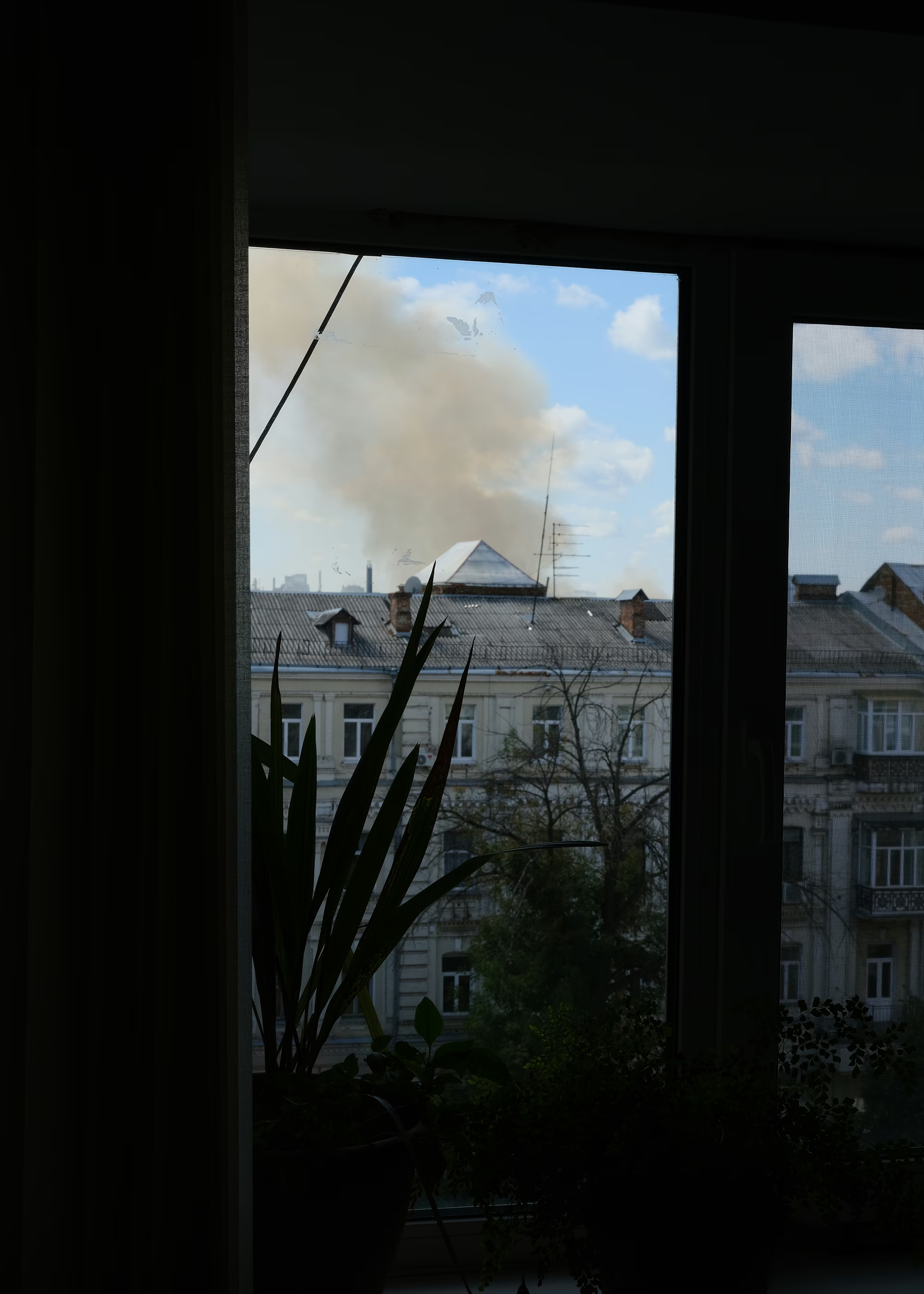
The Judaica department, tucked away on the top floor, was almost cozy by comparison. Houseplants crowded the windows. As I entered, along with the YIVO contingent, an air-raid siren went off. The Ukrainians in the room took out their phones, as though consulting a weather app. “There are 50 Shaheds, but not near us,” one of the librarians said, tucking her phone back into her pocket. Drones rather than missiles. The tour continued.
The reason for Batanova’s wariness of YIVO—and, by extension, me—seemed obvious. As the head of the Judaica department since 2019, she was protective of this material, which had barely survived the 20th century, and she did not seem all that excited to share it with outsiders who presumed they were its saviors. Brent saw his claim to An‑sky’s papers as part of his organization’s mission to preserve Jewish heritage. Batanova saw the same papers as integral to Ukrainian heritage. These were not easily reconcilable positions. But Batanova’s reaction was more than just defensiveness. I also picked up another, conflicting emotion as she led us through the dilapidated stacks: shame.
One look at the large water stains on the ceiling—the roof had been leaking for years, Batanova told us—made it clear that the situation for these thousands of precious books and manuscripts was not great. Century-old newspapers were stacked on top of one another, moldering on shelves that seemed about to topple over. Batanova pointed out where flimsy blue and red construction-paper folders that held the An‑sky material sat in the open. The building lacked any climate control. In the winter, the temperature inside dipped well below freezing, but that was better than the summer, Batanova said with a sigh. Humidity was the enemy of this yellowing paper. As we walked through, Brent muttered, “What a fucking shande.”
Wartime had not helped. In the fall of 2022, two cruise missiles slammed into the park across the street and a nearby intersection, killing several people and shaking the building. In early September, a missile struck within a few blocks of the archive’s many vulnerable windows. But limited resources had long been a problem. A researcher who worked there in the 1990s told me she’d been warned that she should bring her own toilet paper. I assumed she was describing a post-Soviet situation of economic hardship, but when I asked Batanova where the restroom was, she pulled a packet of Kleenex from her purse and handed it to me. As part of the deal with the Ukrainians, YIVO was going to pay the library—Brent wouldn’t tell me how much. In short, Batanova knew she needed help, but she didn’t want to need help.
Yet it was a miracle that anything had survived at all. In an academic article, Batanova’s predecessor had described (with Slavic understatement) the “misadventures” of this archive. In 1929, when nearly 30 percent of Kyiv’s population was Jewish, an Institute of Jewish Proletarian Culture was established with the goal of collecting every Yiddish periodical, book of poetry, newspaper, and manuscript it could get its hands on throughout the new Soviet empire. By 1934 it had more than 100 employees and housed a quarter of a million volumes—including the contents of five suitcases and boxes that An‑sky had left in his will to be preserved. Then, in 1936, as part of the Great Purge, Stalin shut the institute down and executed its founding director. Parts of the collection were carted away by the NKVD, the precursor to the KGB, or burned in the courtyard.
Not long afterward, the Nazis showed up. The occupiers looted what was left of the collection, which had been moved to the Vernadsky, stripping out valuable items to send to Berlin. After the war, the degradation continued. Stalin’s 1949 anti-cosmopolitan campaign targeted Jews and Jewish institutions, and led to the killing of most of the Soviet Union’s leading Yiddish cultural figures. Around this time, almost all of the Judaica collection was taken out of the library and hidden in the dank catacombs of the medieval Vydubetsk monastery, where it remained until 1968. From there, it was moved into a private basement, languishing until it was discovered in the 1990s and eventually transferred back to the Vernadsky.
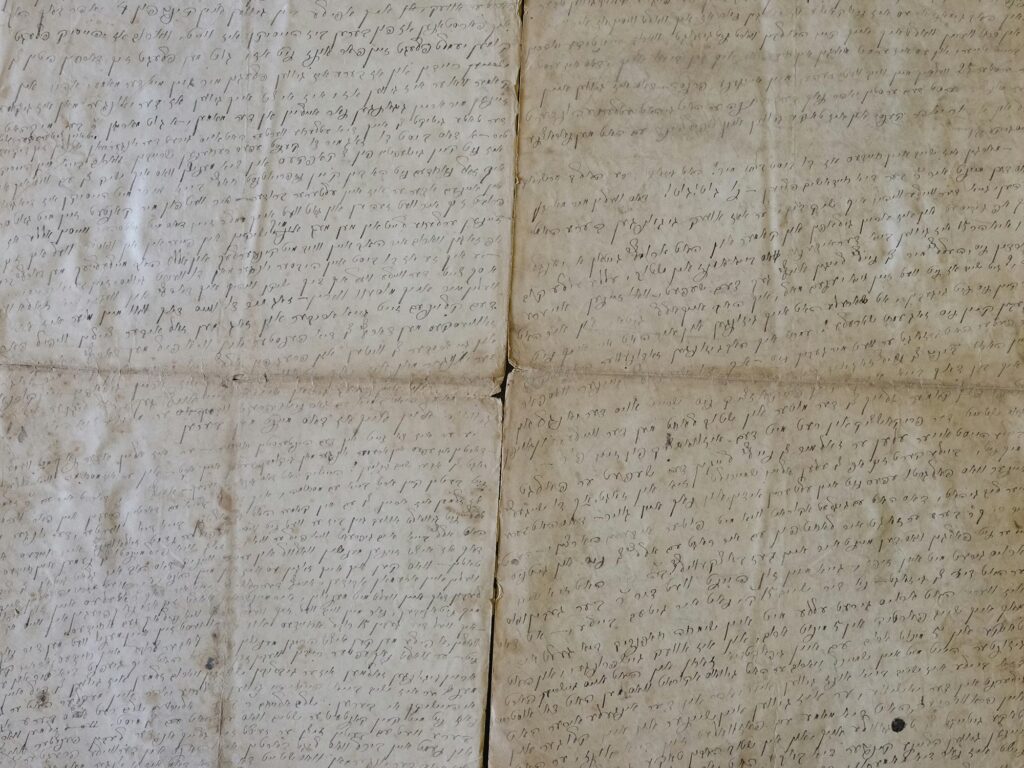
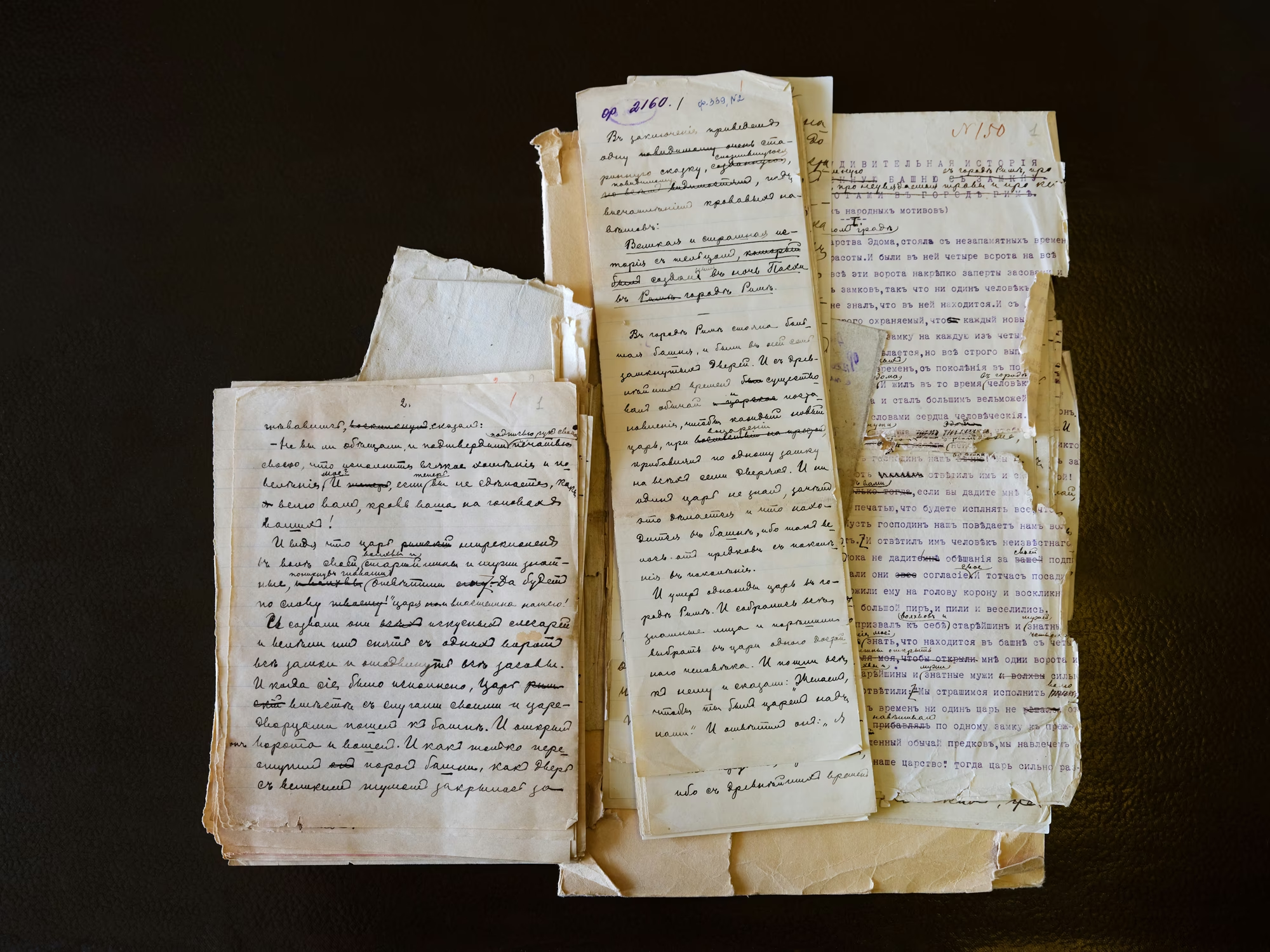
Misadventures, indeed. After the YIVO folks left, I was alone with Batanova and her staff of four. Letting their guard down slightly, they began showing me An‑sky items. In one folder were some drafts of short stories in his handwriting, including “A goyisher kop,” a 1912 tale of a Jewish man who attempts to assimilate and pass as a Christian. An‑sky’s neat Cyrillic cursive slanted across long, thin strips of paper. The folders were full of such strips, pages that seem to have been sliced in half, apparently his preferred writing material. His signature was at the bottom of one page, with its idiosyncratic hyphen. (No one knows for certain where the hyphen came from; one of the many reasons An‑sky offered throughout his life was that it was originally a printer’s typo he’d found charming.)
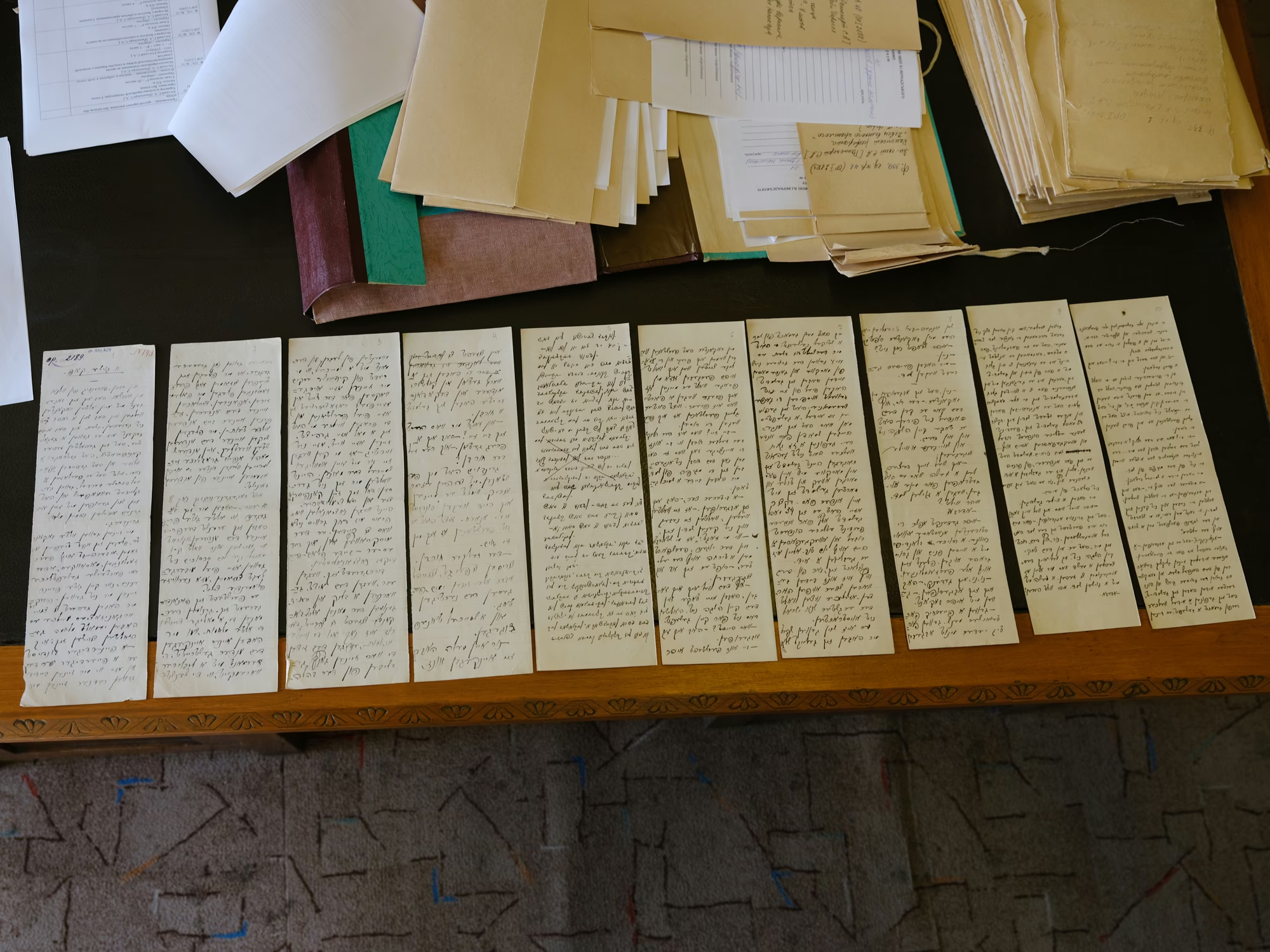
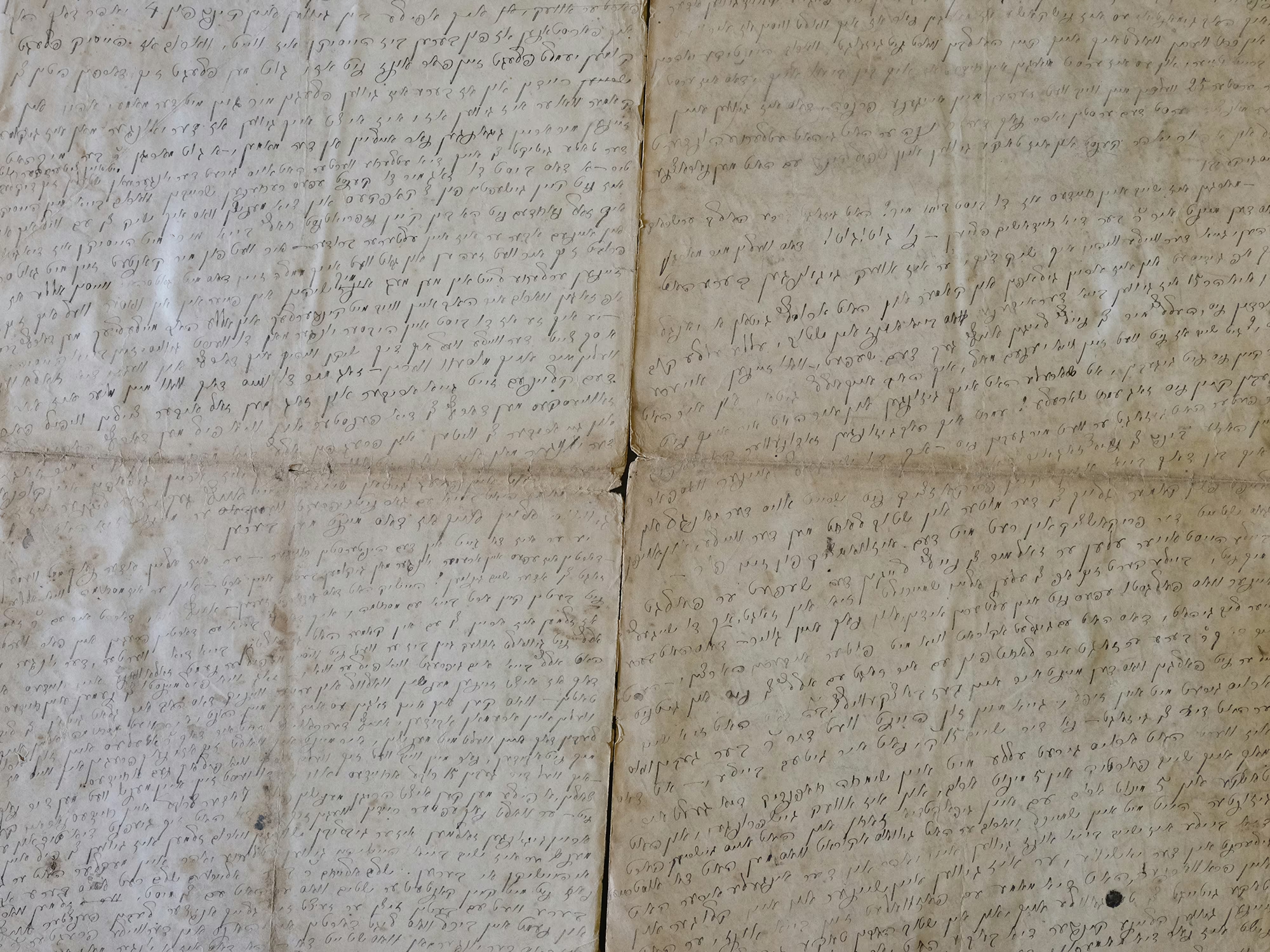
What I really wanted to see were notes from the expedition, but every request seemed to meet Batanova’s resistance. When I mentioned this afterward to people familiar with the library, I was told that a Soviet attitude still prevailed in such institutions; the default was to withhold information. I started throwing more darts, asking for random folders. I saw some strips on which An‑sky had jotted down legends he had heard about the Baal Shem Tov, the mystical 18th-century founder of Hasidism. These were surely from the expedition. One folder revealed a long numbered list of signs that would indicate the Messiah had arrived—including that children would spontaneously clasp hands and start to dance.
I asked to see the wax cylinders and Batanova said no, they were too delicate. At this point I started to worry that coming all the way to Kyiv had been a mistake—if there were ghosts here, they were definitely in those cylinders. When I had spoken with Lyudmila Sholokhova, the musicologist who’d helped discover the abandoned recordings in the early 1990s, she described the first time she heard them as a moment of total awe. “I still remember the shock when actually hearing the voices and laughing and coughing. It was super exciting. People would introduce themselves, saying their name and how old they are, and then they would start to sing.”
But Batanova said that every time the original cylinders were played, they degraded. The best she could do was bring me one of the canisters in which they were packaged. I gazed into the darkness of the empty beer-can-size receptacle with EDISON written on the side in large letters, next to a photo of the inventor. This was what anticlimax looked like.
What about some of the pinkassim that An‑sky had collected? These were local record books, some of which went back hundreds of years. The historians I’d talked with before I left for Ukraine told me they were probably the most precious items I could see at the library. Batanova brought out three from the town of Berdichev, part of the 109 in the collection. The pages were covered in calligraphic Hebrew script. One book was from a “Brotherly Love Society,” which a group of tailors established in the mid-19th century. It included bylaws and some fantastic illustrations, among them a drawing of a lion wrestling a snake.
The reading room was about to close for the day. As Batanova began gathering up the folders, a photograph slipped out of one of them. It was of An‑sky—a strange picture. He is standing in a street, squinting into the sun, wearing a black coat and vest. His salt-and-pepper goatee, thick swept-back hair, and dreamy look give him the appearance of a Jewish Don Quixote. But the strangest thing about the photo is that he is cradling a cat in his arms while a bird is sitting on his shoulder. Everyone, even these two enemies, looks copacetic and calm.
[From the January/February 2024 issue: Judith Shulevitz on Ukraine’s “zombie history”]
III. A Severed Finger
Somehow this photo of An‑sky managed to make me forget my frustration, because it revealed something of his magic. He got people (and apparently animals) to relax in his presence. Those who traveled with him from shtetl to shtetl said he was often mistaken for a holy man. He was 48 when the expedition began but looked like he was in his 60s, which, as one of his biographers pointed out to me, was actually a benefit: Being preternaturally aged was a sign among rabbis of God’s grace.
An‑sky lived a vagabond existence from the time he was a teenager. “I have neither a wife, nor children, nor a house, nor even an apartment, nor belongings, nor even any settled habits,” he once admitted. On the expedition, he developed a method for quickly gaining trust. He would show up at synagogues and study houses to pray with the local men, disarming them. A crowd would usually gather around him after the service and then follow him to the local inn where the expedition members were staying. Abraham Rekhtman, who joined the group in its second year, recorded his memories nearly 50 years later, describing how, “over a glass of tea or, more often than not, a shot of liquor and a bagel for a snack, An‑sky would at last ask questions.” On his long strips of paper, he would jot down stories and sayings and local legends.
His most successful technique, however, was to bring out the phonograph. The shtetl folk may have heard of such machines, but most had not seen one before. An‑sky would demonstrate by recording a familiar song but coughing or laughing or making a mistake halfway through. He would then play the cylinder back and watch the mouths drop as they heard the recital, coughs and all. This was enough to break the ice, and men would then offer up wedding songs, lullabies, and wordless melodies called nigunim. I’ve now heard dozens of these digitized recordings, and they are eerie and sublime and a little sad. To take one example, Shloyme Kulish, a 24-year-old shopkeeper from Ludmir, was recorded singing on July 17, 1913. For 36 seconds, you can hear him lose himself in a song that sounds, as many of them do, halfway to a sob: Oh dey dey mama mey / Oh dey dey mama mey.
An‑sky was particularly interested in healers and exorcists, mostly older women, who seemed to hold a special power in every town and village. Rekhtman described them in his memoir as performing “magic with knives, socks and combs; they poured wax and poached eggs and knew hundreds of ways to cure a patient.” They also closely guarded the secrets of their spells, amulets, and remedies. An‑sky would often invent a tale of catastrophic bad luck, explaining that he had once been a rich man—and now look at him! He could pay to reverse the curse. The healer would usually pity him and oblige, for a fee. The incantation would then get written down and added to the collection.
Out of an intense desire to save all that he was seeing, An‑sky also started to gather artifacts, whether intricately embroidered kippahs or ritual objects such as the silver plaques used in synagogues to indicate east, the direction of prayer. The pinkassim I saw fell into this category. I also saw an album he’d made that included pages from illustrated Passover Haggadahs; some of these booklets dated back to the 16th century. No manner of ephemera was too small for him. Somewhat blasphemously, he even collected kvitlekh, the little notes left on the graves of famous Hasidic rabbis by people asking for intercession on their behalf. When young Jewish men were called up to serve in the czarist army, they sometimes tried to avoid the draft by cutting off a finger. But they usually saved these, because Jewish law demands that a body be buried intact. An‑sky met an old man in Proskurov who sold him his own finger, severed when he was a teenager. It was to be displayed in a planned ethnographic museum.
An-sky managed to persuade people to part with their songs and community records and even fingers not just because he was charming or because he could pay well—though both were true. I imagine that people felt safe with him because they sensed that he was recovering pieces of himself. There aren’t too many firsthand accounts of An‑sky doing his collecting, but I like what this little tidbit from Shmuel Shrayer, a member of the expedition, reveals: “Our phonograph stood in the corner and recorded the Hasidic melodies with all the ‘bimbumim.’ Sometimes An‑sky would get into the groove and he would sing along like one of them.”
IV. Sem Sorok
On my second morning in Ukraine, I woke up to a video of a buzzing kamikaze drone careening into the side of a building in the center of Lviv, exploding in a bloom of flames and debris. The attack had taken place the previous day and nearly destroyed the city’s historic archive. The sirens I had heard while touring the Judaica collection were part of Russia’s biggest air assault on Ukraine since the start of the invasion, involving nearly 1,000 drones and 34 missiles. Lviv’s archive, which caught fire, holds some of the oldest documents relating to Ukrainian history, including three 12th-century manuscripts composed on birch bark.
I happened to have an appointment with Anatolii Khromov, the head of the Central State Historical Archives, who showed up with his tie loosened and nervously sucking on a cigarette. The Lviv attack had left him in shock, he said. We met on the outskirts of Kyiv, where the country’s main archives are kept, and he pointed to an enormous construction site nearby, where an underground bunker was being built to safeguard the collection. “We need to build faster,” he said.
Later, in the center of the medieval Kyiv neighborhood of Podil, I noticed a small tower of wooden panels protecting a statue from shrapnel. Peeking through the cracks, I saw the bronze face of the Ukrainian philosopher Hryhorii Skovoroda. For Ukrainians, the stakes in this conflict are nothing less than their survival as an intact culture. Russia is not just a military aggressor; its invasion is premised on the idea that Ukraine doesn’t even exist.
Oksana Semenik, a young art historian, has made it her mission to “decolonize” Ukrainian art, using social media and podcasts to revive the works of forgotten Ukrainian artists, but also to reclaim cultural figures such as the painter Kazimir Malevich, who has long been considered Russian despite his Ukrainian roots. In Ukrainian House, an enormous concrete structure once known as the Lenin Museum that felt like the inside of a missile silo, she showed me around an exhibit of early-20th-century modernist paintings by Ukrainian women. Semenik seemed to apologize for the sparseness of the paintings and drawings. “We are lucky to have what we have,” she said. Most of these painters’ work was suppressed or destroyed during the Soviet period.
Her desperation to salvage Ukrainian culture is not that far off from An‑sky’s efforts to rescue his own. “With every old man who dies, with every small-town fire, with every exile, a piece of our past is lost, and the most beautiful expressions of traditional life, with its customs, traditions, and beliefs, disappear,” An‑sky wrote in the foreword to his questionnaire. When I mentioned this parallel to her, Semenik stopped walking and looked at me intensely. “When I was young, it shocked me whenever I thought about the Jews who once lived here,” she said. “The idea that a whole people could just disappear. Could a people just disappear?”
Despite a history of murderous anti-Semitism on the part of Ukrainian nationalists, the country’s current vision of national identity is a pluralistic one that includes Jews—such as Volodymyr Zelensky, the country’s wartime president. Semenik told me about a new show she was curating for Ukrainian House about Chernobyl, with the goal of changing the perception that the city is defined only by the nuclear disaster that occurred there. It was also once a major spiritual center of Hasidism.
Seeing Ukrainian history through a Jewish lens means clashing with some patriotic narratives. On his expedition, An‑sky collected traumatic stories about 17th-century massacres carried out by the Cossack leader Bohdan Khmelnytsky, which killed tens of thousands of Jews. Many shtetls preserved similar legends about a local couple about to be married who were murdered together by Khmelnytsky’s men, and whose common grave became a talisman. But for Ukrainians, Khmelnytsky is no villain. He led an uprising in 1648 that established the Cossack Hetmanate, the first independent Ukrainian state. A region of the country is named after him, and an enormous statue of him on a rearing horse stands in the center of Kyiv. My hotel was on Khmelnytsky Street.
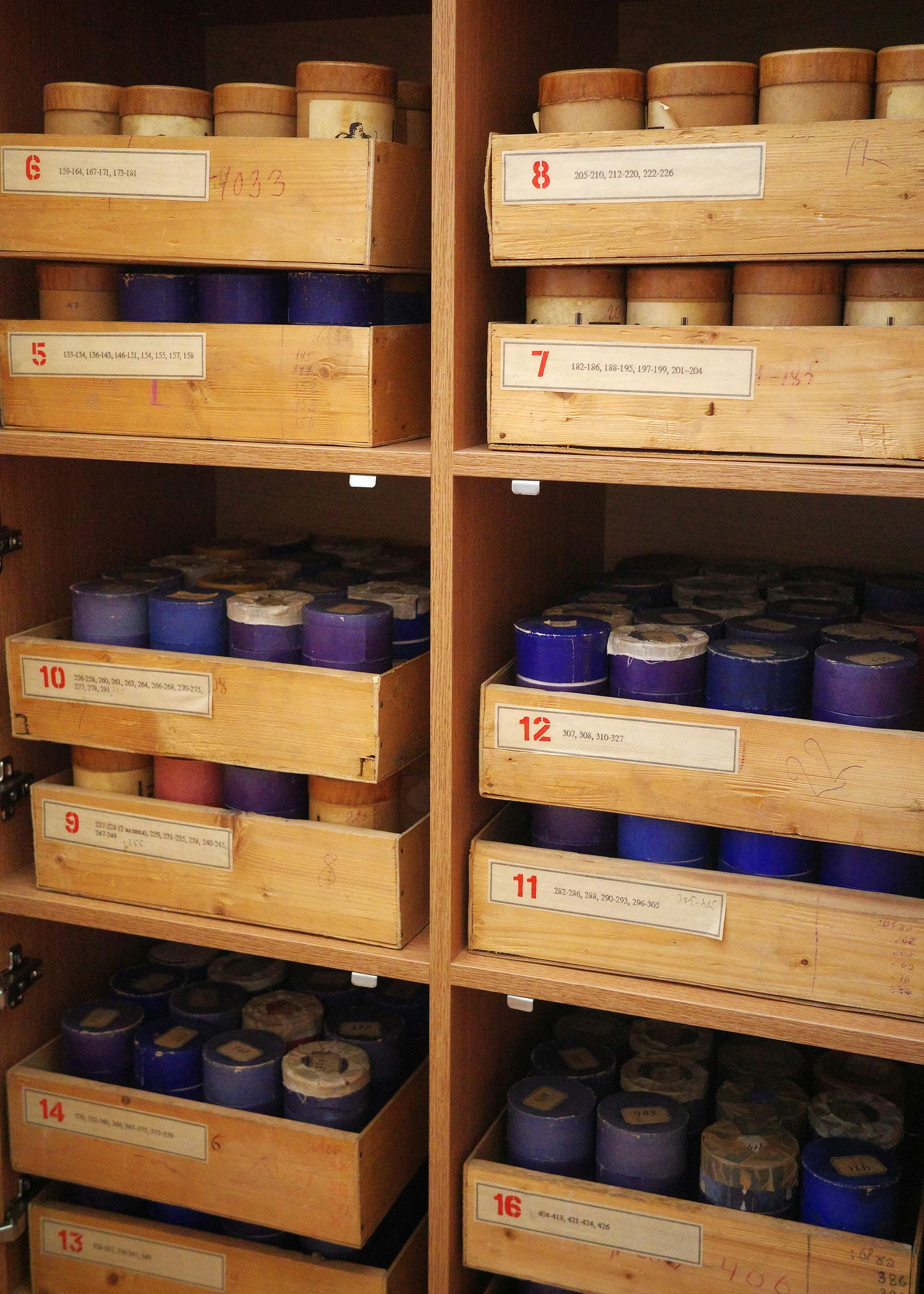
When I returned to the Judaica reading room the next day, Batanova had warmed a bit. She even let me see the wax cylinders after I put my hands together in supplication. I went down to another, freezing room in the Vernadsky; signed a number of ledger books so that I could be granted admittance; and then saw dozens of smooth black tubes, kept in the kind of wooden crates in which you might store paint cans.
I asked Batanova whether her family and friends thought it was strange that, as an ethnic Ukrainian, she had devoted her life to Jewish culture, becoming a teacher of Yiddish and a keeper of this Judaica collection. Yes, she said, some members of her family did think it was pretty odd. An encounter with Yiddish as a student had changed her life. After years of trying to master German and failing, she took a Yiddish class. It was “like my language,” she said. “I understand the humor and the pain of this language. It’s in its structure. It’s in everything.” She smiled. She also felt a kinship between Yiddish and Ukrainian, two languages that she learned had both been dismissed by Russian imperial officials as zhargon, or “jargon”: disposable dialects.
Jewishness was part of Ukrainianness, she insisted. It shows up everywhere. In the 2000s, she traveled all over Ukraine to explore Jewish cemeteries, reading the lost histories of those towns on the tombstones. She also found artifacts with “Hebrew words or sayings incorporated in local Ukrainian.” Batanova told me about a dance that is popular at Ukrainian weddings, Sem Sorok, which sounds like traditional Jewish klezmer music—even though the people dancing in the middle of a circle holding a handkerchief between them have no idea about its origins. Sem Sorok means “7:40”; this was the name given to a commuter train that once arrived daily at that time in Odesa, bringing Jewish merchants home from all over the country. On YouTube, I found a video of a Ukrainian teenager with a blue mohawk breakdancing to the tune.
V. A Lullaby
On my third and last day in Kyiv, the archive began to satisfy my demands that it speak to me. This was not a foregone conclusion, even now that I had Batanova’s help; so much had gotten lost and scattered over time, and An‑sky’s expedition itself had been cut short by war. Rekhtman, the member of the group who later wrote a memoir, remembered all he had to leave behind when he fled rampaging Ukrainian militias in 1915. “I did not manage to take along with me the great collection of ethnographic pictures (approximately 1,500), as well as the few hundred journals containing notes on the expedition. Everything remained in my hometown Proskurov,” he wrote, and the material “vanished” during the anti-Jewish violence that convulsed Ukraine after World War I.
I was operating somewhat blindly in this huge archive, and my requests to see more and more items in the hope that An-sky’s expedition might come into view were met with some distress. “How long are you in Kyiv?” a few of the librarians asked me, anxiously. Soon I came across what appeared to be a dirty little saying jotted down in a notebook: “When I become drunk from the liquor, a pretty girl is essential” (this sounds funnier in Yiddish, because the words for “drunk,” shiker, and “essential,” iker, rhyme). Then I began opening folders that contained hundreds of pages of what appeared to be lyrics, which one of the expedition’s musicologists had neatly transcribed in small notebooks. Immediately, I encountered yearning. One song was attributed to a 24-year-old man named Dovid Keller:
Ach, there in the woods stands a tree, The tree is bent and stooped And there and there stands a lover With two eyes filled with tears Ach, there and there stands a vineyard The vineyard has not yet been reaped I wasted the years of my youth Like a gambler with playing-cards A gambler who plays, plays to win Plays his cards with the goal of a win I have lost the years of my youth I will never win them again.
There were a number of lamentations like this: songs of longing, of lost love. And a few truly tragic and disturbing ballads, such as one that seemed like it could have been sung by Johnny Cash, about a boy who follows a girl he loves “one nice night on a summer’s day” and demands to know if she will marry him. Her parents forbid the match:
As soon as he heard this, He got very upset He took out a revolver And shot her on the spot. When he shot her like that She fell like a stone He then turned the gun around And shot himself alone.
I also liked the lullabies, because I could picture a mother or father rocking a baby to them. This one, a lullaby within a lullaby, was attributed to a man named Hersh Perlokh Kaliker:
In the Holy Temple in a corner The widow Bas Tzion sits alone She rocks her only son, Yidel And sings him a beautiful lullaby: La la la Yidel’e, when you become a rich Yidel’e You should remember this little song: Raisins and almonds, that will be your trade, Sleep, my dear Yidel’e, sleep. Sleep, dear Yidel’e, sleep.
Here was the treasure I was after, distinct voices from that lost, muddy world. (The translator Rose Waldman helped me reveal more of their color.) They should have been strange and unfamiliar, but they weren’t really. The emotions were so everyday, so known. I’m sure every culture that ever was had versions of songs carrying these sentiments—the desire to matter, to find love requited, to get a baby to fall asleep.
An‑sky didn’t focus on the universal, though. What felt exhilarating to him about his discoveries in each of these shtetls (“The happiness I feel from this work is limitless,” he wrote) were the inventive ways Jews confronted the human condition—all those ditties and amulets and dirty jokes. I looked through a collection of the photographs taken on the expedition, the originals of which are in St. Petersburg: a man transporting matzah on his back in a large wicker basket. A circle of schoolchildren during recess. A rabbi, with his long white beard, lying down for a nap. Taken by the photographer Solomon Yudovin, these images are incredible. But they don’t move me in the same way as the songs, because the photos are passive; they tell us what people wore, how they worked, and how deep that mud actually was. But folk culture is active—the record of how grief could transform into the stitch on a white burial shroud, how joy could turn into a rhyme belted out by children to accompany the skipping of stones across a lake.
When An‑sky was in his 20s, working in the mines of the Donbas, he began writing down the songs that miners invented to pass the time. Even though these men had been uprooted from their villages—“some kind of nomadic tribe, torn away from one shore but not having reached the other”—they were meeting their new reality by generating new culture, an act of adaptation. When he finally returned to the shtetls on his expedition, this was what he understood ethnography to be: capturing the product of this living process. Never given to understatement, An‑sky said that he was gathering nothing less than “another Torah, an Oral Torah,” one that was “on par with the Book, with the great Written Torah.” What Jews normally called “oral Torah” referred to the history of rabbinic interpretation and reinterpretation of the biblical laws, recorded in works such as the Talmud. An‑sky used the term to refer to something else entirely, created by “the people, themselves, especially the common folk.” This oral Torah “reflects the same beauty and purity of the Jewish soul, the gentleness and nobility of the Jewish heart, the height and depth of Jewish thought.”
What I’d finally seen at the Vernadsky were remnants of this Torah. Batanova, who wore white gloves as she carefully flipped each page, certainly would understand this. YIVO would as well, because this justified the great effort of digitizing it all. It suddenly seemed right that the transcription of a song sung more than 100 years ago and preserved in a little blue notebook should be the subject of such competing attentions. When I made my way down the linoleum hallways of the library for the last time, I had a strange, An‑sky-inspired urge: to go back and kiss the thin pages I’d just seen. Every Jew knows, after all, that when you come across a Torah, this is what you do.
VI. The Tightrope Walker
An‑sky wrote The Dybbuk while on the road, in trains and horse-drawn carts, pouring into it the same curiosities and artifacts that went into his 2,087 questions. I chose to read the play on my return trip to Warsaw, which included an eight-hour wait to cross the Ukrainian-Polish border. The alternative title of The Dybbuk is Between Two Worlds, and that is how I felt while idling in line with dozens of other cars. The eerie dialogue of the play only heightened the sense of being in-between. As the young bride, Leah, is about to be possessed by a dybbuk, a demon, she says to her old nurse, “They are here with us. A person is born to live a long life. But if he dies before his time, what happens to his unlived life, his joys and his sorrows, the ideas he did not have time to develop, the deeds he had no chance to do? What happens to the children who were to have been born to him? What are they? Where?”
The Dybbuk depicts the shtetl as a place saturated in magic, where the dead mingle with the living. A poor young student named Khonon is disturbed that Leah, the woman he loves and believes he is cosmically fated to marry, has been betrothed to another man. Khonon pursues all kinds of magic to stop the wedding. But, as he says, “they didn’t help—not the fasts, not the ablutions, not the mortifications of the flesh, not the kabbalistic spells!” He dies from the intensity of these efforts and returns as a spirit to possess Leah’s body. The last two acts of the play are an extended exorcism, a ritual that An‑sky must have observed.
The stories and customs gathered from the expedition are present in nearly every line of the play—one critic dismissed it as simply “an ethnographic museum.” I even found in it a story I’d seen on one of those thin strips in An‑sky’s own hand, one of the many legends he collected about the Baal Shem Tov. In it, the Hasidic sage joins a crowd to watch an acrobat do a tightrope act. His students wonder why the rabbi is paying attention to such silly entertainment, and he answers, “I came here to observe how a person crosses a deep abyss. And as I watched I thought: If a person were to put as much effort into developing his soul as he does into training his body, how many and what deep abysses would his soul be able to traverse on the slender thread of life.”
The Dybbuk is much more than a patchwork of archives, a way of preserving the oral Torah. It also expresses the horror of experiencing a world in collapse. When I watched the 1937 film version produced in Poland, I jumped at the moment the possessed Leah, about to be wed, shrieks in a voice that is not her own, “You are not my bridegroom!” This cry of dislocation could be An‑sky’s primal scream, addressed to modernity itself—to the waves of murder to come. “We are too late,” Reb Azriel, the exorcising rabbi, says as he rushes into the synagogue in the last moments of the play, to find Leah dead.
When the First World War broke out, in the summer of 1914, An‑sky got himself commissioned by a relief organization to embark on a new kind of expedition, working frantically to save Jews trapped in the crossfire between German and Russian forces. What he witnessed, and then recorded in a four-volume diary published with the title The Destruction of Galicia, was apocalyptic. Hundreds of thousands of hungry refugees, bodies strewn in the streets of abandoned shtetls, survivors of rape, synagogues burned to the ground—and in places where he had been just a year before, recording songs on his phonograph. In a photo from this time, he is dressed in a uniform with a fur hat on his head and a Red Cross armband over his coat. He looks ancient, and exhausted. An-sky also never stopped trying to save Jewish culture. In Lutsk, which I passed on my drive out of Ukraine, he encountered the frazzled remnants of the community, which had become a “ghost town,” he writes, and they handed him a trunk filled with objects from the synagogue, including a silver Torah crown from the 18th century and a gold-embroidered curtain for the ark. An‑sky managed to get them to St. Petersburg.
In the upheavals of 1917, he would lose track of these items from Lutsk and almost everything else he collected from his travels. He had to leave behind even his draft of The Dybbuk. The first phase of the Russian Revolution actually found An‑sky elected to the Russian Constituent Assembly as a Socialist Revolutionary, representing his hometown of Vitebsk. But when the Bolsheviks took power in the fall, he had to flee, first to Vilnius and then to Warsaw. He was already battling heart disease and diabetes, and in November 1920, just after a meeting of a new ethnographic society he was trying to form in the Polish city, he died of a heart attack. He was 57. He did not live to see the worst of it.
I can’t think of a better testament to An‑sky than his play, and I am struck by the self-awareness in that title, Between Two Worlds. He had himself traveled as deftly as a tightrope walker between two worlds—Jewish and secular, traditional and modern—but he also witnessed the passing of one world into another, and it made him determined to hold on to what he came to understand mattered most, and to avoid the abyss. I spent most of my short time in Kyiv frantically trying to put some flesh on those ghosts. As I waited for the border to open, it occurred to me that maybe this manic urgency was what brought me closest to An‑sky.
Will the Ukrainians fare better? I hope so. Struggling to keep fighting, dodging missiles, surviving, gets you only partway there. An‑sky recognized this. Writing in 1916, looking back on his travels through lands now decimated, he still held on to the truth of his expedition: “A nation lives not in suffering, but in the ecstasy of the realization of its ‘I,’ in joyful creation, in pride in its culture, in the poetry of its daily life. Only in that.”
This article appears in the November 2026 print edition with the headline “Ghosts of the Pale.” When you buy a book using a link on this page, we receive a commission. Thank you for supporting The Atlantic.
The post Voices From a Vanished World appeared first on The Atlantic.