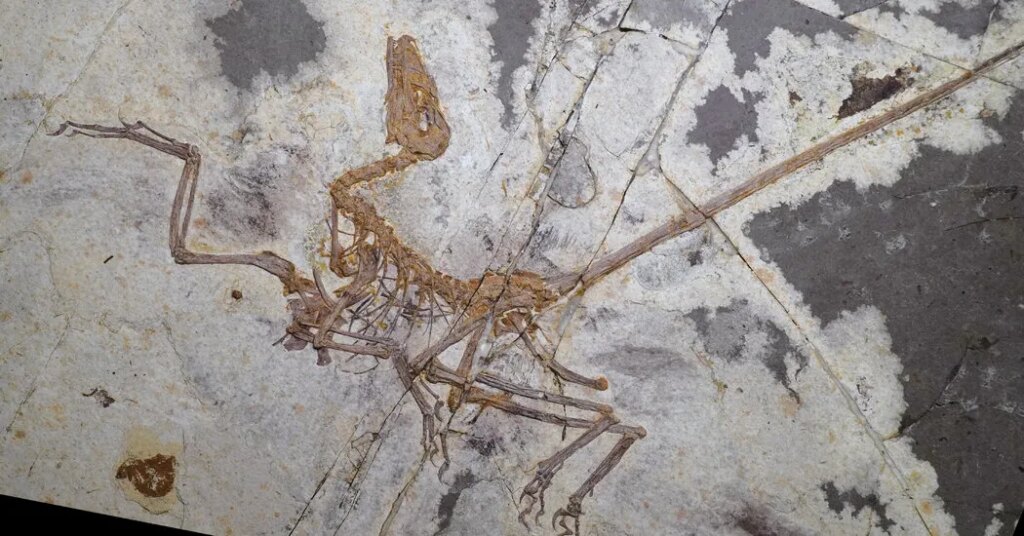
More than 120 million years ago, a small creature soared across the Cretaceous skies above China. Was it a bird or a pterosaur or … a four-winged raptor?
Researchers recently examined a remarkably well-preserved skeleton of such a dinosaur — it sported sharp claws, a mouthful of teeth and twice the number of wings expected for an avian relative.
The newly identified species, about the size of a crow, sheds light on how other groups of flying dinosaurs achieved liftoff alongside the ancestors of living birds.
Scientists have long debated the evolutionary runway that took dinosaurs into the skies. In 2020, researchers constructed a tree of early birds and closely related dinosaurs, and concluded that flight evolved at least three times, indicating that aerial behavior was most likely more widespread in dinosaurs than previously thought.
“Today’s birds are the only survivors of this once bountiful Mesozoic aviary of airborne dinosaurs,” said Stephen Brusatte, a paleontologist at the University of Edinburgh who was not involved in the new research, published in the journal Nature Communications. He added that over the past decade, researchers have uncovered fossil evidence that dinosaurs were most likely capable of all kinds of flying styles.
These ancient aviators included the microraptorines, a group of small, carnivorous dinosaurs that sported long feathers along each of their limbs. Paleontologists have unearthed hundreds of microraptorine fossils from China, many of which are very well-preserved and offer detailed looks at these dinosaurs’ skeletons and feathers.
The new fossil was discovered by a farmer in northeastern China. It comes from an outcrop of rocks known as the Jiufotang Formation that dates back to the Early Cretaceous period more than 121 million years ago. At the time, this part of China was covered by a mosaic of lakes, forests and volcanoes, and was home to pterosaurs, early mammals and a multitude of ancient birds, including the recently discovered Plumadraco bankoorum, which possessed a pair of prodigiously long tail feathers.
In 2023, the farmer donated his find to the museum of Hebei GEO University. Scientists there were enthralled by the detail of the skeleton, which is preserved on a slab of rock with its head thrown back and arms outstretched. Around the bones, which have a rusty, orange tint, are patches of preserved plumage.
Andrea Cau, a paleontologist at the OPHIS Paleontological Museum and Herpetological Center in Teramo, Italy, and a coauthor on the new paper, was struck by how the flattened skeleton was still articulated with most of the bones positioned how they were when the animal was alive. This kept them from needing to piece the skeleton together like a jumbled puzzle.
A closer examination of the fossilized skeleton revealed several aerial adaptations, including fused bones in the wrist, elongated bones in the forearm that would have made for a more powerful wing and an enlarged breastbone to anchor flight muscles. The animal also had shorter fingers than other birdlike dinosaurs. This suggested that the “hand had reduced the ancestral predatory function and was remodeled for some aerodynamic function,” Dr. Cau said. The scientists named the new species Norellraptor barsboldi.
Many of these adaptations are also seen in the fossils of early birds, making it possible that birds and microraptorines evolved flight from a shared ancestor. However, when the team slotted Norellraptor in an evolutionary tree of Paraves (the group that includes both microraptorines and birds), they discovered that birds and microraptorines evolved their flight-related traits in a different order.
“The evolutionary sequences along the two lineages do not match in any step,” Dr. Cau said.
Because birds and microraptorines did not evolve these traits in tandem, it is more likely that they each independently fine-tuned their flight capabilities. “This work underscores that the origins of birds and flight, long thought to be intimately connected, are actually separate evolutionary events with flight evolving multiple times,” said Peter Makovicky, a paleontologist at the University of Minnesota who was not involved in the new paper.
Microraptorines may have taken a distinct evolutionary route to flight, but they most likely would have resembled their living kin in the air, according to Dr. Brusatte. “If we saw microraptorines flapping about in the air and soaring overhead, I doubt we would consider them too different from modern birds.”
Well, besides the extra set of wings.
The post What Can Four-Winged Dinosaurs Teach Us About Birds? appeared first on New York Times.