THE END OF EVERYTHING, by M. John Harrison
A global crisis has reconfigured human life in “The End of Everything,” a fascinating, sometimes frustrating and thoroughly original new novel by the British writer M. John Harrison. The crisis, put simply, is an alien invasion, though this phrase falls short for a couple of reasons.
The first is that it conjures images and narrative tones that will not apply to this book, a masterly exercise in restraint, unsettling beauty and elliptical writing that can enlighten even when it obfuscates. “The End of Everything,” a finalist for this year’s Booker Prize, is a novel about aliens in the way that “Solaris” and “2001: A Space Odyssey” are movies about space travel: It’s not an inaccurate description, but it misses the point.
The second problem is that it’s not clear if the foreign entities described in this book are even aliens (as opposed to some latent earthly life form). Nor is it clear what they want or how long they plan to stay. In fact, very little is clear in this book, which deals in shifting realities and the volatile nature of selfhood. Reading it can feel like working on a jigsaw puzzle with a picture that keeps changing, wondering all the while if stray pieces have fallen in from another box.
The maybe-aliens, known as the iGhetti, have set off military campaigns, “months of collective trauma” and the partial collapse of social and political orders. Some of these events are detailed in Harrison’s 2017 short story “The Crisis,” which this novel expands on to great effect.
In the story, the iGhetti are described as lightning-fast, shape-shifting creatures that look like “fleshy, weak rhubarb” at times and “tentacles which seem to bulge out of nowhere” at others. Their interactions with humans involve fatal illness and possibly parasitism, but the details are scant and oblique.
In “The End of Everything,” a generation has passed since these troubles began, and no one is any closer to understanding the iGhetti. People have learned to ignore them even as their societies fall apart, living in a state of permacrisis that most have given up trying to fix. “It had been a long time since anyone could make sense of anything,” we’re told.
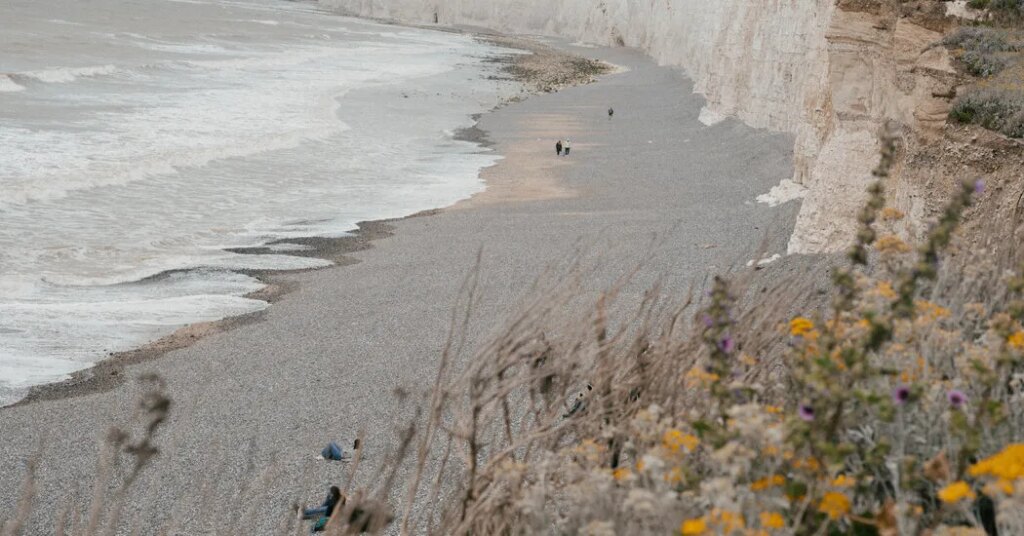
The novel alternates between the story of Phillip, a 38-year-old beachcomber on the southern coast of England, and that of his aunt Marnie, a 70-year-old artist. Phillip finds an “artefact” on the shore, one of the valuable “biological gadgets” that the iGhetti have discarded in our oceans.
For much of the novel we follow Phillip as he tries to sell his discovery, which proves challenging when the artefact — initially “the size of a baby,” and “wrapped in some bleached-out rags” — grows, starts to speak and passes for a male adult within days.
Marnie, too, goes on the move after a series of dumbfoundingly ruthless decisions force her to abandon her home. Whenever she crosses paths with Phillip, she’s wary of his fast-evolving companion and wants it gone, suspecting trouble to come.
The artefact is a source of intrigue and tension throughout. It’s hard not to allegorize this adaptive entity that is capable of absorbing huge amounts of information, that learns to imitate, converse with and finally become terrifyingly interchangeable with humans. We’ve seen this movie, and it’s not a movie anymore.
But “The End of Everything” insists on obscuring its intentions. One scene suggests a way to read the novel: The sight of the artefact one moonlit evening evokes for Marnie (a painter) “the early-Cubist shattering of the visible.”
It’s both an invitation and a warning. If the Cubist’s aim is to capture a subject from multiple perspectives, and at multiple moments, in a single image, then the subject must be fractured in the process. Each distinct fragment is an impossibility, irreconcilable with the others. The more “complete” the image is, incorporating ever more perspectives and moments, the less legible its original subject becomes.
Likewise, the more we learn about the conditions of this novel’s broken world, the harder it is to grasp. All of Europe is reported to be “lost,” but what that means remains a mystery. Refugees once regularly arrived on English shores, but now many more are fleeing. Murder seems to be a common way to resolve minor conflicts, basic commodities are in short supply, yet you can still have a cold beer with strangers at an outdoor cafe. This grim but powerful book portrays the many incompatible states of existence, and the baffling collapse of time, that stem from extreme crises.
In a world defined by uncertainty and constant threats that we can’t stop or even comprehend, “we’re held in suspension,” as Phillip says at one point. We’re locked in a tangle of stunted possibilities, unresolved fates, and we can neither carry on for the sake of our futures nor restore the comforts of our pasts. What now? the humans in this strange but eerily resonant tale always seem to wonder. It’s a hell of a way to live.
THE END OF EVERYTHING | By M. John Harrison | Riverhead | 198 pp. | $30
The post Society Has Collapsed, Leaving Chaos (and Aliens) in Its Wake. Now What? appeared first on New York Times.