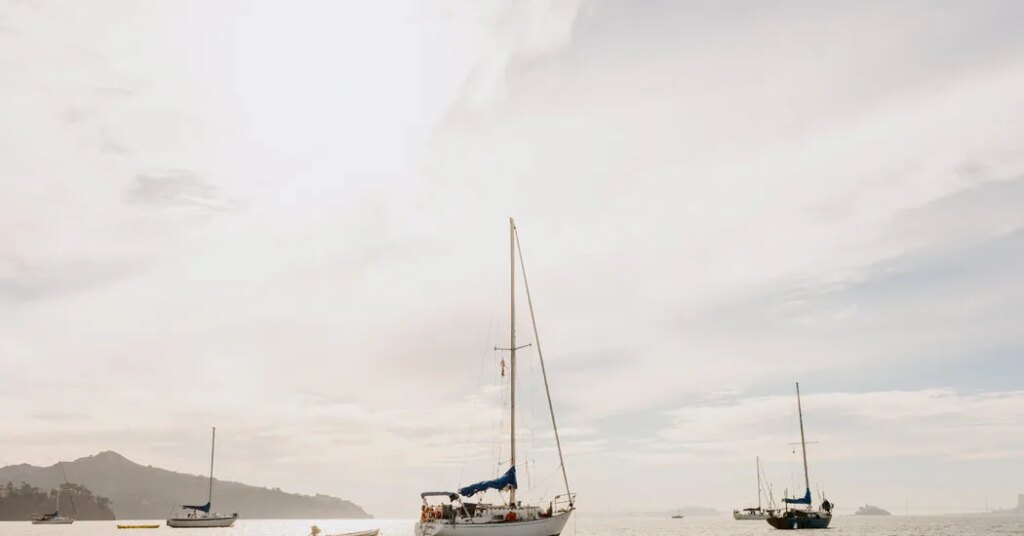
Chad Wycliffe lives on a bay with a front-row view of the San Francisco skyline. Waves lull him to sleep. He’s surrounded by hills dotted with multimillion-dollar mansions and marinas with luxury yachts.
He doesn’t pay any rent.
His home is a half-century-old sailboat with a faded red jib and barnacles growing beneath it. At 45, Mr. Wycliffe, has lived on the water for nearly half of his life.
He first moved to Richardson Bay, just north of the city, as a troubled teen drawn to the thrill of the open water. There, a group of mariners, exiles and artists who called themselves “anchor outs” lived aboard vessels less than a mile — but worlds away — from ordinary society.
To many, the bay was a refuge. To officials and some Marin residents, however, the collection of boats was more like a floating homeless encampment.
Now, the community, one of the last vestiges of counterculture in the Bay Area, has been all but dismantled. Officials say Richardson Bay will be cleared of the last “illegally anchored vessels” by Thursday.
Mr. Wycliffe is one of the final holdouts.
“They’re having a hard time finding out how to get me out of here,” he said. “They’re going to have to kill me.”
Richardson Bay is a shallow arm of the San Francisco Bay in Marin County, one of the most expensive places to live in the country. It’s surrounded by waterfront cities, including Sausalito, a former shipbuilding town that now has a promenade of galleries, white-tablecloth restaurants and gift stores selling trinkets and T-shirts with the slogan “Keep Sausalito Salty.”
For decades, the sailboats floating on the bay were part of the scene. “It was a painting,” said Jeff Scharosch, a general manager and partner at The Spinnaker, a glass-walled restaurant suspended over the water. But he and some other locals also considered the boats a blight and a hazard.
“I used to to tell people, ‘Yeah, they look beautiful from afar because you don’t see that they’re barely seaworthy,” he said.
Officials said many of the boats were unsafe or abandoned, and that their anchors and chains were damaging the bay’s eelgrass beds, a marine habitat that sequesters carbon. About a decade ago, the authorities began a concerted effort to remove and destroy boats they said were abandoned or derelict.
In Sausalito, many residents are opposing a measure that would allow large-scale development that they fear will push out boatyards and maritime trades, turning their waterfront into one that more closely resembles Miami Beach.
Sophia Collier, a Sausalito-based investor and sculptor said she saw the campaign to remove the anchor outs as part of that broader effort to gentrify the region and force out nonconformists.
“The anchor outs are the edge,” she said. “Those are our saltiest residents.”
Richardson Bay historically has drawn the free-spirited, the outcast and the priced out. After its World War II shipyard closed in the late 1940s, veterans and artists moved into the abandoned vessels and barges.
By the 1970s, hundreds of people lived in a sprawling waterfront neighborhood of makeshift houseboats and homes built from salvaged materials. They had their own newspaper, and an offshore settlement, known as Dredgetown. . Many got by on a mix of odd jobs, bartering and scavenging.
Over the years, efforts to clear the waterfront sparked violent clashes, known as the Houseboat Wars, with the authorities. Most of the houseboats were ultimately regulated and brought into onshore marinas.
Some anchor outs, however, remained or moved into the open bay. As economic conditions grew worse in the Bay Area, the flotilla mushroomed, expanding to nearly 250 boats by 2016, according to official counts. Mr. Wycliffe and other anchor outs said that the water provided solace to those who didn’t conform to life on land.
“The water was just like a magnetic source for me,” he said. “And the people that were here, they were real.”
At the same time, some locals became fed up with the boats. Some complained of refuse and human waste dumped into the bay. Others cited safety concerns: during storms, boats often broke loose and crashed ashore. Others caught fire, collided, or sunk.
“It was kind of the Wild, Wild West,” Mr. Scharosch said. He recalled that on a couple of occasions, boats came close to hitting the restaurant.
Richard Ashlock, one of the last anchor outs, said he felt the true mariners deserved to stay on the water. But he acknowledged that others had moved there with little experience or respect.
“When all the rents went up in Oakland, Berkeley, and San Francisco, a lot of people ended up losing their apartments, but you could get boats for a song,” he said. “They were just desperate to have a place to live, and I never blamed them for that. What I did blame them for was their boats were completely trashed.”
Mr. Ashlock, 75, recalled paddling his kayak up to the side of boats that had dumped trash into the water, then throwing it back to them with a warning that the anchorage would be shuttered. He and others dispute the eelgrass concerns, arguing that their vessels are like floating ecosystems and that onshore activities are far more polluting.
Officials approved a plan last week for Mr. Ashlock to move his boat to a marina, where he will earn his keep as a caretaker, although he remained on the bay as of early October.
In 2022, officials began offering the anchor outs $150 per foot for their surrendered boats and, the following year, offered temporary housing vouchers under a $3 million state grant. As of this month, the Richardson Bay Regional Agency, which has been responsible for clearing the bay, had removed more than 500 boats from the water. Temporary housing was provided to 52 former anchor outs, said Brad Gross, the agency’s executive director.
The program was designed to place the anchor outs in apartments for a year, with the goal of transitioning them to permanent federal housing. But that pipeline broke down in May 2025, after rising rental costs exhausted the housing authority’s budget. Permanent federal housing vouchers remain limited, Mr. Gross said.
Some forced from the anchorage have ended up displaced.
Meredith Rodas, 56, who lived on the anchorage for two decades, said that she and her husband had applied for housing vouchers, but didn’t receive them. Last month, they were living with their two dogs in a pickup truck at a marina about 10 miles from Sausalito.
“It’s a disaster,” she said.
Mr. Gross said that those who fell through the cracks had been referred to housing officials. “We’re not a housing program,” he said. “Our housing program was very, very specific with a very specific target audience, and we were able to accommodate those that were interested.”
Some who were lucky enough to get housing have welcomed the comforts of moving ashore. In his final days on the anchorage, Peter Glaser, 65, said he couldn’t believe he would have a bathtub, washer and dryer, and walk-in closet.
Still, he was miserable at the prospect.
“I’m depressed that they basically won,” Mr. Glaser said from below deck on the sailboat he shared with his cat, piled with books and mementos. “They’ve managed to obliterate our community that’s been around for 70 years,” he said.
Mr. Wycliffe insists that he will remain on the water. When officials ordered him to leave, he applied for housing, he said, but was not offered anything he felt could accommodate himself and his two dogs.
So Mr. Wycliffe moved farther offshore, beyond the reach of the local officials.
Out on the open water, large swells make getting between his skiff and his sailboat treacherous. A fall overboard could leave him alone in the dark, freezing cold. But he can see no viable alternative.
Mr. Wycliffe is afraid of who he might become on land.
“I’ve lived this way for so long that I don’t really know how to live any other way,” he said. “It’s weird saying that because people would think that, well, it’s more dangerous to live out here.”
“Maybe,” he observed. “But I’d rather die out here.”
Alain Delaquérière contributed research.
The post These California Boat Dwellers Fear the Worst: Life on Land appeared first on New York Times.