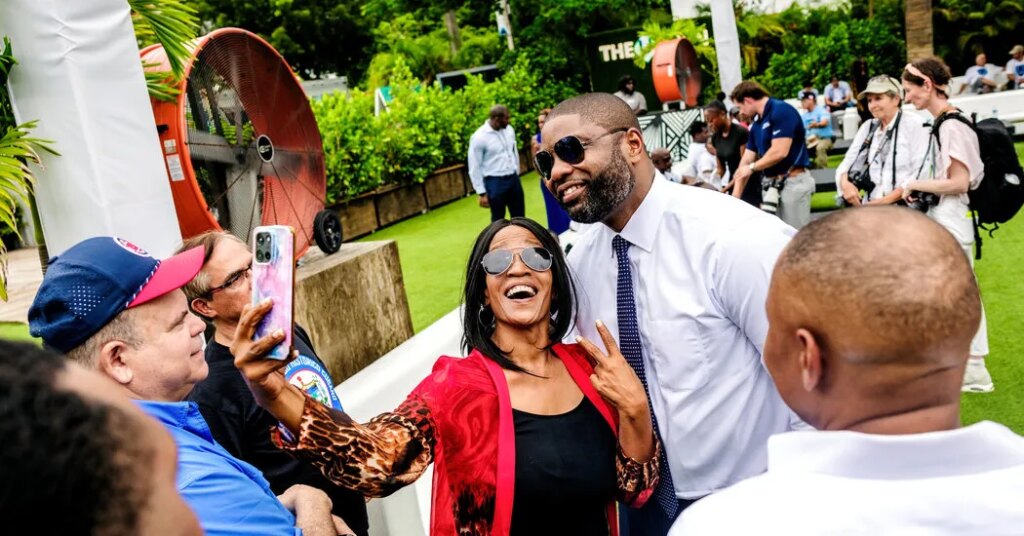
The Black men at the Caribbean restaurant outside Miami wanted to hear how Byron Donalds would fix Florida’s soaring cost of living when he stopped there to mingle this month.
But they also pressed him about whether he would be a puppet for another Florida voter: Donald J. Trump, the increasingly unpopular president.
Mr. Donalds, the Republican congressman hoping to become Florida’s first Black governor, assured them during the private meal in Miami Gardens, Fla., that he was on the ballot — not Mr. Trump.
“I was persuaded,” said Drumene Woodside, 53, who said he would cast his ballot for Mr. Donalds though he normally votes for Democrats.
Mr. Donalds is working to win over Black Floridians like Mr. Woodside in the stretch run, as his party girds for the possibility of low turnout among many of the voters who powered Mr. Trump to victory two years ago.
The race has been surprisingly competitive for a state that has been reliably red for well over a decade. Mr. Donalds’s Democratic opponent is David Jolly, a white former Republican congressman who left the party in 2018.
In recent weeks, Mr. Donalds has held several campaign events focused on Black voters, including a forum at Florida A&M University, the historically Black college he attended in the 1990s, where he was grilled by some of the students in attendance.
He is rolling out endorsements from local Black leaders, including longtime Democrats. He is also buying ads in news outlets with large Black audiences in voter-rich South Florida, and visiting Black churches to share his conservative vision. His campaign staff includes Janiyah Thomas, who was the Black media director for the Trump campaign in 2024.
It’s an uphill battle in a state where Black voters have historically backed Democrats by wide margins. Florida, with more than 13 million registered voters, has fewer than 100,000 Black Republicans.
On a recent Saturday, at a lightly attended event in Overtown, a historically Black neighborhood of Miami, some attendees were affiliated with a faith-based nonprofit and said they had been driven in from two counties away.
Another attendee, Kalyn James of Miami, wore a pin endorsing Angie Nixon, a Black Democratic state legislator running for the U.S. Senate. Ms James watched quietly holding a small “Vote Blue” sign as the candidate spoke.
She said she attended to hear Mr. Donalds’s pitch, but was unconvinced that his support for Republican policies would be good for Black people.
Voters have elected only three Black governors in the country’s history, all Democrats, and none further south than Virginia.
But this year, the two major parties are fielding seven Black gubernatorial candidates. Three are Republicans: Mr. Donalds; Representative John James of Michigan; and Lisa Demuth, the speaker of the Minnesota House of Representatives.
In Florida, Democrats have not held the governor’s mansion since the 1990s. Andrew Gillum, a Black Democrat who was the mayor of Tallahassee, narrowly lost in 2018 to Ron DeSantis, a white Republican who has since cemented Florida into a conservative bastion.
Mr. Trump made inroads with Black and Hispanic voters nationally in 2024. But as he faces sagging approval ratings, that fragile coalition is fraying and many Republican candidates are downplaying their ties to the president.
Overall, Mr. Donalds remains favored in the governor’s race. There are 1.5 million more registered Republicans than Democrats in the state, and he won Mr. Trump’s endorsement before he even declared his candidacy.
But in the primary, Mr. Donalds underperformed with white voters in rural counties. If that pattern holds in a tight general election, support from Black voters will be crucial, said Sean Freeder, an associate professor of political science at the University of North Florida and the director of its Public Opinion Research Lab.
A native of New York City who moved to Florida for college, Mr. Donalds was raised by a single mother who voted Democrat. His family has roots in Panama and Jamaica. On the campaign trail, he has mostly downplayed the significance of potentially becoming the first elected Black governor in the South.
Instead, Mr. Donalds has described Florida as a “great meritocracy,” pitching plans to address the affordability crisis, lower insurance costs and build businesses.
At the Florida A&M event, he urged Black students to stop moving “as a monolith” for Democrats.
“You’ve been faithful to that party,” Mr. Donalds said. “Have they been faithful to you?”
Black voters often perceive him as doing Mr. Trump’s bidding, Mr. Donalds told reporters this month at Lorna’s Caribbean & American Grill, the restaurant in Miami Gardens where he made a campaign stop.
“That’s not true. I have my own thoughts, my own opinions, I have my own ideas,” he said after meeting with a small group of Black voters over conch fritters, oxtail with peas and jerk chicken.
Jude Civil, 56, who had volunteered for past Democratic gubernatorial campaigns, was not wholly sold. But he appreciated Mr. Donalds’s willingness to field tough questions.
“He’s a lot closer than he was before,” Mr. Civil said of Mr. Donalds’s chances of landing his vote.
Three men at the event said they also planned to vote for Ms. Nixon, who has energized Black voters across Florida. Donalds supporters are hoping that at least some Black voters who turn out for Ms. Nixon will split their ticket and vote for him, too.
Black leaders around the state are divided over Mr. Donalds’s candidacy, with many expressing unease about his support for Mr. Trump and Mr. DeSantis. Many have bristled at Mr. DeSantis’s efforts to curb diversity initiatives, rewrite state history lessons on race and reshape Congressional districts, decreasing Black elected representation.
“I will forfeit having the first Black governor any day, especially when it’s someone who has participated in the degradation of our people,” said State Senator Shevrin D. Jones, a Democrat who represents part of Miami-Dade County and advises the Jolly campaign.
Still, Mr. Donalds has won the support of some Black Democrats who were upset that Mr. Jolly did not choose a Black running mate, and instead picked Gwen Graham, whose father was former Gov. Bob Graham.
“We have people who are overqualified for the position to serve as lieutenant governor, and yet all those people were passed over,” said Cynthia Chestnut, a Black Democratic city commissioner in Gainesville who endorsed Mr. Donalds.
Mr. Jolly, who has described Mr. Donalds as having an “anti-Black agenda,” is also aggressively courting Black voters. On Sunday, he appeared with the Rev. Al Sharpton and Ben Crump, the civil rights lawyer, at Bethel Missionary Baptist Church in Tallahassee.
At another Black church recently, Antioch Missionary Baptist in Miami Gardens, Mr. Jolly energized the crowd by quoting Bible scripture and imploring people to turn to God.
He impressed Joseph Grant III, a parishioner who said he had been disturbed by a comment Mr. Donalds had made in 2024, while campaigning for Mr. Trump, that “more Black people voted conservatively” during the Jim Crow era of racial segregation.
Black Democrats criticized the comment at the time; Mr. Donalds has repeatedly said it was taken out of context.
Others in the congregation said they were bothered by Mr. Donalds’s unwavering support for the president.
“I hear a lot of Trump in him, and his ideology is not sitting right with me,” said the Rev. Rodney Pinder, 72.
Back in Miami, at the Overtown event, Amanda Bazil, 30, pressed Mr. Donalds on the quality of private schools that have exploded in numbers since the state extended tuition aid in 2023. Ms. Bazil, who is Haitian American, said she was somewhat reassured by his answer — but that he had not yet won her vote.
One of her concerns: Mr. Donalds’s support for Mr. Trump’s aggressive immigration enforcement, including ending legal protections that allowed 330,000 Haitians to live and work in the United States. Some of her relatives are worried about being deported.
“It’s very disheartening,” Ms. Bazil said.
Valerie Crowder contributed reporting from Tallahassee, Fla.
The post He Would Be Florida’s First Black Governor. Can He Sway Black Voters? appeared first on New York Times.