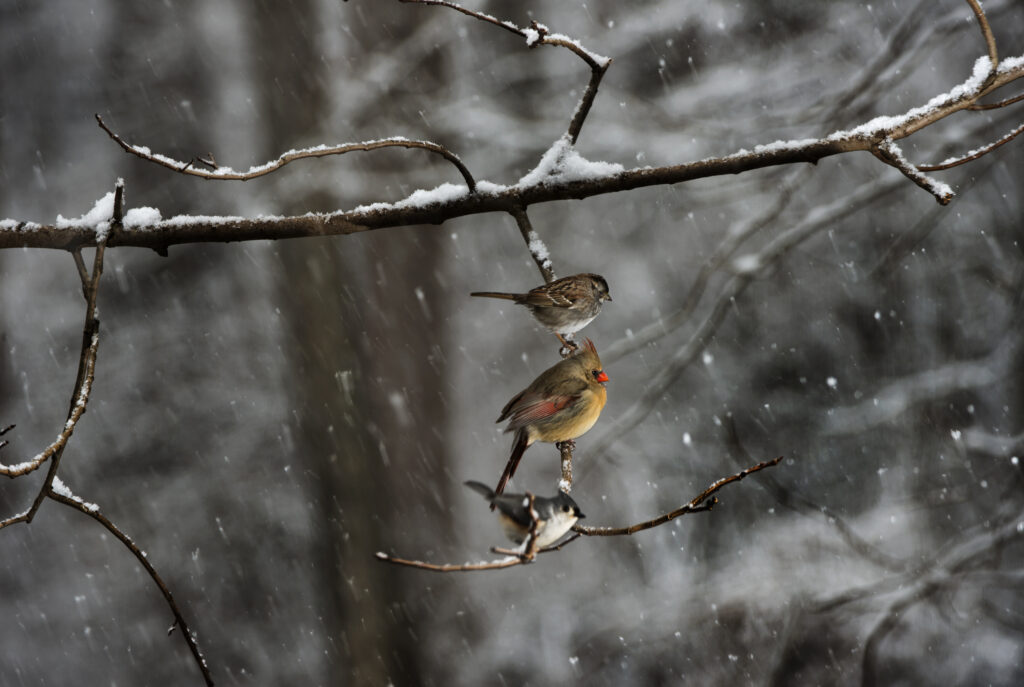
While some birds migrate south for the winter, others, like the blue jay and classic cardinal, remain on the East Coast and brave the cold. These resident birds survive by foraging for food sources, which can be more difficult to find as temperatures drop. To help them, you can install a seed feeder, but a more lasting, low-maintenance alternative is to plant native plants that provide seeds, berries, insects and shelter even when snow covers the ground.
Here are some perennials, shrubs and trees that will turn your outdoor space into a self-sustaining buffet for feathery friends.
Go with natives
When choosing plants, first consider natives. “Native plants are important because they’re supporting this whole ecosystem of life,” says Constance Cleveland, an advanced gardener at the United States Botanic Garden. They produce seeds that birds instinctively seek and provide a home to insects, a valuable food source. “They’re going to attract the insects and larvae of the insects that the birds want,” Cleveland says. “The majority of birds are going after the high-value, high-protein, high-calorie, yummy bugs.”
Native plants have also already adapted to local climate and soil conditions, so they’re hardier in winter and require less watering and pruning. To find out which plants are native to your area, call the extension program at your local state university or visit Homegrown National Park, a nonprofit organization with information about creating backyard habitats.
Perennials
Many perennials offer colorful flowers during the growing season, but a select group creates both color and desirable food for birds in the winter. “Black-eyed Susans [Rudbeckia hirta] are a very common and easy one that birds love,” says Becca Rodomsky-Bish, a project leader at the Cornell Lab of Ornithology. “Finches love them. Juncos love them. Chickadees will forage on them.” These cheery yellow flowers produce a thin, needlelike seed that is rich with oil and dense with nutrients that towhees, nuthatches, cardinals and even robins adore into January.
Purple coneflowers produce high-fat, protein-rich seeds on stiff cones that maintain their shape despite harsh weather. Finches can land easily on them and feast on their seeds. But Rodomsky-Bish recommends caution when buying this meadow mainstay. “They’re one of the most hybridized types of plant,” she says. “There’s mixed science based on the impact those kinds of hybrids can have on wildlife.” When shopping, she says, look for the straight species, Eastern purple coneflower (Echinacea purpurea).
Goldenrods and asters might be common clichés to some gardeners, but they’re rock stars when it comes to feeding birds. Their nutrient-dense, abundant seeds stand on tall stems despite the weather and attract American goldfinches, dark-eyed juncos, pine siskins, chickadees and sparrows. “These two plants are host plants to the majority of insects out there,” Cleveland says, including dozens of moth and butterfly species. “You’ve got … larvae or eggs wintering over in the plants’ leaf litter or rolled up in that stem.” Chickadees, downy woodpeckers and nuthatches also eat this bug protein to survive winter.
Common aster varieties include New England aster (Symphyotrichum novae-angliae) with purplish-pink flowers, and common goldenrods include tall goldenrod (Solidago gigantea) and Canada goldenrod (Solidago canadensis). Note that it’s the look-alike ragweed, not goldenrod, that’s often responsible for hay fever.
Finally, the straight species of false sunflowers (Heliopsis helianthoides) produces abundant, high-fat seeds in daisy-like, yellow flowers. “Anything in the heliopsis family is a really great seed producer for songbirds,” Rodomsky-Bish says.
Whatever you grow, resist the urge to tidy up during fall. “When things do get covered in snow … perennials stand tall above the grass,” says Rodomsky-Bish says. “So leaving your plant standing with those dried seed heads is going to make it easier for birds to find the food.”
Shrubs
When it comes to shrubs, winterberry holly, chokeberry, American cranberry bush viburnum and American elderberry all produce berries that often remain into January. But Possumhaw viburnum (Viburnum nudum) produces berries and provides a home for insects. “What I like about it is, it’s a larval host plant, so it does host insects,” Cleveland says. “It’s got stunning fall color, bright red, and it produces berries. And for those three reasons, I think it’s a winner.”
Red osier dogwood (Cornus sericea) boldly stands out in a winter landscape with dense, brilliant crimson twigs that provide shelter from strong winds and safety from predators. Plus, its V-shaped branching patterns offer nesting sites. “The birds love it,” Cleveland says. “It’s a host to a large number of insects, and the berries are typically gone before we notice they have berries, they’re so popular. The berries don’t look like much, but the birds love it.” Cardinals, mockingbirds, robins and blue jays will all forage for dogwood berries and insects.
Grey owl juniper (Juniperus virginiana) is a low, broad shrub that grows in icy blue sprays and is home to select butterflies and moths. It produces berrylike cones that mockingbirds and robins adore. “And because it’s evergreen,” Cleveland says, “the insects tend to stay up in the shrub and it also acts as cover. So on a heavy snow day, the birds can just sit up under the branches. They’ve got a great place to hang out without having to get snowed on.” What’s more, they can eat the insects living in the branches. (Note: Grey owl juniper can be prone to insect infestation.)
Trees
If you have the space, a tree goes a long way in providing food and shelter for birds. The shorter serviceberry, sweet crabapple and flowering dogwoods are strong choices for small yards. In a larger garden, the mighty oak supports wildlife the most. “Oak trees are the big success story for biodiversity,” says Rodomsky-Bish. “Oak species support more butterflies, moths, mammals and birds than any other species of tree.”
Oaks, through their craggy bark and large fallen leaves, foster a vast variety of insects and more than 500 species of caterpillars. Wrens, chickadees, titmice, thrushes and nuthatches all forage either through the leaf canopy or the slowly decaying ground litter for beetles, caterpillars, spiders, ants and other insects. Woodpeckers and blue jays search for acorns. Thick oak canopies also shelter birds from severe weather, and their branches and trunk hollows create nesting sites for spring. The most common natives are northern red (Quercus rubra) and white oak (Quercus alba).
And perhaps most important (and a reason to skip the leaf blower?), leaf litter, Rodomsky-Bish says, “provides really important overwintering habitat for a lot of insects, many of which birds need to feed their young the following spring.”
Karen Hugg is an ornamental horticulturalist and the author of Leaf Your Troubles Behind: How to De-stress and Grow Happiness Through Plants.
The post What to plant now to help backyard birds survive this winter appeared first on Washington Post.