On the afternoon of Friday, Oct. 2, the White House invited a mix of mainstream and right-wing reporters to an online briefing about “weaponization.” A briefer previewed records the White House planned to release from the investigation of Donald J. Trump’s retention of classified documents while out of office, and his obstruction of their retrieval.
The files reflected scattered topics. Among them: an internal debate over probable cause to search Mr. Trump’s social club and residence, Mar-a-Lago; plans to execute any search warrant while Mr. Trump and his family were away; and the collection of phone logs of Mr. Trump’s top aide, Susie Wiles.
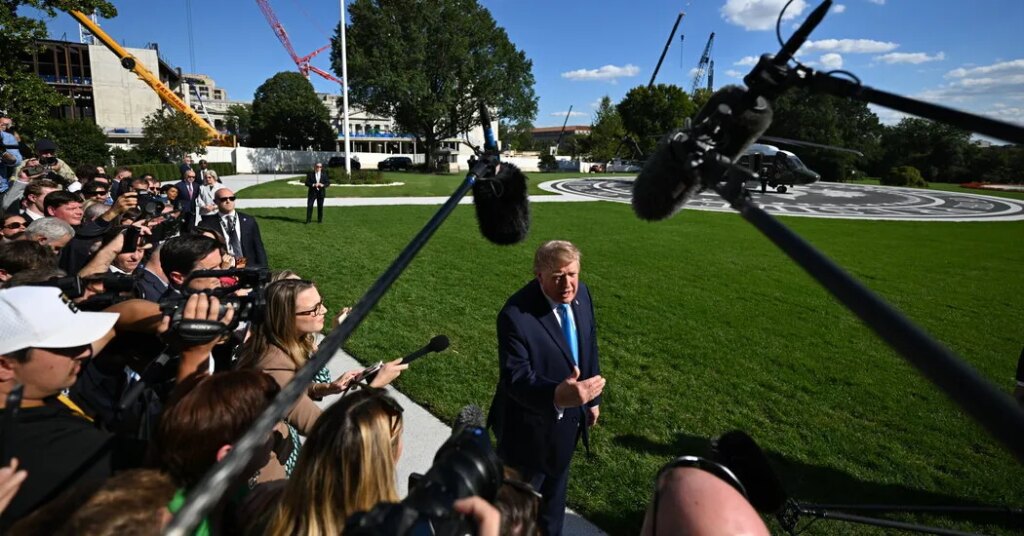
Most facts were already known or minutiae, and mainstream reporters ignored the files when the White House posted them on Monday. But Trump allies pushed an alarmist and decontextualized interpretation through the conservative information ecosystem. By Wednesday, a reporter from Trump ally and MyPillow founder Mike Lindell’s website asked Mr. Trump about it in the Oval Office. The president thanked her for the question, denouncing the inquiry as “weaponization.”
“They did things to people that were associated with us that nobody should have been able to do, and it all came out just recently in the files,” Mr. Trump said.
The episode shows how the Trump administration and its allies selectively disclose government files, omitting context to discredit investigations that led to Mr. Trump’s federal indictment and that anger his supporters. As the midterm elections approach, it also shows how a grievance narrative can be manufactured and inserted into national political discourse.
The Oct. 2 briefing was led by John Solomon, a former mainstream journalist who is now employed by the White House as a so-called special government employee. He has been active for years in presenting pro-Trump narratives, including during the 2019 events related to Ukraine that led to Mr. Trump’s first impeachment. In 2022, Mr. Trump named him his representative to the National Archives so he could gain access to records related to the investigation into the 2016 Trump campaign’s ties to Russia.
Mr. Solomon chairs a White House “transparency” task force that has released batches of government documents on more than half a dozen occasions since July. The documents appear to have been selected to bolster narratives Mr. Trump has promoted, including those that cast doubt on the integrity of U.S. elections and seek to discredit investigations into his conduct.
In an interview, Mr. Solomon acknowledged conducting the briefings. He said that he is unpaid and has no security clearance, but that about half-dozen task force officials do. He said he suggests categories to search, and task force officials sift through “millions of pages” for responsive documents. The White House counsel then declassifies them.
Mr. Solomon said he is briefed in advance on the files’ contents, but sees them only shortly before briefing other journalists. He described himself as a “pool reporter” — the term for a reporter chosen to share information with a larger group of news organizations when there is not enough room for all to fit — seeking more information for the public. He said he always encourages journalists to do their own reporting.
“It isn’t an effort at subterfuge,” he said. “It isn’t an effort at not giving you something in context. It’s giving you what the government made available and then giving you a chance to go find the rest of the story.”
Mainstream reporters have only occasionally found news in Mr. Solomon’s presentations. But once he completes his role as White House briefer, he writes articles based on the same material for his website, JustTheNews.com. In this case, his article — like his briefing — presented known information as revelations and omitted key context about new details. Its narrative entered a right-wing media echo chamber.
Old News and Missing Context
Mr. Solomon highlighted a paragraph from an F.B.I. Washington field office email from July 2022 saying that the office, unlike Justice Department counterespionage prosecutors, “does not believe” the available evidence established probable cause that Mr. Trump was still illegally keeping more classified documents at Mar-a-Lago. At issue was whether there was sufficient evidence to justify a search warrant.
On a podcast the following Monday with the right-wing commentator Benny Johnson, Mr. Solomon said the first of “three major revelations in the documents” was that before the Mar-a-Lago raid, “very senior F.B.I. officials, including an assistant director, raised concerns that the F.B.I. had not met the probable cause standard for authorizing a raid,” but “were overruled.”
That paragraph was not a revelation. It has been public since last December, when the F.B.I. gave Senator Charles E. Grassley, Republican of Iowa, files containing it verbatim. Mr. Grassley and conservative news outlets had highlighted it then just as Mr. Solomon did in his briefing and Monday reporting.
Mr. Solomon’s presentation, both times, also omitted key context: The field office’s legal doubts came before Mar-a-Lago surveillance footage emerged that showed a Trump aide moving boxes from a storage area before a lawyer came to search it for subpoenaed classified files. The additional evidence resolved legal concerns about probable cause.
The Washington field office’s assistant director, Steven D’Antuono, has testified that he and his team continued to urge officials to try again to obtain Mr. Trump’s voluntary compliance with the subpoena before escalating to a search — but for prudential, not legal, reasons. (The eventual search recovered more than 100 classified documents that Mr. Trump had not turned over when purporting to comply with the subpoena.)
A more complicated example involves Ms. Wiles’s phone logs. She ran Mr. Trump’s political action committee while he was out of office, then his 2024 campaign. She is now the White House chief of staff.
The files showed that in early to mid-2023, investigators — operating under Jack Smith, the special counsel appointed to oversee the federal inquiries into Mr. Trump — logged Ms. Wiles’s calls using a device known as a pen register, which creates a record of who called whom and when, but does not collect conversation content. The F.B.I. can get a court order to use one if a judge agrees that a low legal standard — mere “relevance” to an investigation — is met.
The collection of her call logs was already known. Court filings in 2024 showed that her phone records since January 2021 had been subpoenaed from a phone company. (The material identified her as “Person 49,” but accompanying excerpts from her April 7, 2023, investigative interview pointed to her identity.) Kash Patel, the F.B.I. director, told Reuters in February that the agency had subpoenaed Ms. Wiles’s phone logs in 2022 and 2023.
The actual news, then, was subtle: Investigators had used a pen register in addition to subpoenas, meaning they had logged her calls in real time in addition to collecting logs of her past calls. By omitting that context, right-wing news accounts created the sensational impression that the scrutiny of her call activity itself was a revelation.
Contacts With Lawyers and Journalists
The White House did not release case-file material explaining why officials and a judge might have deemed Ms. Wiles’s call logs relevant to the investigation, leaving that to imagination or insinuation. But two reasons for investigators’ interest in her are known.
She was a witness. According to the indictment, Mr. Trump showed her a classified map, evidence he knew he possessed such records. More broadly, she oversaw his political action committee’s hiring and payment of lawyers provided to his employees who were also witnesses.
Investigators suspected that this could have been a scheme to monitor and shape testimony by the employee-witnesses about Mr. Trump, although they did not find sufficient evidence to charge any such conspiracy.
The indictment, for example, said a decision to pay for the defense of a Mar-a-Lago property manager — eventually Mr. Trump’s co-defendant, charged with conspiring to cover up the box movements — followed confirmation in a Signal chat with Ms. Wiles that the worker remained “loyal” to Mr. Trump and would do nothing to affect their relationship.
The “Person 49” material released in 2024 included Ms. Wiles’s call logs with Stanley Woodward Jr., now a senior Justice Department official. Mr. Trump’s political action committee hired him to represent both the Trump aide who moved the boxes — who also became a co-defendant — and a computer worker at Mar-a-Lago.
But the computer worker later replaced Mr. Woodward with his own lawyer, then told investigators for the first time that Mr. Trump, via the property manager, had pushed him to delete surveillance footage of the box movements, according to the indictment.
The court files released in 2024 also show that in her April 7, 2023, interview, a prosecutor pressed Ms. Wiles on whether free lawyers were contingent on employees not divulging damaging things about Mr. Trump. She “unequivocally” denied it.
The newly released material included F.B.I. reports flagging Ms. Wiles’s “contacts of interests”: about 20 lawyers, half a dozen journalists, political advisers and Mr. Trump. There were bursts of such calls around key moments, like her April 7 interview.
The names of lawyers are redacted. Mr. Solomon described investigators as having “tracked Trump defense lawyers’ calls.” That framing is misleading; they were tracking Ms. Wiles’s calls, not logging the lawyers’ calls with other people. It is not clear from the files, moreover, who each lawyer’s client was. Some might have been representing employee-witnesses.
Ms. Wiles’s six reporter contacts included Mr. Solomon, who left his name unredacted; names of reporters at ABC News, CNN, The New York Times, Politico and The Washington Post were blacked out. In promoting the files, Mr. Solomon expressed incredulity at how that could be of legitimate interest to investigators.
The missing context: As news reports recounted nonpublic investigative developments like grand jury subpoenas and sealed court rulings, Mr. Trump, his campaign spokesman and sympathetic commentators kept blaming Mr. Smith’s team for the leaks, accusing them of prosecutorial misconduct. (Unlike prosecutors, subpoena recipients may discuss grand jury matters.)
A Spreading Narrative
After publishing his account Monday morning, Mr. Solomon appeared on right-wing podcasts, including Stephen K. Bannon’s and Mr. Johnson’s, repeating his decontextualized account and suggesting the activity was unconstitutional.
By afternoon, other right-wing outlets emphasized another released file. It showed that when searching Mar-a-Lago was first proposed in May 2022, an F.B.I. official’s to-do list included determining travel plans for Mr. Trump, his wife Melania and their 16-year-old son Barron, all of whom lived there part of the year.
In context, officials wanted to do any search while the entire family was away, to keep it low key. Out of context, this was presented in sinister terms as the F.B.I. “tracking” Melania and a child. Around 4 p.m., for example, a Newsmax host opened an interview by asking the defense lawyer Alan Dershowitz if he objected to Mr. Smith and the F.B.I. having “tracked” Melania and Barron Trump. He called it “terrible.”
Late that afternoon, the National News Desk of Sinclair, a conservative owner of many local stations, distributed a similar segment for the evening newscasts of its stations. Fox News posted a similar article, but included the context for checking the Trumps’ travel plans.
The New York Post went further, inaccurately reporting: “Biden F.B.I. tracked Melania and Barron Trump’s travel — and even tapped Susie Wiles phone, documents show.”
The tapping claim was unambiguously false. The documents did not describe wiretapping, which means eavesdropping on private conversations. The legal difference is significant: Fourth Amendment privacy rights cover call content but not call logs, the Supreme Court has said.
Mr. Trump’s top policy aide, Stephen Miller, shared the New York Post headline and declared, “This was a seditious conspiracy against the Republic waged from within the Department of Justice and at the highest levels of government.” Representative Randy Fine, Republican of Florida, reposted it, too, declaring, “This is 1000 times worse than Watergate.”
That Tuesday evening, Mr. Trump’s social media account fanned the narrative, posting another right-wing site’s story: “Jack Smith Spied on Trump Staffer’s Communications and 20+ Lawyers: Report.” Then came Wednesday’s Oval Office question from Mr. Lindell’s reporter.
On Thursday morning, Fox News ran another article covering essentially the same ground as Monday’s.
And on Friday, the White House press office again invited selected reporters to another late afternoon briefing on “weaponization.” Another document release was coming.
Alan Feuer contributed reporting.
The post How the White House Manufactured a Narrative About a Trump Aide’s Call Logs appeared first on New York Times.