By 2010, the year Jesse Eisenberg played the Facebook chief executive Mark Zuckerberg in “The Social Network,” the real Zuckerberg had made only a modest number of public appearances. The first was in 2004, when the 19-year-old executive talked to CNBC about what was then called TheFacebook. In the video he’s composed and articulate, explaining his site’s purpose to an audience that largely wouldn’t have used it, since at the time it was open only to students at select colleges. He maintains direct eye contact. His head moves slightly; his body not at all. His lines sound rehearsed, as if he had practiced a script before this big opening performance.
His body language had barely changed by the time the movie was released six years later. In an interview with Diane Sawyer, his eyes have the same fixed quality. Seated onstage at an advertising conference, his body remains still while he gesticulates with his arms.
The real Zuckerberg’s appearance is a performance from a not particularly gifted actor, though nobody expects a coding genius to be an entertainer. His mannerisms barely shifted as he became more famous. That blankness made it easy for actors to project onto him — Eisenberg, but also Jeremy Strong, who plays him as a seething, embattled middle-aged executive in the new follow-up, “The Social Reckoning.” By now it has become clear just how much of Zuckerberg’s real persona has been an act.
But that was not yet the Zuckerberg we saw in “The Social Network.” As portrayed by Eisenberg, he was a different kind of guy. The general public wasn’t all that familiar with him yet, so Eisenberg didn’t need to do an impression. He had free rein to play the executive as an idea: a smug, insolent teenager secretly desperate for connection.
Thus the Zuckerberg of “The Social Network” is a motormouth, twitchy, brilliant, a brat. He’s a force in perpetual motion, tossing staccato zingers at his opponents and skirting the rules and hierarchies that govern stodgy Harvard. When he comes to rest, it’s to gather energy to strike again. In a scene in which he’s called before a Harvard disciplinary board, his foot taps rapidly, not with nerves so much as pent-up energy, and his eyes dart around the room.
The performance was mesmerizing and netted Eisenberg an Oscar nomination, but it wasn’t much like the real Zuckerberg, who was showing up more and more on TV, still sitting stiffly and only intermittently emoting. After “The Social Network” was released, he told “60 Minutes” that he had liked the movie, but that they had gotten him all wrong.
A month later, Eisenberg hosted “Saturday Night Live” and explained to Andy Samberg — a cast member who’d been impersonating Zuckerberg as a doofy bro — that to play the role, “I speak in short, clipped sentences and I keep my head very still.” (The latter part is debatable.)
In a backstage shot, the real Zuckerberg joked with Lorne Michaels about wanting to join the stars onstage. As he talked, he gestured with his arms in the same way he did in media appearances: bent at a right angle, forearms parallel, cantilevering up and down. Back onstage, Eisenberg continued: “I wasn’t really doing Mark Zuckerberg; I was interpreting a fictional character in a movie script.”
Then the real Zuckerberg walks onstage, ready to play himself. “Jesse, I don’t know if it came off that way,” he says with a practiced smile.
OVER THE YEARS, the possibility of a “Social Network” sequel was floated repeatedly in interviews, and Eisenberg eventually declined to take part in “The Social Reckoning,” the new follow-up. “I don’t want to be associated with that character” anymore, he told Variety.
Instead, Jeremy Strong stepped in. His section of “The Social Reckoning” is set in 2021, just before the release of The Wall Street Journal’s “Facebook Files” investigation. In the conceit of the film, Zuckerberg is preparing, with the aid of lawyers, to testify before Congress. His team is coaching him on the body language required to, as he puts it, appear likable. Nod your head to signal you’re listening. Be nice.
Strong’s Zuckerberg is not Eisenberg’s, and no wonder. We’ve had 16 years of watching Zuckerberg as he grew from wunderkind to chief executive of one of the most powerful, consequential and mistrusted companies in Silicon Valley. We know who this guy is, sort of. He does jiu-jitsu and goes to White House state dinners and makes decisions that affect billions of lives.
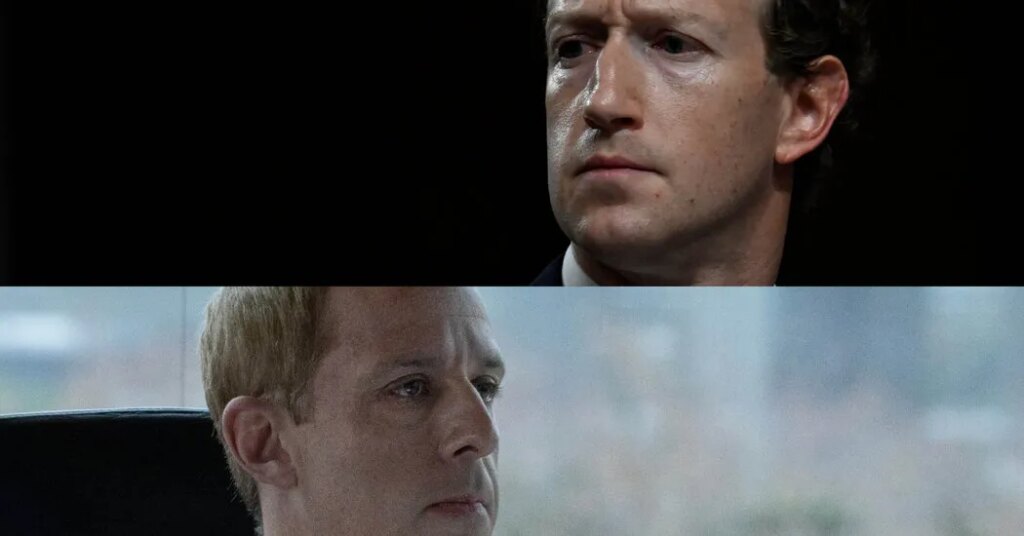
Strong’s performance has elements of impersonation. His hair is cropped short and colored a reddish brown. His demeanor is formal and stiff, unlike Eisenberg’s vibrating ball of nerves. He’s sitting at a desk on a stage, with harsh lighting and lines to learn. Strong is a great actor playing a lousy actor who’s preparing for the performance of his life.
But what Strong really nails is Zuckerberg’s eyes. They are unblinking. If Zuckerberg’s expression is generally blank on TV, Strong plays him as though there’s fuming impatience and rage just beneath. Eisenberg’s version was angry, too, but he was jumpy, antsy, annoyed with the sluggishness of the world around him. Strong’s version seems to be filled with molten lava ready to boil over. Even when he’s talking to his employees, he’s frustrated that they’re around at all.
If we were to trace a Zuckerberg arc from Eisenberg to Strong, we’d imagine that the cocky teenager who built a website discovered that when your user base outnumbers the population of whole countries, running a company becomes very difficult. The kid who just wanted to connect became a man who wished everyone would leave him alone. He was never prepared for the consequences of his actions.
But of course, these are fictional versions of Zuckerberg. They’re portrayals of a public figure who dodges efforts to know him.
And that is what’s most interesting about anyone playing the role of Mark Zuckerberg. Unlike some of his colleagues in Silicon Valley, those who ooze charisma and those who seem simply unhinged, Zuckerberg has stage-managed his persona: First he was an awkward genius, then a cool and competent business guy. Lately, he’s played a man’s man, telling the podcaster Joe Rogan that “the corporate world is pretty culturally neutered” and calling for “masculine energy” and “a culture that celebrates the aggression a bit more.” It comes off as a line reading, an echo of something somebody said on the internet.
Who is the real Mark Zuckerberg? It’s hard to say. Eisenberg played him as a type; Strong plays him as the dark side of a guy we know from TV. Zuckerberg himself seems malleable, depending on what’s expedient. Maybe it makes sense that someone who thought we could connect with one another through data-driven profiles and glowing flat screens turns out to be fundamentally unknowable.
The post Three Mark Zuckerbergs, Three Surprisingly Different Men appeared first on New York Times.