Within the span of eight days, the country has learned of a failed execution and a successful execution, and has been promised a livestreamed execution by military firing squad before year’s end.
The most severe form of criminal punishment — there are roughly 2,000 people on death row nationwide — execution has taken center stage in a nation already split politically and culturally, amplifying divisions just weeks before a pivotal midterm election.
Death penalty opponents have seized upon the blundered attempt to kill Christa Pike in Tennessee last week to push for an end to the death penalty. Conversely, the nation’s top military official said on Thursday that the United States would carry out the government’s first public execution since 1936.
The announcement from the Pentagon chief, Pete Hegseth, and its timing, exemplify the salient place that the death penalty has taken in the nation’s polarized political landscape in President Trump’s second term.
On the day Mr. Trump returned to office, he urged prosecutors across the country to pursue and carry out capital punishment. In 2025, states executed more people than they had since 2009, largely driven by a sharp jump in Florida under Gov. Ron DeSantis, a Republican.
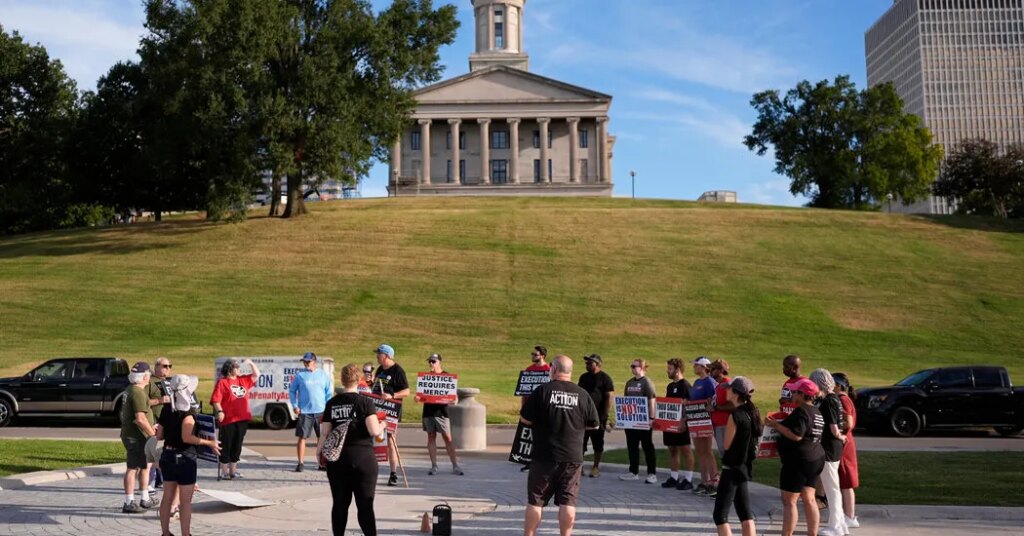
The failed execution of Ms. Pike — who survived two doses of pentobarbital that may have been injected improperly — has galvanized death penalty opponents, who have denounced what they see as a grisly example of capital punishment’s faults.
And the two events together have brought the issue of the death penalty — something that has for decades taken place in hidden rooms inside mostly rural prisons — back into the forefront of Americans’ minds.
“What we’re seeing is the brutality of the institution of the death penalty coming back into public focus,” said Mark Osler, a law professor at the University of St. Thomas in Minneapolis who has studied the death penalty. “Tennessee didn’t intend to do that; the federal government does.”
“Given that there has been a rise in executions,” he added, “it’s a good time to have that debate.”
Nearly 1,700 people have been executed in the past 50 years, including Jamaal Howard, 46, who was put to death on Wednesday in Texas, according to the Death Penalty Information Center, with a peak of 98 killed in 1999. Mr. Howard had been convicted of murdering Vickie Swartout, 42, during a 2000 robbery. Tennessee had sought to execute Ms. Pike for her 1995 killing of her classmate, 19-year-old Colleen Slemmer.
While 27 states retain the death penalty, fewer than half of those have carried out an execution in the past five years. Virginia abolished the penalty in 2021, and Ohio’s Republican governor, Mike DeWine, said in June that he wanted his state to do so as well.
In modern times, lethal injection has been used far more than any other method, though states have turned to alternative methods — both new and old — in recent years. Several have authorized the firing squad, and two, Alabama and Louisiana, have used the novel method of asphyxiation via nitrogen.
Public opinion polls have shown support for the death penalty steadily declining in recent decades, though a majority of Americans still support it. One poll from this past summer found that two-thirds were in favor.
Still, the specter of livestreaming the execution of Nidal Hasan, a former Army major who was convicted of murdering 13 people — mostly soldiers — and wounding dozens more at Fort Hood in Texas in 2009, has upset many who might otherwise support his killing.
“Hasan should face the death penalty, but making his execution public and streaming it? Beyond disgusting,” Senator Thom Tillis, Republican of North Carolina, wrote on social media. “Public executions are what oppressive dictatorships like Iran and Afghanistan do. It should not be happening in America.”
Mr. Hasan, now 56, was motivated by his radical views of Islam to carry out the killings in retaliation for America’s wars in Afghanistan and Iraq. He was wounded by responding police officers and is now paralyzed from the waist down, raising the possibility that he could be transported in a wheelchair to his execution, which is scheduled for Dec. 3. Mr. Hegseth said Mr. Hasan would be killed at Fort Hood around the same time of day — early afternoon — that he committed the crimes.
The reactions to the announcement fell largely along ideological lines — Republicans are much more likely to support capital punishment — but were far from uniform, underscoring the complexity of the issue.
Some Roman Catholic leaders condemned the execution plans. The Catholic Church has long opposed the death penalty as part of its theological commitment to humans across their life spans, though recently U.S. bishops have prioritized ending abortion and defending immigrants.
Archbishop Paul S. Coakley, the president of the U.S. Conference of Catholic Bishops, called the planned livestream “a barbaric promotion of a culture of death” and warned it would harm the country.
“The public execution even of one who has done grave harm will only further undermine the moral fabric of our nation and be a blight on the conscience of its people,” he said.
Vice President JD Vance, an atheist turned Catholic, said on Friday that he would not watch the execution if it was livestreamed and also cast doubt on that idea, saying, “I don’t know if that’s actually going to happen.”
But in a sign of the continued sharp divide that the Trump movement has carved in American Christianity, an energetic cohort of right-wing Christians defended the livestream on biblical grounds.
Josh Howerton, the pastor of Lakepointe Church, an evangelical congregation with locations in and around Dallas, argued on social media that executions in the Bible were carried out publicly as deterrents.
“I do not think you can say it’s unbiblical or automatically wrong,” he said of public executions, noting passages that described public stonings.
The prospect of a public execution was raised prominently around the turn of the century, when some proposed televising the killing of Timothy McVeigh.
Mr. McVeigh, convicted of carrying out the Oklahoma City bombing in 1995 that killed 168 people, himself had urged as much in a letter to The Oklahoman newspaper in which he argued for “equal access” to his execution: “A reasonable solution seems obvious: hold a true ‘public’ execution — allow a public broadcast.”
In the end, he was executed by lethal injection at an Indiana prison in 2001, with a couple of dozen people watching his death in person and about 232 more — including survivors and their relatives — viewing on closed-circuit television from Oklahoma City.
Notably, Mr. Hasan has said he wants to be killed for his crimes, saying he sees an opportunity for martyrdom, though he does not appear to expect the firing squad or a public death.
“I’m paraplegic and could be in jail for the rest of my life,” he told a military panel in 2010. “However, if I died by lethal injection I would still be a martyr.”
Emily Cochrane contributed reporting from Nashville, and Elizabeth Dias from Washington.
The post Executions Are Again on the Minds of a Divided Public appeared first on New York Times.