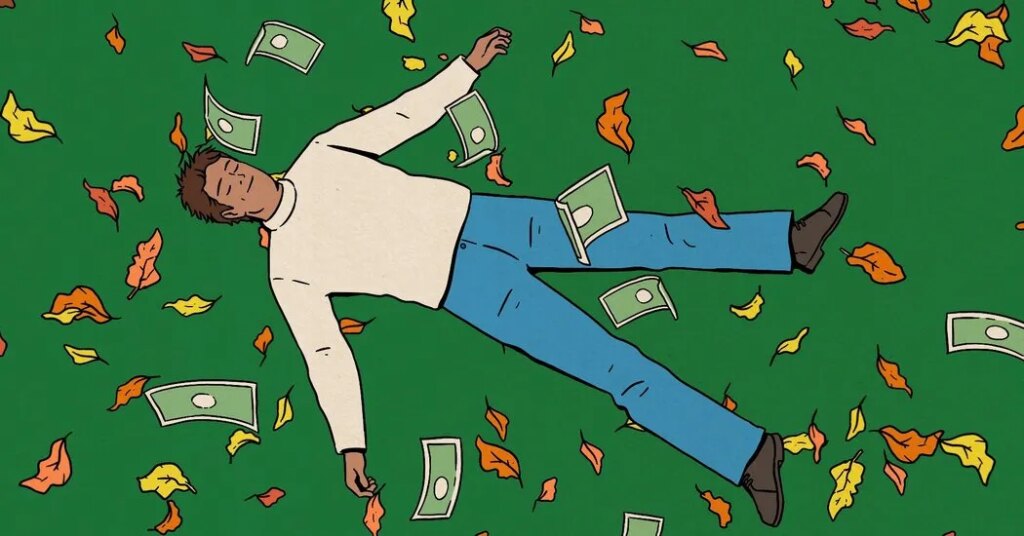
To leave the leaves or not to leave the leaves? That is the question — for October, anyway, which is Leave the Leaves month, a yearly campaign encouraging property owners and managers to let fallen leaves remain on their yards and in their gardens.
One eager adherent is Matthew Morrow, director of landscape operations at Green-Wood Cemetery in Brooklyn. The cemetery, with 478 rolling acres and stirring views of New York Harbor, is a national historic landmark; in the mid-19th century, only Niagara Falls saw more tourists annually. It has half a million human “residents” and is also an accredited arboretum, with 8,000 trees, spanning 700 species and hybrids, that together drop 34 tons of leaves every year for Mr. Morrow to manage. The leaves, he told me on the phone, “are mostly a love but sometimes — how to phrase this — I guess a chagrin, dealing with the sheer volume.”
I ventured out to Green-Wood on a warm morning in late September, thinking vaguely of Thoreau: “When the leaves fall, the whole earth is a cemetery pleasant to walk in,” he wrote. “Here are no lying nor vain epitaphs.” But the leaves were still green and firmly affixed.
To be clear, even fallen leaves are not truly dead, any more than the feathers shed by a bird are dead, as they were never truly alive. The tree, the bird are living things; the leaf, the feather are hangers-on of sorts. They gain their dynamism from being connected to a flow of nutrients but, unattached, cannot sustain themselves.
“I do not think of them as dead matter,” Mr. Morrow said, referring to leaves.
Obviously, there’s a transition from alive-ish to dead-like, a glorious one visible as autumn foliage. The leaves of deciduous trees are made to be shed at the end of the season, prompted by changes in temperature and the amount of daylight. The cellular machinery of photosynthesis falls apart, and the tree recalls the nutritional crumbs to store in its roots. As the green chlorophyll dissipates, other pigments, like orange carotenoids, appear. Finally, the stems are walled off and the leaves are cast free. It might look like a resplendent form of dying, but it’s just the way trees dismantle their solar panels for winter.
Of course, other trees work on a longer time scale, retaining their leaves for two to 10 years. (The needles of the great bristlecone pine can hang on for 45.) Evergreen needles are sturdier than, say, maple leaves, so they require a higher upfront cost to build. They’re also less efficient at photosynthesis — they’re needles, after all. But year over year they offer solid return.
The gradient from deciduous to very evergreen represents what ecologists call the “leaf economic spectrum.” To a tree, a leaf is a financial instrument, providing a return on investment in the form of glucose, generated through photosynthesis. There’s no one optimal strategy for maximizing R.O.I.; elevation, latitude, the local climate, the life span of the tree and the size and surface area of the leaf all factor in. Some trees invest in long-term leaves. Others opt for the seasonal cash grab, with flimsy, disposable, high-yield leaves.
Mr. Morrow was unaware of the leaf economic spectrum concept but found it “amusing that we had to go prove our money-doesn’t-grow-on-trees adage incorrect,” he said. Regardless, every leaf faces the same bottom line: When its R.O.I. drops below its operating cost — from damage, fungus, dwindling daylight — its days are done.
But the leaf economy continues to thrive post-tree; that’s one impetus behind Leave the Leaves Month, which was first observed in 2023. (It’s also a bid to keep leaves out of landfills; according to the U.S. Environmental Protection Agency, leaves and other yard debris account for more than 13 percent of the nation’s solid waste.) Left alone, fallen leaves represent a rich secondary market, notably for the countless beetles, spiders, butterflies and vital pollinators seeking housing or a safe place to lay eggs before winter. A 2025 study found that removing the leaves from suburban lawns in Maryland reduced the next year’s crop of moths and butterflies by 45 percent.
But leaving the leaves can chafe the suburban mind. How much nature do we really want around us? (A resident of my bucolic suburban village was recently attacked in broad daylight by a rabid coyote.) When I mentioned the concept to a fellow suburbanite, I was met with a tirade about a neighbor who lets leaves blanket her yard through the fall, winter and, unattractively, well into spring. Also her lawn, where not covered in leaves, is weedy and scruffy. Also the leaves keep blowing onto my friend’s lawn, spreading unkemptness.
Mr. Morrow counseled moderation; leaving your leaves in a soggy, unbroken layer could lead to “smothering and fungal issues,” he said. Better to mulch them, or at a minimum rake them into scattered piles, as invertebrate real estate.
I went to Green-Wood partly in hopes of catching sight of a mourning cloak, a large, dark-winged butterfly that Mr. Morrow considers one of the cemetery’s more remarkable (living) inhabitants. Unlike other butterflies, which overwinter as eggs or larvae, the mourning cloak hides out in fallen leaves and in tree nooks as an adult and reappears in late winter or early spring. It survives by converting its body’s store of glycogen (a sugar) into glycerol, an alcohol that serves as an antifreeze, protecting the cells while the animal continues in suspended animation. In effect, it overwinters by becoming one with winter; fallen leaves offer extra insulation.
The mourning cloak enjoys tree sap, often sipping upside-down. So I wandered for a while among the older trees, inspecting their trunks: a tremendous eastern white pine, a grand northern red oak with bark as crumpled and thick as the hide of a rhinoceros. Eventually, with nothing to report, I emerged from the trees and found a bench by a pond, near a row of turtles warming themselves in the sun.
Brooklyn was near but far away, its traffic muted by foliage. It took sitting still for a few moments to appreciate all the other life that was teeming close at hand. Gnats circled on invisible thermals. A small lizard skittered in the twigs. Here and there a strand of spider’s silk, strung between stems, lit up in the sun. And there was every other busy thing underground: springtails and millipedes, earthworms and beetles, microbes and mites, detritivores and decomposers.
Lately, news headlines have been warning of an artificial-intelligence apocalypse: swarms of digital agents breaking their gates and, by hook or crook, subjugating our species and eliminating us from the physical world. Suddenly I wondered: What if A.I. is the tree and we are the leaves? Another thought followed too naturally: If we are the leaves, how does the A.I. tree calculate our R.O.I.?
(My chatbot, when I queried it, gave a discomfitingly long and technical reply that involved our species’ “cellular depreciation schedule” and ended with “work force defoliation.” Then it reassured me that humanity’s accomplishments — our hard-won grasp of art and science, our centuries of effort to articulate our “purpose” in life, our energy grids and fiber-optic networks — would remain vital. “Even post-mortem, human existence leaves behind distinct layers of value that directly shape, sustain and give purpose to A.I. systems,” it said. We won’t truly be dead, just dead-ish.)
At the cemetery, sitting among the dead and the living, I wagered that A.I. has little chance against biology as a whole. Some of the simplest organisms exhibit behaviors that could be regarded as a kind of thinking, if not intelligence or consciousness. Mycorrhizal fungi, which fill every inch of soil, connect the roots of plants and trees in an astonishingly sophisticated marketplace of carbon and nutrients. Slime molds are so good at path-finding that scientists have enlisted their help in designing transportation systems. The core algorithm of life — survive long enough to reproduce — has succeeded for four billion years and counting.
I stood up and made another search for mourning cloaks, but, finding none, I headed back to the subway. Maybe they had migrated south, as some mourning cloaks do. Maybe their camouflage was too clever for me. I’ll try again at the bright end of winter, when they’ll be among the first to emerge — crawling from the crevices and leaf litter, clambering to the peaks of last autumn’s rotting cash and taking flight across the fading snow.
The post How to Cash In on Autumn’s Fallen Leaves appeared first on New York Times.