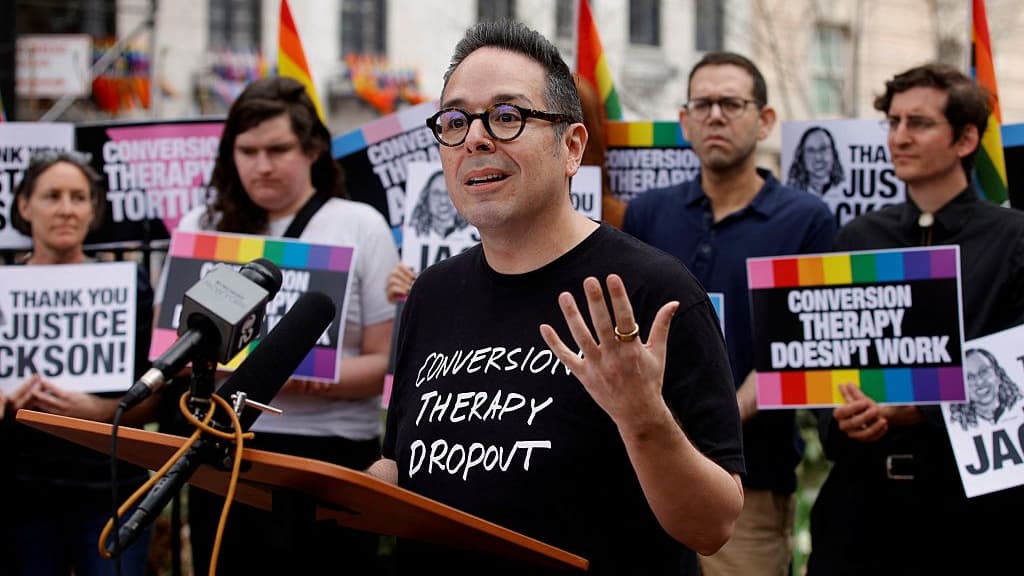
I spent eight years in conversion therapy trying to heal what church leaders called my “core wounds.” I did individual therapy with Christian psychologists who claimed they could help me change my sexual orientation. I went to conferences and retreats hosted by Exodus International, the largest conversion therapy organization of its time. I deepened my faith and built a career in full-time church work. I did everything I was told to do, but my sexual orientation never changed.
When I finally dropped out of conversion therapy, I walked away carrying anxiety, depression, religious trauma, and a substance abuse problem I had to fight my way out of.
Today, the promise that drew me into those rooms—that I could pray the gay away—is being made in different words. One group driving this shift calls itself the CHANGED Movement. Its website offers “A New Way Forward For LGBTQ+” and promises freedom for people who want to leave an LGBTQ+ identity behind. It says accepting an LGBTQ+ identity locks a person into “a life of unhealed trauma.”
I know that idea well. In conversion therapy, I was taught that my sexual orientation was evidence of something wounded inside me, and that if I did enough work, I could heal it.
CHANGED is taking that message beyond churches. Last month, its co-founder Elizabeth Woning spoke before a federal advisory committee meeting about the American Psychological Association (APA)’s Commission on Accreditation, which sets standards for programs that train psychologists. Woning argued that counselors are being trained to affirm LGBTQ+ identities without adequately respecting clients who want to live according to different convictions.
To be clear, CHANGED was not seeking APA accreditation for its own programs. The APA’s commission was seeking continued federal recognition (which drives licensure and funding) as an accreditor and an expansion of that recognition to master’s programs. Woning urged the committee to withhold the expansion. After hearing a range of complaints, including allegations of antisemitism in APA-accredited programs, the committee recommended suspending the commission’s federal recognition for one year. The Department of Education has yet to make a final decision. CHANGED did not drive that outcome, but claimed victory for it.
Underpinning CHANGED’s argument was the same belief I was once taught: that being LGBTQ+ is a symptom of unhealed trauma. It is true that LGBTQ+ people experience higher rates of anxiety, depression, and suicidality compared to their peers. But that’s not what makes us queer. It’s what happens to us when we’re taught that being queer makes us broken, through rejection, shame, and theology that treats who we are as a problem to be fixed.
Major medical and mental-health associations, including the APA, have rejected efforts to change a person’s sexual orientation or gender identity as ineffective and harmful. Peer-reviewed research published in the American Journal of Public Health found that LGBTQ+ young people subjected to conversion therapy were more than twice as likely to report attempting suicide as those who had not. The ideology Woning promotes creates the very wounds it claims to heal.
The APA hearing wasn’t CHANGED’s first attempt to reshape the laws and protections around conversion therapy. The group filed amicus briefs in Chiles v. Salazar, supporting a Christian counselor who challenged Colorado’s ban on conversion therapy for minors. In March, the Supreme Court sided with her, ruling that the ban likely violated her free speech rights. In her testimony, Woning pointed to those briefs as evidence that the APA was violating freedom of speech.
Much of the world is moving in the opposite direction. Canada, Germany, France, Mexico, New Zealand, and Brazil have adopted bans or restrictions on conversion practices, with several imposing criminal penalties. The U.K. is moving toward banning the practice nationwide, which Woning decried in July.
Even in the U.S. states with bans, the rules prohibiting the practice of conversion therapy only apply to licensed therapists, and usually only to their work with minors. A group independently teaching CHANGED’s curriculum in a church basement is untouched by those laws, as long as they’re not licensed therapists or psychologists. And the practice is growing. The Trevor Project found that the share of LGBTQ+ young people who reported being threatened with conversion therapy doubled in a single year, from 11% to 22%.
CHANGED and groups like it don’t need government permission to run their programs in churches. It does seem, based on Woning’s testimony, that they are looking for that practice to be legitimized and for it to be billable by insurance and removed from the APA’s list of harmful practices.
Neither of CHANGED’s founders is a psychologist, a licensed therapist, or a physician. Woning’s degree is in ministry. Her co-founder, Ken Williams, holds a bachelor’s degree in marketing and finance. Yet they go before government bodies asking to reshape the standards of mental health care, on the strength of religious convictions they insist are protected speech.
And they’re now welcomed into powerful rooms. In April, the pair were invited to Washington for America Reads the Bible, a weeklong public Scripture reading marking the nation’s 250th birthday, whose promotional lineup included Sen. Ted Cruz and evangelical leader Franklin Graham. In a social media post announcing their participation, CHANGED wrote, “At the same time, we’ll be engaging directly with legislators on some of the most pressing issues of our time. We believe moments like this matter. We believe presence matters. We believe truth spoken in the right rooms matters.”
Woning’s website makes the larger goal clear, saying she works “closely with think tanks and activists worldwide to inspire thoughtful approaches and visionary (socially conservative) language protecting First Amendment rights—for all people—so that Judeo-Christian heritage prevails.”
When I was in conversion therapy, groups like Exodus International promised that “change is possible.” Then, in 2012, Exodus’s own president, Alan Chambers, acknowledged that “99.9%” of the people he’d met had not experienced a change in their orientation. A year later, Exodus shut down.
Groups like CHANGED kept the idea and changed the language. Parents, clinicians, and anyone who cares about LGBTQ+ young people should be paying attention. I spent years in the church basements where this ideology used to thrive. It is clear to me that it has now moved into courtrooms and federal hearing rooms, where its promoters are attacking the organizations that protect the vulnerable from it. The next room they are knocking on: the therapist’s office.
The post The New Fight to Legitimize Conversion Therapy appeared first on TIME.